Report by : Gan Yung Chyan, KUCINTA SETIA
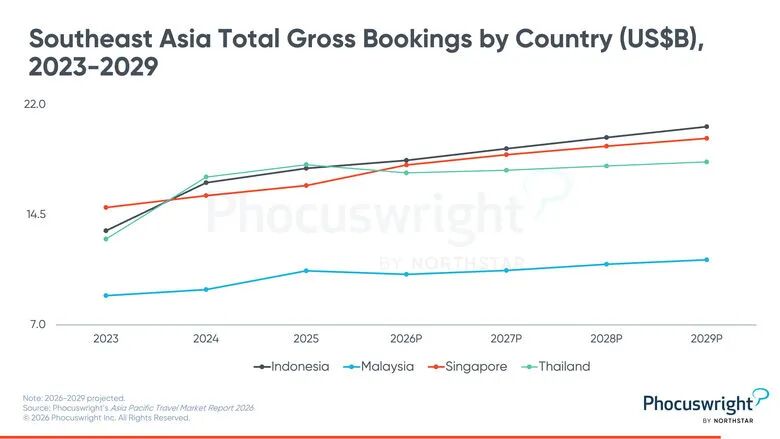
According to Phocuswright's latest report, *Southeast Asia Travel Market Overview 2026*, Indonesia is poised to overtake Thailand by 2026, becoming the largest travel market in Southeast Asia.
Data shows that in 2025, Thailand’s travel market will record total bookings of $17.9 billion, maintaining the top spot in the region, with Indonesia close behind at $17.7 billion. Phocuswright projects that sustained growth in travel demand will allow Indonesia to surpass Thailand in 2026.
Growth of the regional travel market slows
The report indicates that total bookings in the Southeast Asian travel market will rise by 6% year-over-year in 2025, reaching $63 billion. However, market growth is expected to decelerate in 2026 due to factors such as rising jet fuel prices, route adjustments, and increased travel costs for consumers; actual growth will depend on market performance in the fourth quarter.
The report highlights several key pressures facing the regional travel market:
- Rising jet fuel prices are driving up airline operating costs;
- Airlines are passing costs on to travelers through fuel surcharges and higher fares;
- Some low-cost carriers are cutting routes;
- Higher airfares are prompting travelers to reduce long-haul and cross-border trips;
- Increased hotel supply is putting downward pressure on accommodation prices in major cities.
Aviation market growth driven primarily by price hikes
Phocuswright projects that total air travel bookings in Southeast Asia will grow from $33.5 billion in 2025 to $34.4 billion in 2026. However, this growth is driven primarily by rising fares rather than a significant increase in passenger numbers.
The report notes that rising jet fuel prices have altered route networks and pricing structures within the Southeast Asian aviation market. Airlines are raising fares and surcharges while simultaneously cutting back on low-yield routes. Meanwhile, Asian carriers continue to increase flights to secondary cities in Southeast Asia, while gaps in long-haul routes between Europe and Southeast Asia are being filled by airlines such as Lufthansa and Singapore Airlines.
Faced with high airfares, some travelers are shifting toward short-haul and domestic travel. Domestic travel demand has risen in Malaysia and Indonesia, while Thailand has introduced tourism incentives to stimulate domestic travel amidst a decline in inbound tourist numbers.
Hotel bookings expected to remain stagnant
The report projects that total hotel bookings in Southeast Asia will remain at approximately $28.4 billion in 2026, essentially unchanged from the previous year.
Rising airfares, route reductions, and a consumer focus on low prices are all exerting pressure on hotel demand. Meanwhile, an increase in new hotel supply in major cities is further driving down room rates and industry revenue.
This implies that while the overall Southeast Asian travel market continues to expand, growth in the hotel sector will lag behind that of the aviation and online travel booking markets.
Online bookings continue to expand
The report forecasts that online travel bookings in Southeast Asia will grow from $41.2 billion in 2025 to $51.6 billion in 2029. By 2029, Online Travel Agencies (OTAs) are expected to account for 42% of all travel bookings in the region.
Despite the rising share of online channels, offline travel agencies, airline direct sales channels and government-operated air and rail services remain influential. Market competition will focus on factors such as pricing, loyalty programs, mobile services and bundled products.
Uncertainty driven by conflict and jet fuel prices
Phocuswright notes that the market size estimates were calculated before the full impact of a potential conflict between the U.S. and Iran could be factored in. Consequently, the ultimate changes in jet fuel prices, route operations, and consumer travel demand will depend on the duration of the conflict and its impact on global energy markets.
Overall, the Southeast Asian travel market is undergoing structural changes: Indonesia is poised to overtake Thailand by 2026, driven by its large population, domestic travel demand, and growth in online spending; nominal growth in the aviation market is primarily attributed to rising airfares; and the hotel market faces the dual pressure of increased supply and slowing demand.


No comments:
Post a Comment