Direct translations
He emerges as the biggest Republican winner of the midterm elections! Has he secured a ticket to the White House for 2028?
Editor: Fang Xun | Source: Mubei Technology (墓碑科技) / https://www.aboluowang.com/2026/1105/2453675.html / Image : X

DeSantis’s successful defense of Florida makes him the biggest winner of the midterm elections for the Republican Party!
He has effectively secured his ticket to the White House for 2028.
The GOP lost both chambers of Congress.
Across the country, Republican candidates saw their campaigns collapse.
Almost everyone is lamenting the election results.
Yet, within circles on Wall Street and among conservative donors, a consensus has emerged: the biggest winner last night was Ron DeSantis.
Some even argue that he has already locked in his path to the White House for 2028.
With his own party suffering a crushing defeat, how could a governor—who is nearing the end of his term—emerge as the top winner?
The answer lies in the sole exception on last night’s national electoral map.
While the GOP lost ground across most swing states—and even in some reliably "red" states—Florida held its line firmly.
Byron Donalds, an ally of DeSantis, secured his position.
State Attorney General Ashley Moody won a special election for a U.S. Senate seat.
Florida voters also approved Amendment 3, further cutting property taxes.
By January, among the ten most populous states in the U.S., Florida will stand as the only major state still under Republican leadership.
Why did the national political storm lose all its force when it reached Florida’s doorstep?
Many attribute the midterm debacle to poor messaging or the failure of a specific campaign slogan.
But in reality, voters cast their ballots based on very practical, tangible calculations.
For the past few years, federal politics in Washington has been defined by social media squabbles, bitter confrontations during congressional hearings, and performative displays on prime-time television.
This brand of "theater politics" might stir up emotions when the political winds are at one's back. Yet, once the macroeconomy hits a rough patch—with mortgage rates remaining stubbornly high, grocery prices staying elevated, and overseas conflicts draining resources—federal politicians in Washington find themselves with no tools at their disposal to provide any real relief to ordinary people.
When the daily lives of voters are squeezed, the party in power—currently the one occupying the White House—bears the full brunt of the backlash.
This is the most brutal "pendulum effect" of American midterm elections.
Florida, however, operates on a different logic.
Back in 2018, when Ron DeSantis first ran for governor, Florida was by no means a "red" (Republican-leaning) state.
It was, in fact, the most prominent "purple" swing state in the nation.
In the 2000 presidential election between George W. Bush and Al Gore, the margin in Florida was a mere 537 votes.
On election day in 2018, there were 260,000 more registered Democrats than Republicans in the state.
DeSantis ultimately won by just 32,463 votes—a margin of only 0.4%.
Given the trends at the time, the state could easily have slid toward becoming a deep-blue (solidly Democratic) stronghold.
Over the years that followed, DeSantis accomplished something remarkably rare.
Instead of wasting his energy on televised political squabbles, he focused on transforming the state’s day-to-day governance into a mechanism for fundamentally reshaping the electorate.
In the field of public choice theory, this is known as the "Tiebout Model"—a concept where voters "vote with their feet."
It began with strict fiscal and regulatory discipline.
Florida has steadfastly refused to impose a state personal income tax, aggressively slashed red tape, and consistently maintained a multi-billion-dollar emergency budget surplus.
Furthermore, the state pushed administrative efficiency to its absolute limit.
When Hurricane Ian destroyed the causeway to Sanibel Island—a project that, under typical, cumbersome federal procedures, might have taken months or even years to address—Florida’s construction crews managed to build a temporary, functional crossing in just three days.
Then, consider the state’s approach to education and public safety. He implemented a universal school voucher program across the state, allowing parents to direct their tax dollars toward the schools of their choice. Simultaneously, he took decisive action against local prosecutors who refused to charge serious felons, suspending or removing them from office.
What happens when a state slashes the tax burden, ensures public safety, and restores school choice to families?
A massive influx of ordinary middle-class families—previously residing in New York, Illinois, and California—began relocating, bringing their assets and businesses with them.
Over the past few years, hundreds of thousands of people have arrived in Florida, driving trucks packed with their belongings.
They didn’t move all this way for the sake of political slogans.
They came for tangible, real-world governance results.
More importantly, this act of "voting with their feet" has completely reshaped the voter rolls.
In 2018, the Republican Party trailed by 260,000 voters in Florida.
By 2022, they had surged ahead by 300,000.
As of 2026, there are now over a million more registered Republicans than Democrats in Florida.
In just eight years, a gap of 1.3 million voters has opened up.
Even Miami-Dade County—a major Hispanic stronghold that had been firmly in the Democratic column for decades—has flipped red, driven by these concrete governance outcomes.
If you understand this process, you can understand the power landscape for 2028.
In January 2027, DeSantis will complete his term and step down.
He is only 48 years old this year.
Due to the 22nd Amendment, Trump cannot seek another term in 2028; the conservative presidential primary is destined to be a comprehensive transition of power.
The crushing defeat that swept across the nation last night has exposed a fatal flaw in the strategy—relied upon for years—that prioritized media stunts and emotional mobilization.
Faced with the crushing weight of inflation and the rising cost of living, mere rhetoric on social media is simply not enough to retain independent voters in swing districts. As the dust settles, the party’s major donors, grassroots organizers, and strategic planners are taking a fresh look at the battlefield—and what they see is a stark, brutal contrast:
Across the nation, nearly every high-profile federal-level politician has been left in total disarray by this political storm.
Only Ron DeSantis managed to transform a once-swing state—Florida—into an unshakeable political fortress, one so secure it could withstand even a meteor strike, while ensuring a seamless transition of power to his own allies.
The core question on everyone’s mind has shifted.
Looking toward the next general election, the focus is no longer on who can shout the loudest on camera.
Instead, everyone is asking: Who can offer a concrete, viable plan that both upholds conservative principles and delivers real economic results?
The sweeping defeats elsewhere in the country have not weakened DeSantis.
On the contrary, they prove that without a solid track record of effective governance, any amount of political noise is nothing more than shifting sand.
In a night defined by widespread collapse, the results DeSantis delivered in Florida stand out as a clear, defining landmark amidst the ruins.
As political storms battered the nation—with both "red" and "blue" states falling—one place managed to stand firm against the catastrophic onslaught!
Florida Governor Ron DeSantis delivered a major address, and his opening remarks stunned everyone!
👇 Key takeaways from the video:
💥 1. A Political Meteor Strike
DeSantis put it bluntly: "To call what happened last night a 'wave' isn't accurate—it was, in essence, a political meteor strike!" While a massive wave swept across the rest of the country, Florida stood as the only state to hold its ground and successfully repel the impact!
🏆 2. A Clean Sweep
In every major statewide race in Florida—including U.S. Senator, Governor, Attorney General, Chief Financial Officer, and Commissioner of Agriculture—Republican candidates secured a total, sweeping victory! Amidst the intense and dramatic landscape of last night’s events, Florida stands in a league of its own across the entire United States!
💣 3. A Historic Moment: Moving Toward the "Abolition of Property Taxes"!
The highly anticipated Amendment 3 has passed with a strong majority! This marks a historic first step for Florida—the beginning of a phased elimination of property taxes!
🔥 From tax cuts and exemptions to a steadfast commitment to liberty, this battle in Florida serves as a prime example! As the wave of conservatism rises, could Florida’s model—combining the "abolition of property taxes" with "hard-nosed governance"—become the ultimate blueprint for other states across the U.S. to follow?
Democrats sweep Congress! Trump still holds key cards; Europe fears these 5 things
Reporter : Wang Duruo / Editor : Zhongkang / https://www.aboluowang.com/2026/1104/2453479.html / Image : In the U.S. midterm elections, the Democratic Party has decisively reclaimed control of both the Senate and the House of Representatives. On the 3rd, crowds gathered in Washington to watch live election coverage. (Anadolu Agency)
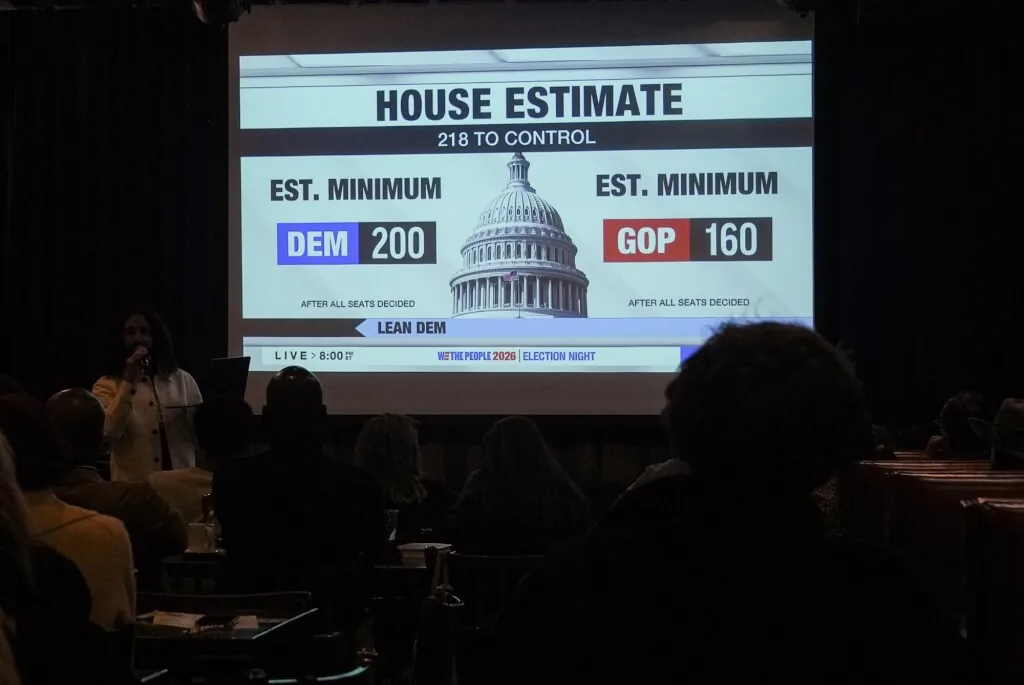
The Democratic Party has secured both chambers of Congress in the U.S. midterm elections. According to estimates from CNN, RealClearPolitics, and *The New York Times* as of late on the 3rd, the Democrats have won at least 54 seats in the 100-member Senate and at least 228 seats in the 435-member House. The prediction platform Polymarket projects they could reach 250 seats in the House and 55 in the Senate. An analysis by *POLITICO* suggests that with the shift in the power landscape in Washington, Europe is the most anxious party.
While the Democrats can exert checks on the White House through budget appropriations, congressional hearings, and conditions attached to legislation, the Constitution grants the President significant autonomy in foreign policy, national defense, and trade. Even Phil Gordon—who served as a national security advisor to former Vice President Kamala Harris—acknowledged: "Trump holds command of the military and controls tariffs and trade negotiations... and even if the Democrats control both chambers of Congress, he retains the power to veto legislation."
The first concern for Europe is that Trump may demand even more. Trump has consistently pressed allies to increase their defense spending and ensure fair, reciprocal trade—a stance likely to harden further over the next two years. Wolfgang Ischinger, a former German diplomat and former chairman of the Munich Security Conference, has warned Europe to prepare for "more demands from Trump."
The second concern involves Ukraine. Many prominent Democrats support aid to Ukraine and could push for increased support now that they control Congress. However, Bronwen Maddox, director of the Royal Institute of International Affairs (Chatham House), notes that the process for securing and delivering funds and supplies "often takes months or even years," whereas the immediate, urgent priority is simply surviving the coming winter.
The third concern relates to policy toward Russia. Trump styles himself a "peace president," claiming to have brought an end to eight international conflicts. Kurt Volker, who served as the Trump administration’s special envoy for Ukraine, believes that withdrawing from NATO or significantly reducing troop deployments—moves unsupported by either party in the U.S.—are unlikely to occur. However, Trump might unilaterally adjust sanctions against Russia and seek energy cooperation, potentially paving the way for American companies to re-enter the Russian market.
A fourth issue concerns Iran and energy. Until full navigation is restored through the Strait of Hormuz, electricity prices and the cost of living in Europe will remain high. With France, Italy, Poland, and Spain all facing elections in 2027, oil prices will directly influence their respective political landscapes.
A fifth issue is the internal friction within Washington. Although former Vice President Kamala Harris urged Democrats last month to abandon efforts to impeach Trump, John F. Harris—a journalist for the anti-Trump outlet *POLITICO*—predicts that political infighting could spread across various sectors. Both parties face their own internal power struggles; if Washington descends into chaos, foreign policy may well be sidelined.
Aboluowang commentator Wang Duran observes that it is common in American politics for a president’s party to lose in the midterm elections—noting that while Barack Obama lost over 60 House seats in 2010, he still won re-election two years later. A "divided government" is not necessarily a bad thing; during his presidency, Bill Clinton worked with a Republican-controlled Congress to achieve welfare reform and a balanced budget. The Democrats’ recent gains were driven by oil prices rather than a clear policy agenda. With a contingent of socialist lawmakers—affiliated with the Democratic Socialists of America (DSA)—entering Congress, even the election of Democratic leader Hakeem Jeffries as Speaker remains uncertain. If the Democrats pursue further impeachments of Trump, attempt to expand the Supreme Court, or push for statehood for the District of Columbia, voters will surely hold them accountable in two years. With the power of the veto and authority over foreign policy in his hands, it is not necessarily the White House that will fall into disarray.
Wang Duran points out that for the Democrats, who have secured control of Congress, their greatest adversary may well be the socialists within their own ranks. As an aside, the opposing side might argue that the Democrats managed to flip even deep-red states like Texas and Kansas—a shift far exceeding the typical swings seen in midterm elections. Furthermore, Trump himself acknowledged that the war with Iran drove up oil prices, which hurt his electoral prospects; therefore, the outcome cannot be entirely attributed to "historical norms".
Trump posts late at night— just this word!
Editor : Zhongkang / Source : World Journal (World News Network) / https://www.aboluowang.com/2026/1104/2453436.html / Image : Excerpted from Trump’s social media
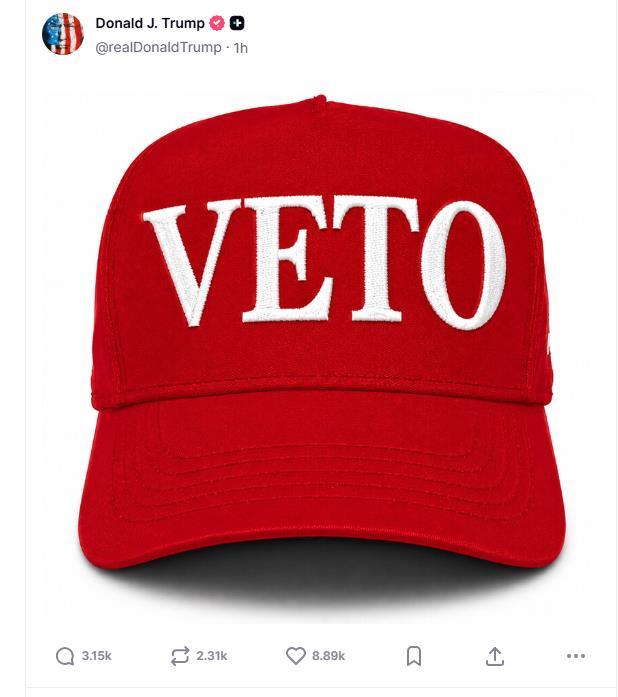
With the U.S. Democratic Party poised to gain full control of Congress, President Donald Trump has posted an image on his social media platform featuring a large red hat emblazoned with the word "VETO". This aligns with his earlier suggestion that he might have to become "Mr. Veto"—frequently exercising his veto power against legislation sent to him by Congress.
On Tuesday evening (3 November 2026), Trump also posted: "I wasn’t on the ballot—but had I been, we would have won a massive, landslide victory!"
In interviews with outlets including *The New York Times* that same day, Trump attributed the Republican losses to his own absence from the ballot, which he argued limited the mobilization of voters, as well as to voter dissatisfaction over rising oil prices linked to the conflict with Iran.
He further stated that he is "absolutely willing" to accept the midterm election results and is prepared to work with the Democrats, adding, "We look forward to working with them. We’ll probably be able to find some solutions."
According to Bloomberg and *The Wall Street Journal*, Trump expressed surprise at the midterm election outcomes, noting, "I thought some of the Republican candidates would have done better."
"The veto is one of the most powerful tools I have," Trump remarked. "We’ll work together to get things done."
Acknowledging that the conflict with Iran drove up oil prices—which he admitted severely hurt his party's electoral prospects—Trump maintained that he had no regrets. He described his decision to engage in the conflict with Iran as "a very smart move," asserting that "if I had to do it all over again, I would do the same thing." He did, however, concede that voters were unhappy with the price of gasoline. Trump stated: "They don’t mind the Iran issue, but they might be unhappy with oil prices—they certainly are unhappy with oil prices. So, you know, that’s one of the factors. But I have absolutely no regrets about that decision. In fact, you know, that decision was very wise for the future of the country and the entire world."
Trump added: "I think these have been the most successful two years in history for any president."
Democrats flip seven States to retake the Senate; Deep-Red States Texas and Kansas shift, signaling potential roadblocks for Trump’s final two years
Reporter : Wang Duruo / Editor : Zhongkang / https://www.aboluowang.com/2026/1104/2453407.html / Image : Real-time midterm election results from the Associated Press
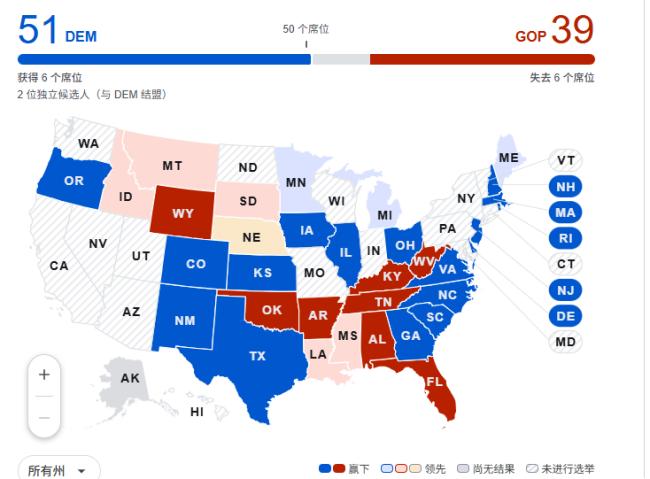

As of the early hours of 4 November 2026 (Eastern Time), multiple media outlets, including the Associated Press and NBC, have projected that the Democratic Party has regained control of the Senate. Combined with their earlier victory in the House of Representatives, the Democrats are set to control both chambers of Congress starting next January.
Heading into the election, the Republicans held a 53–47 majority in the Senate; the Democrats needed a net gain of four seats to flip the chamber. Ultimately, the Democrats managed to flip seven seats previously held by Republicans: Texas, South Carolina, Ohio, North Carolina, Iowa, Kansas, and Maine. According to NBC, the Democrats have secured 53 seats to the Republicans' 43, with votes still being counted for the remaining seats—meaning the final tally may shift slightly.
Deep-Red States shift
The most stunning result occurred in Texas, where Democratic State Representative James Talarico defeated Republican Attorney General Ken Paxton. Paxton—who had previously ousted incumbent Senator John Cornyn in the primary—ultimately lost in the general election. Talarico becomes the first Democrat elected as a Senator from Texas since 1988, effectively breaking the Republican monopoly on statewide offices in Texas that had held since 1994. Reports indicate that Elon Musk contributed $168 million to a Republican Senate leadership fund, with a significant portion earmarked to support Paxton.
South Carolina also saw a major upset, as pediatrician Annie Andrews defeated Republican Senator Darline Graham. Darlene, the sister of the late Senator Lindsey Graham, was appointed to succeed her brother following his passing and received the endorsement of Donald Trump. Andrews became the first Democratic senator from South Carolina since 1998, as well as the first woman from the state to be elected to the Senate. Graham has conceded the race.
In Kansas, Adam Hamilton—a pastor at a large Methodist church—defeated the Republican incumbent, Senator Roger Marshall, becoming the first Democratic senator from the state since 1932. Hamilton, who identifies as a moderate, advocates for term limits for members of Congress and has stated that he would not support Chuck Schumer’s continued leadership within the party. Marshall, meanwhile, has been embroiled in controversy over lawsuits filed against hundreds of patients with unpaid medical bills.
In Maine, former State Senate President Troy Jackson defeated five-term Republican Senator Susan Collins, bringing an end to her nearly 30-year Senate career. Jackson entered the race in July as a last-minute replacement for Graham Platner, who had withdrawn, leaving him with a campaign period of just over 100 days. Collins has called to offer her congratulations and has pledged to ensure a smooth transition.
Other seats that flipped include: Ohio, where former Senator Sherrod Brown defeated Republican Senator Jon Husted to return to the Senate; North Carolina, where former Governor Roy Cooper defeated former Republican National Committee Chairman Michael Whatley; and Iowa, where Josh Turek defeated Republican U.S. Representative Ashley Hinson. In Alaska, vote counting is still underway in the race between former Democratic Representative Mary Peltola and incumbent Republican Senator Dan Sullivan; the outcome remains undecided. Republicans have held onto seats in states like Florida, while Democrats have retained their existing seats in states such as Georgia.
For voters, the cost of living and fuel prices were the primary concerns in this election. The conflict involving Iran has caused a sharp spike in diesel and gasoline prices—an issue of particular sensitivity in agricultural states like Kansas.
Voter ID legislation effectively dead
One of the most immediate consequences of the shift in Senate control is that the "SAVE America Act" (Safeguard American Voter Eligibility Act) is effectively dead. The bill—which would require proof of U.S. citizenship for voter registration and the presentation of a photo ID at the polls—passed the House in February by a vote of 218 to 213, but stalled in the Senate; an amendment requiring photo identification garnered only 53 votes in March, falling short of the 60-vote threshold. With Democrats now controlling both the House and the Senate, there is no possibility of federal-level voter ID legislation for the next two years.
Trump’s final two years likely to face constant obstacles
The Senate holds more direct power to obstruct the White House than the House of Representatives does. While the House controls subpoenas and the federal budget, the Senate holds the ultimate authority over appointments: Cabinet secretaries, heads of federal agencies, and federal judges must all be confirmed by the Senate.
The greatest uncertainty concerns the Supreme Court. Before the election, Republican Senator John Kennedy stated that he did not expect any of Trump’s Supreme Court nominees to be confirmed by a Democratic-controlled Senate. Democratic Senator Richard Blumenthal also remarked that the likelihood of Democrats confirming a Supreme Court nominee put forward by Trump is "infinitesimal." Some within the Democratic Party have already suggested following the precedent set by the Republicans in 2016—delaying the filling of any vacant Supreme Court seat until after the 2028 general election. In recent years, every Supreme Court justice has been confirmed by a Senate controlled by the same party as the president.
The same applies to the Cabinet. Given Donald Trump’s history of frequent personnel changes, any future nominee will require the Democrats' approval. As the majority party, the Democrats also control committees and the legislative agenda; they alone decide which nominees receive confirmation hearings and which bills are brought to a vote.
On the Republican side, Senate Majority Leader John Thune warned before the election that if the Democrats gained control of both chambers of Congress, they would raise taxes and pursue a "frightening" agenda—including expanding the number of Supreme Court justices and granting statehood to Puerto Rico and Washington, D.C.
For the next two years, Donald Trump’s most potent weapon will be his veto power. He has already signaled his intention to be "Mr. Veto." It appears that a long, drawn-out tug-of-war between the White House and Congress lies ahead.




No comments:
Post a Comment