Sunday, September 27, 2026

Walking to Bus Stop No. 2 of Airport Limousine in Haneda

 Report, photo copyright by : Gan Yung Chyan, KUCINTA SETIA


Walk along the bridge of Haneda Airport Garden until you reach the lift opposite the sign "Bus". Ride down to reach Bus Stop No. 2 of Airport Limousine  to wait for the bus departing for Ariake along the Odaiba Line of the bus company.

The Airport Limousine staff checks the QR code ticket printout or screenshot on the passenger's handphone before the passenger boards the bus. A luggage tag is issued to the passenger.

Arrive 5 to 10 minutes earlier to wait for the ride.

Friday, September 18, 2026

Egyptair launches cargo flight to Hanoi on 27 October 2026

 Report, photo copyright by : Gan Yung Chyan, KUICNTA SETIA


Egyptair Cargo, the freighter unit of Egyptair, launches direct flight to Hanoi from Cairo on 27 October 2026.

On 27 October 2026, according to schedules, Egyptair Cargo flight MS5084 takes off from Cairo for Hanoi at 7.30 am and touches down in Hanoi at 10.30 pm. Later at 12.30 am of 28 October 2026, it leaves Hanoi for Suvarnabhumi at 12.30 am and lands in Suvarnabhumi at 2.15 am under flight MS510 before continuing its journey to Cairo under flight MS511 at 3.15 am and arriving in Cairo at 8.30 am.

Egyptair Cargo flies to Hanoi on Tuesdays while the connecting flight to Cairo from Suvarnabhumi is operated on Wednesdays.

As a result of the launch of the Cario=Hanoi=Suvarnabhumi route, the frequency of the route Cairo=Hong Kong=Suvarnabhumi=Cairo will be reduced from four flights a week to thrice weekly.

Egyptair Cargo flies to Hanoi and Suvarnabhumi with its A330 frieghter.

Thursday, September 17, 2026

2,100-fold surge in Chinese border control exit bans

Direct Translation

Wails of despair everywhere! 188,760 people in China reached the airport only to discover they couldn't leave
—It was only upon arriving at the airport that the massive 2,100-fold surge in Chinese border control records came to light

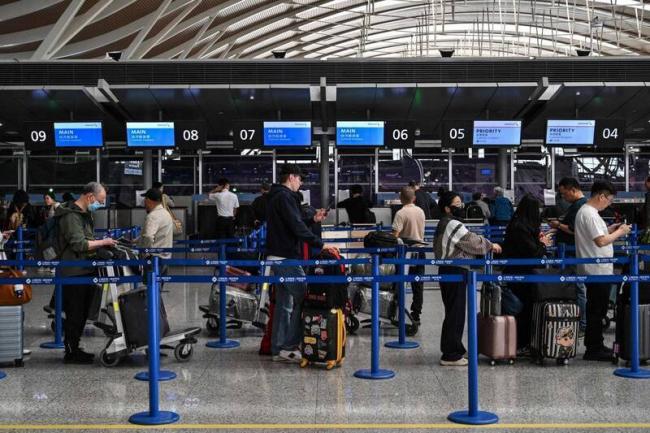
Reporter : Wang Duruo / Editor : Fang Xun / https://www.aboluowang.com/2026/0916/2434056.html / Image : China's new entry-exit regulations took effect on the 15th, drawing attention to the rules restricting exit from the country; pictured is Shanghai Pudong Airport. (AFP file photo)


New exit regulations take effect: CCP border control records surge 2,100-fold; You might already be blacklisted before traveling

Holding a passport does not guarantee you can actually leave the country—China's latest round of exit controls is quietly turning the ability to "leave whenever you want" into a game of chance.

The "Regulations of the State Council on the Administration of Exit and Entry" officially took effect on 15 September 2026. The rules stipulate that Chinese citizens who engage in illegal or criminal activities abroad—or actions that endanger national security and interests—may be banned from leaving the country for a period of six months to three years upon their return, subject to verification. Similarly, individuals who violate regulations regarding export controls or technology import/export management—thereby potentially endangering national industrial or technological security—may also be barred from leaving the country.

Are Taiwanese people Included?

A BBC report notes that observers are closely watching how these new regulations might be expanded in scope. Taiwan is paying particular attention to one specific point: Chinese law has long classified Taiwanese people as "Chinese citizens". Consequently, there is significant concern regarding whether these regulations could apply to the Taiwanese public.

From 89 records to 188,760: A 2,100-fold surge

The figures are truly chilling. Data provided to the BBC by the human rights organization *Safeguard Defenders* reveals that records mentioning "exit bans" in the Supreme People's Court's public database skyrocketed from 89 entries in 2016 to 188,760 in 2025—a staggering 2,100-fold increase. The organization emphasizes that this figure represents only what is searchable in the database and does not reflect the total number of exit bans actually issued; the real figure is likely much higher.

Discovering you can't leave only upon reaching the airport

Even more ironic is the fact that many people are completely unaware they are subject to "border controls." *Safeguard Defenders* points out that some individuals under exit bans often do not realize they are barred from leaving until the very moment they attempt to depart. The BBC has also confirmed instances where Chinese citizens only discovered the restriction when applying for a passport or preparing to travel abroad. Among them are employees of state-owned enterprises and government agencies who had long been subject to varying degrees of exit restrictions without ever being formally notified. Cooperate and have your phone checked, or refuse and face an immediate ban.

The new regulations grant immigration and visa authorities expanded powers: when verifying identities and reasons for travel, they may directly question individuals and demand the submission of documents, materials, and electronic data—requirements with which individuals must comply. Providing false materials or making false statements can result in consequences ranging from the denial of travel documents to an outright ban on entering or leaving the country.

A summary in one sentence:

Safeguard Defenders notes that China has increasingly expanded the scope of exit bans through various laws in recent years, extending from ordinary citizens to foreign nationals, and from tourism management to matters of national security, technology, and cross-border business activities; a tightening net is taking shape. The signal sent by these new regulations is clear: while you might think holding a passport allows you to travel whenever you please, the ultimate decision on whether you can leave the country has never been yours to make.

The BBC also reported that some Chinese citizens only discovered they were subject to travel restrictions when applying for a passport or preparing to leave the country. The report cited individuals within China—including employees of state-owned enterprises and government agencies—who were already facing varying degrees of exit restrictions.

The new regulations stipulate that immigration and visa authorities may question individuals and demand documents, materials, and electronic data when verifying identities and reasons for travel or entry; individuals are required to cooperate. Those who provide false materials or make false statements risk having their entry-exit documents denied or facing a ban on entering or leaving the country.

The controversy surrounding these new regulations extends beyond tourism management to encompass national security, technology, and cross-border activities. Safeguard Defenders points out that China has expanded the use of exit bans through multiple laws in recent years, affecting both Chinese citizens and foreign nationals, with the regulations increasingly linked to national security, industrial supply chains, and corporate activities.


Wednesday, September 16, 2026

Fuzhou Changle T2 serves international and XiamenAir Group flights from 16 September 2026

 Report by : Gan Yung Chyan, KUCINTA SETIA

At 5 am on 16 September 2026, Terminal 2 (T2) at Fuzhou Changle International Airport (Changle T2 , in short) officially commences operations. With the successful departure of XiamenAir flight MF8487—the first outbound flight from the new terminal—Fuzhou Changle Airport has entered a new era of development characterized by a "dual-terminal, dual-runway" configuration.

"Dual-Terminal, Dual-Runway" configuration a fully integrated operational layout


The airport's second runway began operations this past June, making Fuzhou Airport the first 4F-class airport in Fujian Province and the 17th nationwide. With the launch of Changle T2, the dual-runway and dual-terminal systems are now fully synchronized, marking a significant leap in the airport's operational capacity and service standards.

Zoned flight operations launched simultaneously


On 16 September 2026, Fuzhou Changle Airport officially implements a zoned flight operation system.

Terminal 2 (T2) Operations:

Handles domestic flights operated by XiamenAir, Hebei Airlines and Jiangxi Air as well as all international, Hong Kong, Macau and Taiwan flights.

Terminal 1 (T1) Operations:

Handles domestic flights for all airlines other than the three mentioned above; Changle T1 no longer services international, Hong Kong, Macau or Taiwan flights.

"Mindu Reception Hall" officially unveiled


Centered on the theme "Enduring Blessings of Min and Sails on the Silk Road,"  Changle T2 integrates cultural symbols of "Mindu" (Fuzhou) into its architectural design. The departure hall ceiling features the distinctive "saddle-back wall" design found in traditional Fuzhou architecture. The surrounding coloured-glaze glass panels utilize the warm hues of the local Fuzhou tangerine as a backdrop, accented with jasmine flower motifs, collectively reflecting the city's identity as the "City of Blessings."

Serving as a showcase for the city's image, Changle T2 excels in both cultural presentation and the passenger travel experience. The province's first airport branch of the Fujian Museum has opened here, featuring a curated collection of intangible cultural heritage items—such as Shoushan stone carvings, Dehua white porcelain, and cork pictures—alongside renowned heritage brands like Antai Lou and Yonghe Fish Balls. An end-to-end intelligent system has been deployed, covering check-in, security screening, baggage handling, mother-and-baby services, and customs clearance, allowing travelers to experience the city's thoughtful hospitality through a seamless and efficient journey.


From a single runway to dual runways and from one terminal to two, Fuzhou Airport has achieved a comprehensive upgrade in its operational layout, handling capacity, and service standards. As a gateway hub for the core area of ​​the Maritime Silk Road, the airport is accelerating its development into a massive regional hub serving international destinations, the Maritime Silk Road, and cross-strait connections. The full-scale launch of these new facilities provides the critical infrastructure to support this strategic positioning.

Building on this new starting point, Fuzhou Airport will continue to leverage the synergistic power of its dual-terminal and dual-runway operations. It will optimize its route network, enhance domestic and international connectivity, and better serve the development of the Fuzhou metropolitan area and cross-strait integration, thereby injecting robust aviation-driven momentum into Fujian’s high-level opening-up and the joint construction of China's "Belt and Road Initiative".

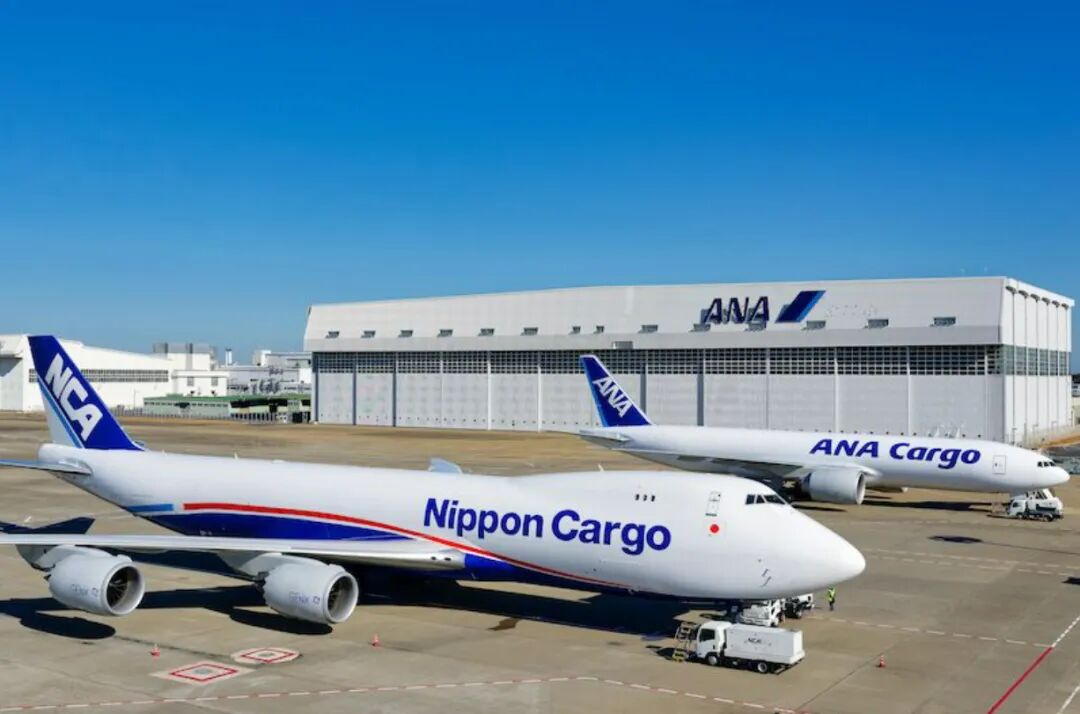
ANA Cargo, Nippon Cargo Airlines and NCA Japan merge to become ANA Nippon Cargo

 Report, photo copyright by : Gan Yung Chyan, KUCINTA SETIA


ANA Holdings has announced the name of its new merged cargo airline, which is set to launch on 1 April 2027, under the brand "ANA Nippon Cargo."

While the official corporate name will be "ANA Nippon Cargo Airlines Co., Ltd.," the company will initially retain the existing name "Nippon Cargo Airlines Co., Ltd." The full corporate name change is expected to take place in the second half of the 2027 fiscal year or later, subject to government approval.

The new airline is formed through the merger of three cargo business units under ANA Holdings: ANA Cargo, Nippon Cargo Airlines, and NCA Japan.

This integration—first announced in March 2026—is part of a broader initiative by ANA Holdings to strengthen its position in the global air cargo market.

**How ​​the three business units are merging**

Each of the three business units brings distinct capabilities to the new airline.

ANA Cargo has managed international air cargo sales and mail operations since 2013; Nippon Cargo Airlines, established in 1978, is a specialized cargo carrier with scheduled and non-scheduled cargo networks; and NCA Japan, a subsidiary of Nippon Cargo Airlines established in 2006, handles warehousing and cargo processing operations.

The combined cargo airline will have a workforce of over 2,100 employees and a sales network spanning cities such as Tokyo, Osaka, Fukuoka, Hong Kong, Singapore, Bangkok, Shanghai, Chicago, New York, Amsterdam and Frankfurt.

Nippon Cargo Airlines will serve as the surviving operating entity, retaining its air transport business license and Air Operator Certificate (AOC) following the merger.

"ANA Nippon Cargo": Reflecting a unified identity and "Japanese quality" standards

ANA Holdings stated that the new name and brand reflect three elements: the unified identity of the ANA Group; pride in the "Japanese quality" of its service standards; and a commitment to continued growth based on the combined expertise of the three business units.

The inclusion of "Cargo Airlines" in the corporate name is intentional, signaling that it is a specialized cargo carrier that owns its own aircraft and bears direct responsibility for safety and service. ANA Holdings has set a target of generating ¥30 billion ($195 million) in integration and synergy benefits as part of its medium-term corporate strategy, with cargo restructuring viewed as a key driver for achieving this goal.

By combining Nippon Cargo Airlines' specialized cargo network with ANA's international passenger network, ANA Holdings aims to become Asia's leading combination carrier.

Integration efforts are already underway

ANA Holdings has initiated the integration process ahead of the official merger date in April 2027.

Since April 2026, the company has unified its international cargo sales structure, allowing customers to use a single point of contact across the entire network, regardless of which carrier operates the flight.

Warehouse operations have also been consolidated at Chubu Centrair International Airport (NGO) and Kansai International Airport (KIX), enabling centralized cargo drop-off and pickup. Inbound cargo handling at Chicago O'Hare International Airport (ORD) was also merged as part of these early integration efforts.

ANA stated that further details regarding the new brand will be announced prior to the launch in April 2027.

Thursday, September 3, 2026

Nepal offers many valuable lessons for everyone in high-altitude disaster relief

 Direct translation

(Banned Article) Nepal has truly impressed everyone this time

Editor : Li Guangsong / Source: Descartes' Reflections / https://www.aboluowang.com/2026/0903/2428711.html

As a backpacking enthusiast, I had heard for years that Nepal was a mecca for trekkers worldwide, and I had always dreamed of hiking the classic ABC and EBC routes. However, lack of funds prevented me from doing so, and I never expected such a devastating mudslide disaster to occur.

However, this mudslide disaster has made me take a fresh look at this small, impoverished country with a land area of ​​only 147,200 square kilometers and a population of approximately 29.6 million. While Nepal's disaster warning system was poor, the local government's performance in post-disaster relief was truly commendable.

The first thing that struck me was how quickly the Nepalese government, with most roads destroyed, deployed over ten helicopters for rescue operations—both military and civilian—after the disaster. On the day of the mudslide, numerous Nepalese rescue workers were already visible at many disaster sites throughout Nepal. Their rapid response confirmed what a friend I met on a trek last year had said.

Last July, shortly after leaving my job, I backpacked through the southern Tianshan Mountains in Xinjiang, traversing the northern route. On the last day of our trek down the mountain, we met a Hong Kong couple who were also backpacking along the northern route of the Southern Tianshan Mountains. We shared a ride back to Yili. On the way, the man told me about his trekking experience in Nepal.

He said that when he reached the top of the mountain, he felt unwell and suspected altitude sickness. He immediately called for help, and a helicopter arrived very quickly. More importantly, he didn't have to pay for it himself, as he had purchased insurance beforehand; the helicopter and hospitalization costs were covered by the insurance company.

Besides the rapid helicopter response, Nepal was also remarkably efficient in disclosing rescue information.


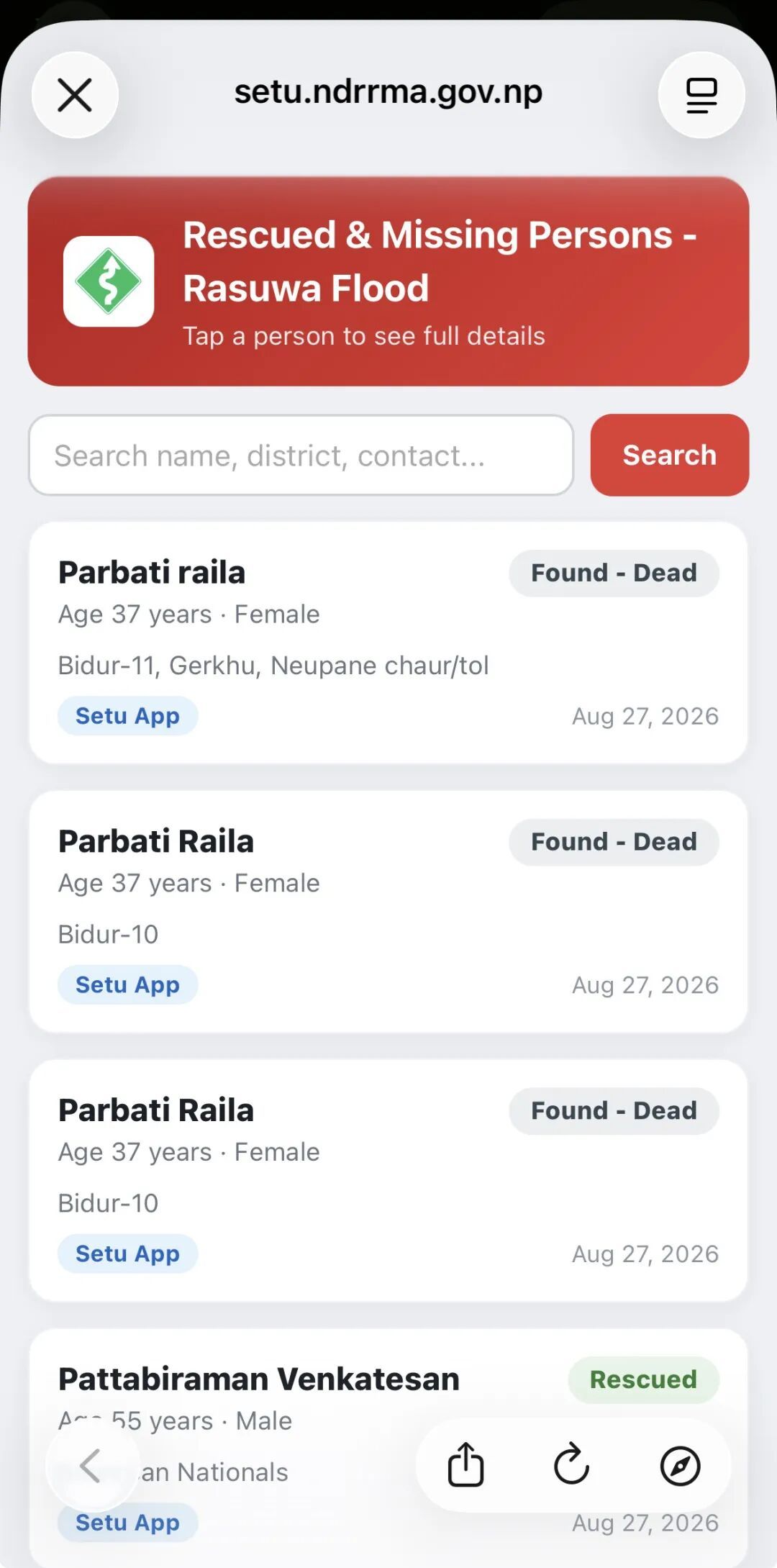
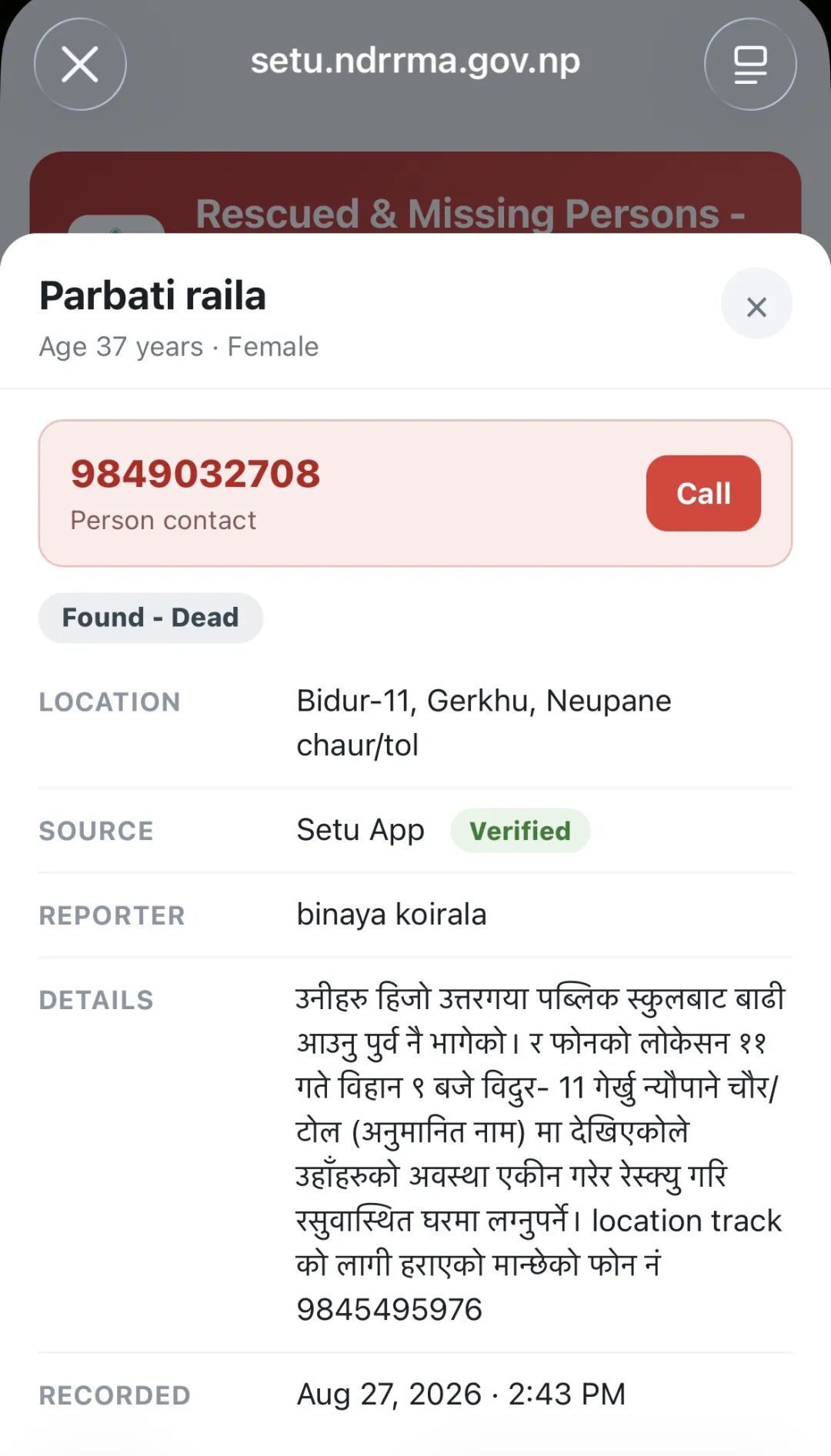
Nepal's National Disaster Risk Reduction and Management Authority (NDRA) has established a public "Missing and Rescued Persons List," which includes each person's name, age, gender, location, whether they were rescued, which hospital they were taken to, whether they were a foreigner, etc. The list is constantly updated daily with the number of dead and rescued, and everyone in the world can access the information.

Furthermore, Nepal also demonstrated highly professional rescue capabilities in the recent hydroelectric tunnel rescue operation.

In this mudslide disaster, many hydroelectric power stations were located in the valley. Floodwaters and mudslides directly flooded the tunnels, trapping numerous workers inside. The rescue operation was extremely difficult due to the risks posed by mud, boulders, floodwater, lack of oxygen, secondary collapses, and rising river levels.

However, the Nepalese government did not give up. Instead, it continuously organized excavation, search and rescue, drainage, ventilation, and tunnel entry efforts. A truly remarkable scene unfolded: Nepalese Everest climbers and mountain guides participated in the tunnel rescue.

These individuals, skilled in rope securing, cliff rappelling, and high-altitude rescue, found their expertise invaluable in this mudslide disaster. Using their experience and skills, they entered the mud-blocked hydroelectric power station tunnels, advancing approximately 120 meters before being unable to continue due to the mud and loose rocks. This demonstrates a very special social capability in Nepal: rapidly transforming mountain rescue capabilities into mudslide disaster relief capabilities.

So, why was Nepal able to perform so efficiently in this mudslide disaster?

I suspect it is because Nepal has long been a tourist destination, especially a mecca for global hiking enthusiasts. Over the years, it has established a complete and rapid rescue system, capable of quickly deploying helicopters and efficiently disseminating rescue information. Furthermore, the constant presence of mountaineers there has resulted in a large pool of experienced rescue personnel.

Finally, I truly believe that despite being a small country, Nepal offers many valuable lessons for us in high-altitude disaster relief.


StayGate Exclusive : The onboard toilet of Airport Limousine's bus between Narita and Tokyo

 Photo copyright by : Gan Yung Chyan, KUCINTA SETIA