Direct translations
Impressive! Takaichi used world-class language to turn the page on the CCP
—Sanae Takaichi quotes a line from "Attack on Titan" to urge investment in Japan! Akio Yaita reveals the strategy behind it
Editor : Fang Xun / Source : Newtalk / https://www.aboluowang.com/2025/1202/2313846.html / Image : Japanese Prime Minister Sanae Takaichi. Photo: Taken from the Prime Minister's Official Residence

Japanese Prime Minister Sanae Takaichi attended the Future Investment Initiative (FII) conference in Tokyo on 1 December 2025. During her speech, she quoted a line from the popular manga *Attack on Titan*, specifically from the character Eren Yeager: "Shut up, everyone! Just invest everything in me!" This sparked heated discussion. In response, veteran media personality Akio Yaita commented that Japanese anime is a global language. In many diplomatic situations, using complex political language is unlikely to be effective; a simple anime line that even a child can understand is much more memorable.
Akio Yaita posted on Facebook: "China is still fixated on Prime Minister Sanae Takaichi's remarks on November 7th regarding Taiwan, protesting, imposing sanctions, banning Chinese tourists from Japan, and even blacklisting Japanese celebrities. The whole set of actions seems tough, but in reality, it's like an unstoppable emotional blackmail. But the protested Prime Minister Sanae Takaichi has already turned the page."
Yita mentioned that while China was comprehensively blocking Japan politically, economically, and culturally, Takaichi attended an investment conference in Tokyo led by Saudi Arabia, where her speech attracted extensive international media coverage. This was because she quoted a line from *Attack on Titan*. Near the end of her speech, she smiled and said in English, "Shut up! Invest all your money in me!" This appeal to the attendees to invest in Japan ignited enthusiastic applause. Calm, direct, and responsible—it was the tone of a leader.
Yita pointed out that Takaichi is very aware that Japanese anime is a global language. She chose to appeal to the international community in a universally understood "common language," declaring, "Japan is trustworthy, Japan is worth your gamble." This wasn't boasting or self-aggrandizement, but a strategy. In many diplomatic situations, using complex political language rarely moves the other side. It's better to use a simple, relatable line from an anime that even a child can understand, expressing Japan's will concisely and powerfully, making it memorable.
Akio Yaita further pointed out that although Sanae Takaichi has only been in office for a month, she has already become the prime minister in recent years who has best "made Japan visible to the world." She is unafraid of Chinese pressure, does not back down, and is not afraid to speak the truth. She handles situations calmly and with neither servility nor arrogance. Her attitude has brought courage and inspired many countries that have been bullied by China but dared not speak out.
Takaichi's 10-word buzzword spree wins Japan's annual buzzword award!
Editor : Fang Xun / Source : Newtalk / https://www.aboluowang.com/2025/1202/2313913.html / Image : After being elected president of the Liberal Democratic Party, Japanese Prime Minister Sanae Takaichi stated that she would work hard "work, work, work, work, work," a phrase that won the annual Japan's most popular phrase award. (Kyodo News) Photo: Provided by Central News Agency

The top 10 and the grand prize of the year-end "Basic Knowledge of Modern Terminology 2025 T&D Insurance Group New Phrases & Best Phrases Awards" were announced today. The grand prize was won by "Work, work, work, work, work," a phrase uttered by Japan's first female prime minister, Sanae Takaichi.
According to Nikkan Sports, after being elected LDP president on 4 October 2025, Takaichi stated in a speech to party members that she would work hard, "Work, work, work, work, work," immediately sparking widespread discussion.
Today, wearing her signature blue jacket, she attended the awards ceremony and said in her speech, "Hello everyone, I am Sanae Takaichi, Prime Minister of Japan. Thank you very much for receiving the Grand Prize." This is the first time a sitting Japanese prime minister has won the Grand Prize since then-Prime Minister Yukio Hatoyama won it in 2009 for "change of government." The reason for the selection was that "such a powerful expression, rarely seen in recent years, shocked the business community committed to reforming work methods," and that "although it sparked controversy, it likely resonated with many from the Showa era who felt 'this is how work should be.'"
Regarding the focus on the words used to express her determination, Takaichi stated, "That sentence caused both positive and negative opinions. At the time, I was in a position where I might become the manager of Japan, so I said it."
She explained, "I just wanted to express that I wanted to work hard and contribute to the people; I absolutely did not mean to encourage overwork. I hope everyone doesn't misunderstand."
When asked why she emphasized "work" five times when "important things are usually emphasized three times," Takaichi laughed and said, "It was just because of the atmosphere at the time; there was no special meaning."
Takaichi Sanae's wholehearted dedication to work has garnered support from some, but others worry that it contradicts the current call for reforming work methods and emphasizing efficiency over working hours, potentially triggering polarized reactions in Japanese society.
After being elected president, Sanae Takaichi faced the withdrawal of the Komeito Party from the coalition government. Upon assuming the premiership, she immediately welcomed US President Trump's visit to Japan, attended the APEC summit in South Korea, and met with Xi Jinping, keeping her extremely busy with diplomatic affairs. There were even concerns within the Liberal Democratic Party that she was "too thin."
Takaichi herself revealed during a parliamentary interpellation a month ago that she "sleeps about two hours, sometimes four, which isn't good for her skin." Therefore, both the ruling and opposition parties have advised Takaichi to "balance work and rest" and "take breaks when needed." It appears that her work pace has recently slowed down.
The top 10 words also include onomatopoeia for the running owl on social media, "Ehho Ehho"; "Maimai," the popular mascot of the Osaka Expo; "Trump tariffs" imposed by U.S. President Trump on various countries; "Kugukuk rice," the rice reserves released by the government to lower rice prices; "national treasures," which broke box office records for live-action films in Japan; and "emergency hunting rifle/bear attack," a term related to frequent bear attacks in various regions.
Chinese Communist Party media hype up "Sanae Takaichi has backed down," experts debunk the claim and reveal the truth
Editor : Lin Qing / https://www.ntdtv.com/gb/2025/12/04/a104044192.html / Image : Japanese Prime Minister Sanae Takaichi. File photo. (Marco Longari / POOL / AFP via Getty Images)
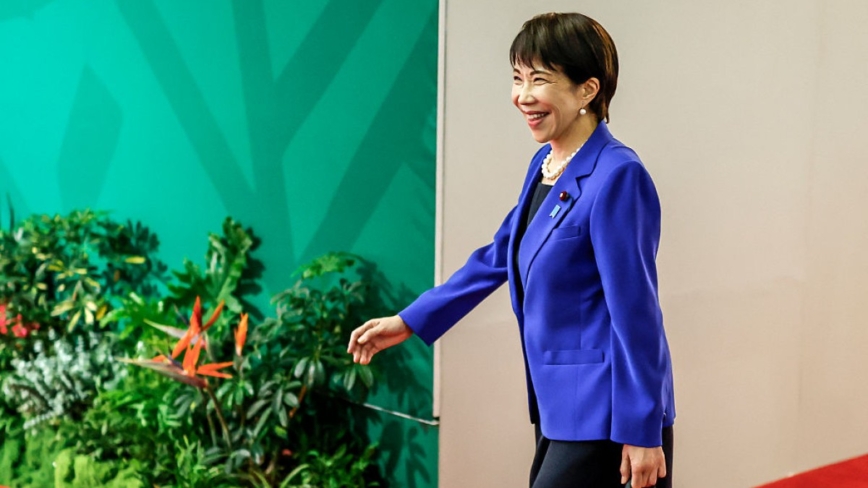
Amidst heightened tensions in Sino-Japanese relations, Japanese Prime Minister Sanae Takaichi cited the 1972 Japan-China Joint Statement, stating that Japan "understands and respects" China's position on the Taiwan Strait. Chinese Communist Party media interpreted this as a sign of weakness, hyping up the claim that "Sanae Takaichi has backed down." However, experts point out that "Takaichi has not changed," and that "the CCP is pretending not to understand."
Earlier, during a parliamentary inquiry, Sanae Takaichi clearly stated that "if something happens to Taiwan," it would constitute an "existential crisis" that would allow Japan to exercise its right of collective self-defense. These remarks provoked a strong reaction from the CCP, triggering a diplomatic storm between China and Japan, and keeping relations between the two countries tense. China again suspended imports of Japanese seafood and strongly discouraged Chinese citizens from traveling to Japan.
On 3 December 2025, at a plenary session of the Japanese House of Councillors, Sanae Takaichi stated that since the 1972 Japan-China Joint Statement, the Japanese government has "understood and respected" the mainland's claim that "Taiwan is an inseparable part of Chinese territory," and this position "has not changed at all."
These remarks were heavily publicized by CCP official media and some pro-unification media outlets as "Sanae Takaichi backing down," even trending on Weibo in mainland China.
In response, Wang Ting-yu, a legislator from Taiwan's Democratic Progressive Party (DPP), analyzed on December 4 that Prime Minister Takaichi's statement was a long-standing diplomatic tactic used by various countries, meaning "China (the CCP) says what you want, I've heard it," but without asserting that "Taiwan is part of Chinese territory." He further questioned whether the CCP official media, pro-unification media, and pro-unification groups were all "pretending to be illiterate" in their collective propaganda campaign, which precisely reflects the Beijing authorities' insecurity.
Veteran journalist Akio Yaita expressed a similar view. He stated, "Sanae Takaichi hasn't changed, and neither has Japan's diplomatic language."
He pointed out that Sanae Takaichi used what is most commonly used in Japanese diplomacy as a "magic spell." This "spell," translated into plain language, means: "I know your position, but it has nothing to do with me, and I don't intend to argue with you."
He emphasized that Sanae Takaichi's remarks were not a concession to Beijing, but merely a diplomatic courtesy. She neither acknowledged that Taiwan belongs to China nor denied her previous hardline "Taiwan emergency" stance.
Yaita concluded that whether Beijing understands or pretends not to, Japan's position on the Taiwan Strait issue has remained unchanged from beginning to end.
On the same day that Sanae Takaichi delivered her speech in the House of Councillors on the 3rd, Taro Aso, Vice President of the Liberal Democratic Party, publicly expressed his support for Sanae Takaichi's "Taiwan emergency" statement while attending a meeting of Aso faction lawmakers in Tokyo.
Taro Aso casually remarked, "Takaichi was simply clarifying its consistent stance. What's wrong with that? I'm very pleased with her attitude."
Taiwanese commentator Huang Pengxiao wrote on Facebook that many Taiwanese people believe the phrase "If Taiwan is in trouble, Japan is in trouble" originated from a speech by former Prime Minister Shinzo Abe on December 1, 2021. In fact, as early as July 5, 2021, then-Deputy Prime Minister and Minister of Finance Taro Aso publicly stated for the first time at a Self-Defense Forces-related seminar: "If Taiwan is in trouble, Japan is in trouble, and further, the Japan-US alliance is in trouble."
He bluntly stated that the Taiwan issue is not merely China's internal affair; "If a major problem arises in Taiwan," it would be a "crisis of survival" for Japan, potentially requiring the exercise of collective self-defense.
The commentary also noted that Taro Aso's proposition was highly regarded by the Japanese Self-Defense Forces and national security team. Therefore, it was included in Japan's Defense White Paper a year later, becoming a fundamental "strategic assumption" within Japan's defense system.
Regarding the CCP's strong criticism of Sanae Takaichi, Taro Aso downplayed the issue, stating, "Although the Chinese (CCP) side has said a lot, the amount of criticism they've received is not too bad." He also praised Takaichi's "extremely high approval rating" as "a symbol of the LDP's reforms."


No comments:
Post a Comment