20 News translations / Updates on the Iran War ceasefire agreement and other news
News (1)
Trump slams left-wing media for spreading fake news about Iran at 10 pm; Iran's "victory narrative" collapses
—Trump: The widely circulated 10-point plan for Iran is fake news
Reporter : Lin Yan / Editor : Wang He / Source: The Epoch Times / https://www.aboluowang.com/2026/0409/2369989.html

On Wednesday (8 April 2026), U.S. President Donald Trump explicitly stated that the ten-point ceasefire plan proposed by Iran, widely reported in the media, is not genuine. He pointed out that some parts were not included in the US version and were never discussed with the US.
"Only one set of 'points' that are meaningful to the United States is acceptable to the U.S., and we will discuss these points behind closed doors during the negotiations," Trump said on the Truth Social website.
The negotiations will take place during the two-week ceasefire agreement reached between the U.S. and Iran, and are expected to begin on Friday (10 April 20226).
White House: The Iranian ten-point plan cited by the media is not the version agreed upon by the U.S.
Earlier on Wednesday, a White House official stated that the Iranian version of the ten-point ceasefire plan cited by the media is different from the conditions for a cessation of war previously agreed upon by the White House.
"The documents reported by the media are not the final working framework," said a senior official who declined to be named.
The official declined to comment further, only stating, "Out of respect for the negotiation process, we will not conduct negotiations publicly."
The President revealed that the U.S. only accepted a set of reasonable ceasefire points.
Trump himself subsequently posted a strongly worded statement on Wednesday regarding the matter.
The President mentioned a set of ceasefire "points" accepted by the U.S., adding, "These points form the basis of our ceasefire agreement. The ceasefire agreement is reasonable and easily rescinded."
He also accused the media of using "fake news."
"Many agreements, lists, and letters were issued by people who have absolutely no connection to the U.S.-Iran negotiations. In many cases, they are outright liars, con artists, or worse," the President wrote.
He stated, "They will be quickly exposed once our federal investigation is complete." It remains unclear whether Trump has the authority to investigate such matters.
How the so-called "Ten-Point Plan for Iran" spread
President Trump announced a two-week suspension of airstrikes against Iran on Tuesday, stating that the suspension was contingent on the Iranian military reopening the Strait of Hormuz. He also noted that his administration had received a "workable" ten-point proposal from Iran.
"We received a ten-point proposal from Iran and consider it a viable basis for negotiations," the president stated. "The U.S. and Iran have reached agreements on almost all past points of contention, but two weeks is sufficient to finalize and sign an agreement."
Pakistani Prime Minister Sheikh Sharif, acting as an intermediary, also invited U.S. and Iranian officials to meet in Islamabad, Pakistan, on Friday to "further negotiate a final agreement to resolve all disputes."
Subsequently, Iranian state media released a so-called ten-point plan, which specifically included Iran continuing to control the strategically important Strait of Hormuz, ending international sanctions against Iran, and "accepting" uranium enrichment activities.
These provisions contradict Washington's public statements regarding actions it hopes Iran will take.
CNN and other U.S. media outlets subsequently reported on the ten-point plan released by Iran's National Security Council.
News (1) is based on The Epoch Times news below.
Trump has accepted Iran's Ten-Point Plan? White House: Ridiculous
- U.S. and Iran attempt to draw red lines before formal peace agreement talks
Reporter : Lin Yan / Source : The Epoch Times / Editor : Lin Yan / https://www.epochtimes.com/b5/26/4/8/n14737327.htm / Image : White House Press Secretary Karoline Leavitt at a press conference in the James S. Brady Press Room at the White House. (Anna Moneymaker/Getty Images)

White House Press Secretary Karoline Leavitt stated that the notion that President Trump has accepted Iran's ten-point plan is absurd.
Levitt clarified that she had seen "a lot of inaccurate reporting" in the media regarding the U.S.-Iran peace talks and plans.
The White House revealed that the U.S. has sent Vice President Vance, Special Envoy Steve Witkoff, and Jared Kushner to the Iran talks in Pakistan on Saturday.
"The first round of talks will be held Saturday morning local time, and we look forward to these face-to-face meetings," Levitt said.
Iran's initial ten-point plan was completely ignored by the U.S.. Levitt revealed that Iran's initial so-called ten-point plan was "completely unserious and unacceptable" and has been "completely ignored" by the U.S.
She pointed out that media reports claiming the U.S. had accepted Iran's ten-point plan are incorrect.
The White House earlier stated that the ten-point plan released by Iran's National Security Council, which has been widely cited in the media, is different from the conditions for a ceasefire previously agreed upon by the White House.
The senior official, who declined to be named, stated, "The document reported by the media is not the final working framework."
The content of this version contradicts the actions Washington has publicly stated it hopes Iran will take.
White House: Iran has recognized reality and proposed a more reasonable and streamlined plan
Levitt stated that Iran has "recognized reality" and has presented the United States with a "more reasonable" and streamlined plan. This plan is the version accepted by the US and has not yet been made public.
"President Trump and his team believe that the revised plan is a viable basis for negotiations and is consistent with our 15-point proposal," Levitt said.
The White House said that the US military's combat performance on the front lines has created the "greatest bargaining chip" for President Trump and his negotiators in order to find an opportunity for a diplomatic solution.
Levitt stated that Iran had no choice but to agree to a ceasefire because they "can no longer tolerate being bombed and cannot afford the consequences that might occur after the 8:00 PM deadline set by President Trump last night."
The U.S. will not allow Iran to continue uranium enrichment
The White House secretary pointed out that it is "absurd" to think that Trump would accept a "wish list" that would allow Iran to enrich uranium.
She stated that Iran has indicated its willingness to hand over its enriched uranium, but did not provide further details.
"The president's bottom line—that Iran must cease its uranium enrichment activities on Iranian territory—remains unchanged," Levitt said. "The idea that President Trump would accept Iran's list of conditions as an agreement is utterly absurd."
"This is a red line the president will not back down on, and he is committed to ensuring it is implemented. We hope to achieve this through diplomatic means," she added.
The White House refutes false reports of Strait of Hormuz closure. The White House also refuted recent reports in Iranian media claiming that Iran had closed the Strait of Hormuz because of Israeli attacks on Lebanon, which it considered a violation of the ceasefire agreement. Levitt stated that the president still hopes the strait can be reopened "immediately, quickly, and safely."
"Lebanon is not a participant in the ceasefire agreement. This has been communicated to all parties involved in the ceasefire," she added.
Israel airstrikes on Lebanon, Iran protests
Iranian Parliament Speaker Bagher Ghalibaf posted on social media X on Wednesday that three clauses of Iran's proposed ten-point ceasefire were violated before negotiations even began.
He pointed out that the ceasefire had not extended to Lebanon, that an "intruding drone" had entered Iranian airspace, and claimed that Iran's "uranium enrichment rights" had also been included in the ten-point plan.
Iran's top diplomat on Wednesday demanded that the United States choose between a ceasefire and allowing Israel to continue its attacks on Lebanon.
Iranian Foreign Minister Araghchi wrote on Telegram: "The conditions for a ceasefire between Iran and the United States are clear and unambiguous: the United States must choose between a ceasefire and continuing its war through Israel; the two cannot coexist."
News (2)
White House: U.S.-Iran ceasefire agreement does not include the war between Israel and Hezbollah
Editor : Lin Yan / https://www.epochtimes.com/b5/26/4/8/n14737329.htm / Image : On 8 April 2026, White House Press Secretary Karoline Leavitt speaks at a press conference in the James Brady Press Briefing Room of the White House in Washington, D.C. (Anna Moneymaker/Getty Images)

The White House spokesperson said on Wednesday (8 April 2026) that the ceasefire agreement recently reached between the United States and Iran does not include the ongoing war between Israel and Hezbollah in Lebanon. Earlier that day, Israel launched a large-scale attack on Lebanon.
At a White House press briefing on Wednesday, a reporter asked President Trump whether he wanted Lebanon to be included in the U.S.-Iran ceasefire agreement.
White House Press Secretary Karoline Leavitt responded, "Lebanon is not part of the ceasefire agreement. This has been communicated to all parties involved in the ceasefire."
"As you know, Prime Minister Benjamin Netanyahu issued a statement last night supporting the ceasefire and the efforts of the United States," Leavitt said. "He also assured the President that they will continue to be a supporting partner for the next two weeks."
When asked by a reporter whether the President might want to include Lebanon in the ongoing conflict between Israel and Hezbollah, "which appears to be causing or potentially undermining the ceasefire agreement with Iran," Leavitt responded, "I'm sure this will continue to be discussed by the President with Prime Minister Netanyahu, the United States, Israel, and all relevant parties. But for now, they are not included in the ceasefire agreement."
Trump announced a 14-day conditional ceasefire agreement with Iran on Tuesday evening, aimed at de-escalating the rapidly escalating regional conflict since the joint U.S.-Israel military action. The agreement is seen as a temporary de-escalation measure but does not cover Israeli operations on other fronts.
PBS reporter Elizabeth Landers said earlier Wednesday that she had spoken with President Trump. Trump told her that the war between Israel and the Iranian-backed Hezbollah militias in Lebanon was "not included in the agreement he announced Tuesday night."
Landers said in a post on social media platform X that she had a brief conversation with President Trump minutes after a Pentagon briefing to inquire about the latest developments regarding Iran.
Landers quoted the president as saying, "They (Hezbollah) are not included in the deal. That thing will be dealt with. It's okay."
Trump added that Israel's continued attacks on Hezbollah were "part of the agreement—everyone knows that. That's another small conflict."
The war between Israel and Hezbollah has lasted for years, but since the joint U.S.-led military action against Iran on 28 February 2026, the scale of Israeli operations has increased significantly, including a ground offensive.
Israeli Defense Minister Israel Katz stated last month that even after the war ends, Israeli forces will remain in control of parts of southern Lebanon, and local residents will not be allowed to return to their homes until Israeli citizens are guaranteed safety.
News (3)
Vance: It would be unwise for Iran to violate the ceasefire over Lebanon
Reporter : Lin Yan / Editor : Li Huanyu / https://www.epochtimes.com/b5/26/4/8/n14737427.htm / Image : On 8 April 2026, U.S. Vice President John Dee Vance gave a media interview at Budapest Ferenc List International Airport before boarding Air Force Two to return to Washington, D.C. (Jonathan Ernst-Pool/Getty Images)

On Wednesday (8 April 2026), U.S. Vice President Vance stated that it would be unwise for Iran to violate the ceasefire agreement over the Lebanon issue.
The White House has announced that the United States will send Vice President Vance, Special Envoy Steve Witkoff, and Jared Kushner to Iran talks in Pakistan on Saturday.
White House Secretary Karoline Leavitt said at a press conference on Wednesday, "The first round of talks will take place Saturday morning local time, and we look forward to these face-to-face meetings."
Vance, who had just concluded a visit to Hungary, told reporters before leaving, "The Iranian side has pledged to open the Strait of Hormuz, and our negotiations are expected to begin this weekend."
"I think this is a good start, but we will see if we can make more progress in the coming days," he added.
Vance pointed out that there are "reasonable misunderstandings" between the two sides regarding Lebanon.
"The Iranian side mistakenly believes that the ceasefire agreement covers Lebanon, but that is not the case. We have never made such a commitment," he said.
He stated that Israel has indicated a "willingness to restrain itself on the issue of Lebanon because they want to ensure the success of our negotiations."
Vance said, "If Iran wants to break these negotiations down, to derail them over Lebanon, and that issue itself has nothing to do with them, and the U.S. has never said Lebanon is part of the ceasefire agreement—that was ultimately their choice. We think it's foolish, but it was their choice."
Levitt also confirmed at the press conference, "Lebanon is not among the participants in the ceasefire agreement. This has been communicated to all parties involved in the ceasefire."
However, Iranian Parliament Speaker Bagher Ghalibaf posted on social media X on Wednesday, accusing the U.S. of not extending the ceasefire to Lebanon and of sending an "intruding drone" into Iranian airspace. He demanded that Iran retain its "uranium enrichment rights."
News (4) to (5) / Reporter : Zhang Ting / Editor : Lin Yan / Further editing : Gan Yung Chyan, KUCINTA SETIA / https://www.epochtimes.com/b5/26/4/8/n14737318.htm / Image : On 8 April 2026, U.S. War Secretary Pete Hegseth spoke at a press conference at the Pentagon. (Andrew Harnik/Getty Images North America/Getty Images via AFP)

News (4)
Why Iran agrees to ceasefire agreement: Hegseth reveals inside story
U.S. War Secretary Pete Hegseth said on Wednesday (8 April 2026) that the new Iranian regime reached a ceasefire agreement with President Trump because they understood that reaching an agreement was far better than the fate awaiting them.
"The president facilitated this moment. We all know Iran pleaded for a ceasefire," Hegseth said.
The U.S. and Iran reached a ceasefire agreement on Tuesday, just before President Trump's deadline for Iran. President Trump stated on Tuesday, before announcing the ceasefire, that the U.S. and Iranian teams were engaged in intensive negotiations.
At a Pentagon press conference on Wednesday, Hegseth, referring to the last-minute negotiations, said, "If Iran had rejected our terms, the next target would have been their power plants, bridges, and oil and energy infrastructure. These are targets they cannot defend, nor can they truly rebuild. Rebuilding would take decades. And we are ready, ready to fire. They simply cannot resist."
The Secretary of War stated that Iran finally understood that its production and power generation capabilities "are in our hands, in President Trump's hands."
"We ultimately said, 'We can take everything from you, your energy export capabilities will be stripped, and the U.S. military has the capability to strike those targets without restraint,'" he said. "It was this threat that ultimately forced them to essentially say, 'Okay, we're willing to make this deal.'"
"President Trump had the ability to destroy Iran's entire economy in minutes, but he chose mercy. He spared those targets because Iran accepted the ceasefire agreement under immense pressure," Hegseth added. "The new Iranian regime understands that reaching an agreement is far better than the fate awaiting them."
"This new regime saw the fate of its predecessor. Their top leadership underwent a systematic purge: the former Supreme Leader of Iran is dead; the secretary of the Supreme National Security Council is dead; the advisor to the Supreme Leader's office is dead; the head of the Supreme Leader's military office is dead; the Minister of Defense was also purged; the commander of the Islamic Revolutionary Guard Corps is dead; the commander of the General Staff of the Armed Forces is dead; the Minister of Intelligence is dead; the commander of the Islamic Revolutionary Guard Corps Navy is no longer alive; the head of the Islamic Revolutionary Guard Corps Intelligence is also dead," Hegseth said, listing the personnel losses of Iran's former leadership.
"I've omitted a lot, and I could go on, including the so-called new Supreme Leader, who was severely wounded and disfigured. This new regime is desperate, time is of the essence. So they reached some kind of agreement," Hegseth added.
News (5)
The U.S. troops will not withdraw from the Middle East
Hegseth also stated that even if the U.S. and Iran reach a ceasefire agreement, U.S. troops will remain in the Middle East to ensure Iran adheres to the agreement.
"Yes, we will hold our ground. We're not going anywhere. We want to ensure Iran adheres to the ceasefire agreement and ultimately bring both sides back to the negotiating table to reach an agreement," he said. "Our forces are prepared defensively, prepared offensively, and prepared to launch attacks against any combination of targets as needed to ensure Iran adheres to the agreement."
News (6)
White House: Trump informed that Strait of Hormuz closure is fake news
Reporter : Xia Yu / Editor: Li Lin / https://www.epochtimes.com/b5/26/4/8/n14737377.htm / Image : A cargo ship sails in the Gulf of Ras Al Khaimah, UAE, near the Strait of Hormuz on March 22, 2026. (Getty Images)

On Wednesday (8 April 2026), Iranian state media reported that the Strait of Hormuz had been closed due to Israel's continued attacks on Hezbollah in Lebanon. White House Press Secretary Caroline Levitt responded that President Trump had been informed that reports of the Strait of Hormuz's closure were "false."
At a White House press briefing, Levitt said the president had taken note of Iranian state media reports that Iran had closed the Strait of Hormuz in response to Israel's attacks on Lebanon.
"The president was aware of these reports before I stepped onto the briefing podium," Levitt said.
She called the possibility of the strait's closure "completely unacceptable" and stated that the Iranian regime was sending contradictory messages.
"This once again proves that their public statements are very different from their private statements. We are seeing increased traffic in the strait today. I will reiterate the president's expectations and demands that the Strait of Hormuz be reopened immediately, swiftly, and safely. That is his expectation. He has been privately informed that this is indeed the case, and these public reports are false."
Throughout the war, Iran's blockade of the Strait of Hormuz disrupted global oil and gas markets. The issue of right-of-way in the Strait of Hormuz has become one of the most contentious issues facing negotiators in their attempts to transform a temporary ceasefire into a long-term peace. Iran wants to maintain control of this crucial waterway, while U.S. allies in the Gulf region strongly oppose it. The Strait of Hormuz is a crucial passage for approximately 20% of the world's oil shipments.
As part of a ceasefire agreement with the United States, Iran has agreed to allow ships to pass safely through the Strait of Hormuz.
News (7)
Trump lashes out at CNN: Iran's "great victory" statement is fake news! Orders retraction of apology
Reporter, editing : Wang He / https://www.aboluowang.com/2026/0408/2369619.html
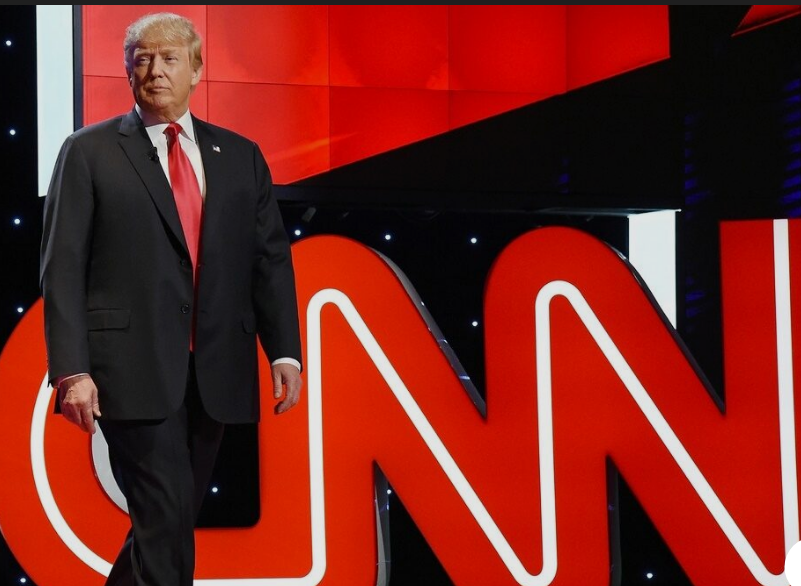
On 7 April 2026, U.S. President Trump posted on Truth Social, fiercely criticizing CNN's report on Iran's "great victory" claim, calling it a "fraud" and demanding that CNN immediately retract the report and issue a public apology.
Trump stated that the so-called official Iranian statement disseminated by CNN was "a complete hoax," its initial link originating from a Nigerian fake news website, but widely disseminated by CNN as a "legitimate headline." He claimed that the genuine official Iranian statement had been published on the Truth platform and instructed relevant departments to investigate the matter and examine whether the actions involved any illegality.
This incident occurred just after the U.S. and Iran announced a two-week ceasefire agreement, with the Strait of Hormuz expected to reopen. Trump had previously stated that one of the conditions for the ceasefire was that Iran would ensure the strait was "fully, immediately, and securely open."
However, shortly after the ceasefire announcement, Iran's Supreme National Security Council issued a statement through state media claiming a "great victory" for Iran, forcing the U.S. to accept its ten-point negotiating framework, including the lifting of sanctions, recognition of nuclear enrichment rights, and troop withdrawal. This statement was subsequently reported quickly by CNN and other media outlets.
CNN denied the report was inaccurate, emphasizing that the content did not originate from a fake website but was based on multiple Iranian official and state media channels, including the Iranian state broadcaster IRIB. As of 8 April 2026, CNN had not retracted or deleted the report.
The controversy currently centres on three main points:
First, the authenticity of the statement's source.
Trump insists the report was based on a fake website; CNN, however, states the information was reprinted by Iranian official media and has a publicly available source.
Second, whether Iran's statement constitutes propaganda.
It is widely believed that Iran is using a "victory narrative" to gain domestic public opinion advantage and to gain the upper hand in subsequent negotiations.
Third, Trump mentioned a judicial investigation.
Trump stated that relevant departments are investigating whether the incident constitutes a crime, but no official law enforcement agency has yet announced further action.
This incident once again highlights the "information warfare" dimension of the U.S.-Iran conflict. Since the U.S. and Israel launched military strikes against Iran in early 2026, the two sides have not only clashed on the battlefield but have also engaged in fierce competition in the public opinion arena. The Trump administration has repeatedly accused mainstream media of amplifying Iranian propaganda while CNN insists its reporting is based on journalistic verification principles.
Analysts point out that this controversy essentially reflects a narrative struggle within the context of a ceasefire: Iran is attempting to portray itself as having won by "forcing the U.S. to make concessions," while the U.S. is striving to maintain its dominant position in the ceasefire.
Key points to watch include: whether CNN will adjust its reporting, whether the investigation Trump mentioned will proceed, and whether the U.S.-Iran ceasefire can be truly implemented.
Amid the escalating international crisis, this propaganda war surrounding a statement has once again demonstrated that in modern conflicts, information dissemination and military action often occur simultaneously.
News (8)
The U.S. State Department urges U.S. citizens to leave Iraq by land
Reporter : Li Yan / Editor : Lin Yan / https://www.epochtimes.com/b5/26/4/8/n14737443.htm / Image : The State Department logo in the State Department briefing room in Washington, D.C. (Madalina Vasiliu/The Epoch Times)
The U.S. State Department issued a new security warning on Wednesday (8 April 2026) regarding the situation in Iraq, advising U.S. citizens to immediately evacuate the country by land due to the activities of militias allied with Iran.
The State Department stated that these groups launched drone attacks that day near the Baghdad Diplomatic Support Center and Baghdad International Airport.
"They may intend to carry out further terrorist attacks against U.S. citizens and U.S.-related targets throughout Iraq, including the Iraqi Kurdistan Region (IKR)," the State Department said in a press release.
The press release stated, "Although Iraqi authorities have announced plans to reopen airspace and resume commercial flights, given the ongoing risks of missiles, drones, and rockets in Iraqi airspace, U.S. citizens should not travel by air within Iraq. U.S. citizens should now evacuate by land."
The State Department issued a Level 4 travel advisory for U.S. citizens: Do not travel to Iraq. "Do not travel to Iraq for any reason. If you are already in Iraq, leave immediately." It also warned that U.S. citizens who choose to remain in Iraq face significant risks.
This warning comes as President Trump announced on Tuesday that the U.S. and Iran had reached a two-week ceasefire agreement, while the two countries are negotiating a longer-term peace agreement.
Following this, news broke that Shelly Kittleson, an independent journalist arrested last week near Baghdad by the Iranian-backed Kataib Hezbollah brigade, had been released. The militia group stated that Kittelson's release was in exchange for its members detained in Iraq, and that there would be no further similar agreements to release American citizens.
Secretary of State Marco Rubio congratulated Kittelson on her release in a tweet Tuesday evening.
"We will continue to use all available tools to bring Americans home and hold those responsible accountable," he said. "We are relieved that this American is now free and are working to support her safe departure from Iraq."
The State Department stated that the U.S. mission in Iraq remains open to assist American citizens with their evacuation, but due to "significant security risks," the State Department advises against traveling to U.S. facilities in Baghdad or Erbil.
The State Department stated that land evacuation routes to Jordan, Kuwait, Saudi Arabia, and Turkiye are open, and advised travelers to be prepared for lengthy delays.
Americans seeking evacuation assistance in Iraq are advised to contact the State Department's 24/7 task force at 202-501-4444.
News (9)
Kane: U.S. military consume 2 million cans of energy drinks during the Iran War
Reporter : Zhang Ting / Editor : Lin Yan / https://www.epochtimes.com/b5/26/4/8/n14737468.htm / Image : On 7 March 2026, a U.S. EA-18G Growler electronic warfare aircraft prepares for takeoff on the flight deck of the aircraft carrier USS Lincoln to support Operation Epic Fury. (U.S. Department of War website)

During the Iran war, the U.S. military continued one of the longest-standing "battlefield traditions" in the global war on terror—"consuming millions of cans of energy drinks." General Dan Caine, Chairman of the Joint Chiefs of Staff, revealed this information at a press conference at the Pentagon.
In addition to providing statistics on the U.S. military's military strikes against Iran during Operation Epic Fury, Caine also mentioned the dietary situation of U.S. troops during the operation.
"We consumed over 6 million meals in total, and I estimate we also consumed over 950,000 gallons of coffee, 2 million cans of energy drinks, and a significant amount of nicotine," he said, jokingly adding, "I'm not saying we had a problem."
Energy drinks have long been closely associated with military culture.
Task & Purpose, an online media outlet focusing on the U.S. military and defense industry, reported that energy drinks, like Humvees, Mine Resistant Ambush Protected (MRAP) vehicles, and tobacco used by soldiers, have become iconic elements of the battlefield during the wars in Iraq and Afghanistan.
Therefore, it is not surprising that veterans of post-9/11 wars have again relied on sugar, caffeine and tobacco in the conflict with Iran.
According to Stars and Stripes, research shows that combat personnel are more likely to use any caffeinated products, "especially coffee and energy drinks," while combat logistics personnel most frequently use tea, chewing gum, and medication.
The U.S. military launched Operation Epic Fury against Iran on 28 February 2026. On Tuesday (7 April 2026), a two-week ceasefire agreement was reached. Kane emphasized at a press conference on Wednesday that the ceasefire is only temporary, and if ordered or required to resume operations, the joint forces will continue to carry out their mission with the speed and precision demonstrated over the past 38 days.
Kane stated that the U.S. joint forces have struck more than 13,000 Iranian targets. 90% of Iran's weapons factories were attacked, including all factories producing the Shahed drone. The U.S. military also destroyed approximately 80% of Iran's air defense systems. More than 2,000 Iranian command and control nodes were also destroyed.
Kane expressed his sincere gratitude for the enormous sacrifices made by the U.S. military in this arduous operation.
News (10) to (14) / Reporter : Lin Yan / Editor : Lin Yan / https://www.epochtimes.com/b5/26/4/8/n14737311.htm / Image : On 25 March 2026, two bulk carriers were stranded at the Muscat anchorage in Muscat, Oman, due to Iran's closure of the Strait of Hormuz. (Elke Scholiers/Getty Images)

News (10)
U.S.-Iran Ceasefire: A comprehensive look at the Strait of Hormuz
With the U.S., Israel, and Iran reaching a two-week ceasefire agreement, the world is paying attention to the reopening of the Strait of Hormuz.
Iran has proposed charging oil tankers passing through the strait a transit fee of $1 per barrel and requires payment in cryptocurrency. U.S. President Trump revealed that the two sides are considering establishing a joint venture to charge fees, with the U.S. responsible for traffic control and the substantial sums collected going to Iran for reconstruction.
Bloomberg-compiled tracking data shows that since Tuesday morning (7 April 2026), seven ships have left the area, while three have entered. Currently, over 800 cargo ships are stranded in the Gulf, mostly awaiting departure.
News (11)
Iran may open Strait of Hormuz on Thursday or Friday
A senior Iranian official told Reuters on Wednesday (April 8) that if a ceasefire agreement is reached, Iran may open the Strait of Hormuz on Thursday or Friday, before a meeting between Iran and the US in Pakistan.
Throughout the war, Iran's blockade of the Strait of Hormuz disrupted global oil and gas markets. The issue of right-of-way in the Strait of Hormuz has become one of the most contentious issues facing negotiators in their attempts to transform a temporary ceasefire into a long-term peace. Iran wants to maintain control of this crucial waterway, while U.S. allies in the Gulf region strongly oppose it. The Strait of Hormuz is a key passage for approximately 20% of global oil shipments.
As part of a ceasefire agreement with the United States, Iran has agreed to allow ships to pass safely through the Strait of Hormuz.
An official told Reuters that the reopening of the strait will be coordinated with the Iranian military.
However, according to the latest reports from Iranian state media, Iran has closed the Strait of Hormuz in response to Israel's attack on Lebanon.

Image : On 6 April 2025, U.S. President Trump addressed the White House press briefing room regarding the war with Iran. (Brendan Smialowski/AFP)
News (12)
Trump: Considering Joint Venture with Iran to charge tolls for Strait passage
On Wednesday, President Trump stated that following a two-week ceasefire agreement with Iran, he is considering a "joint venture" with Iran to establish a tollbooth in the Strait of Hormuz.
He was asked by ABC News reporter Jonathan Karl whether he supported Iran charging fees for ships passing through the Strait of Hormuz.
"We are considering a joint venture," the president said. "This is a way to ensure the security of the Strait—and to prevent other countries from interfering. This would be a good thing."
However, no "joint venture" was included in Iran's ten-point peace plan.
Earlier Wednesday, Trump posted on Truth Social that the U.S. would assist in "traffic clearing" in the Strait of Hormuz and take many positive steps.
"A lot of money will flow into Iran. Iran can begin the reconstruction process," he wrote. "We will send various supplies and then 'stand by' to ensure everything goes smoothly. I believe it will go smoothly."
The Iranian leader said last week that Iran would establish a "tollbooth" system to charge ships attempting to pass safely through the strait.
Iran's previously proposed toll scheme drew criticism from U.S. Secretary of State Marco Rubio. He denounced the potential "toll system" as "illegal" and "a threat to the world," adding that the U.S. and its European partners must develop countermeasures. However, Rubio noted that the U.S. would not lead the project.
A regional official told the Associated Press that funds raised through Iran's toll collection system will be used for national reconstruction. A portion of the revenue will also be remitted to Oman, but it remains unclear how Oman will use these funds.
U.S. President Trump posted on social media Tuesday evening that a ceasefire is contingent on "Iran agreeing to a full, immediate, and safe opening of the Strait of Hormuz."

Image : Illustration of Bitcoin cryptocurrency (Song Bilong/Epoch Times)
News (13)
Iran demands cryptocurrency payments for passage
The Financial Times interviewed Hamid Hosseini, a spokesman for the Association of Iranian Oil, Gas and Petrochemical Exporters, on Wednesday. He stated that during the two-week ceasefire, Iran is demanding that shipping companies pay for passage through the Strait of Hormuz in cryptocurrency.
Iran's Supreme National Security Council is responsible for deciding the conditions for oil tankers to pass through the strait. Hosseini's industry association has close ties to the Iranian government.
Hosseini stated that each oil tanker must report cargo information to Iranian authorities via email, after which Iran will inform them of the required passage fee.
He stated that the passage fee would be $1 per barrel of oil, adding that empty tankers would be allowed free passage.
Hussein added, "Once the email is received, and Iran completes its assessment, ships will be given a few seconds to pay the fee in Bitcoin to ensure they are not tracked or seized due to sanctions."
He also said, "Iran needs to monitor ships entering and leaving the Strait to ensure that this two-week ceasefire period is not used for weapons transport."
He added, "All ships can pass, but the passage process for each ship takes time, and Iran is not in a hurry."
The report said that Hussein's remarks indicate that Iran will require all tankers to use the northern route closer to its coastline, raising questions about whether ships from Western countries or Gulf states would be willing to risk passing through.
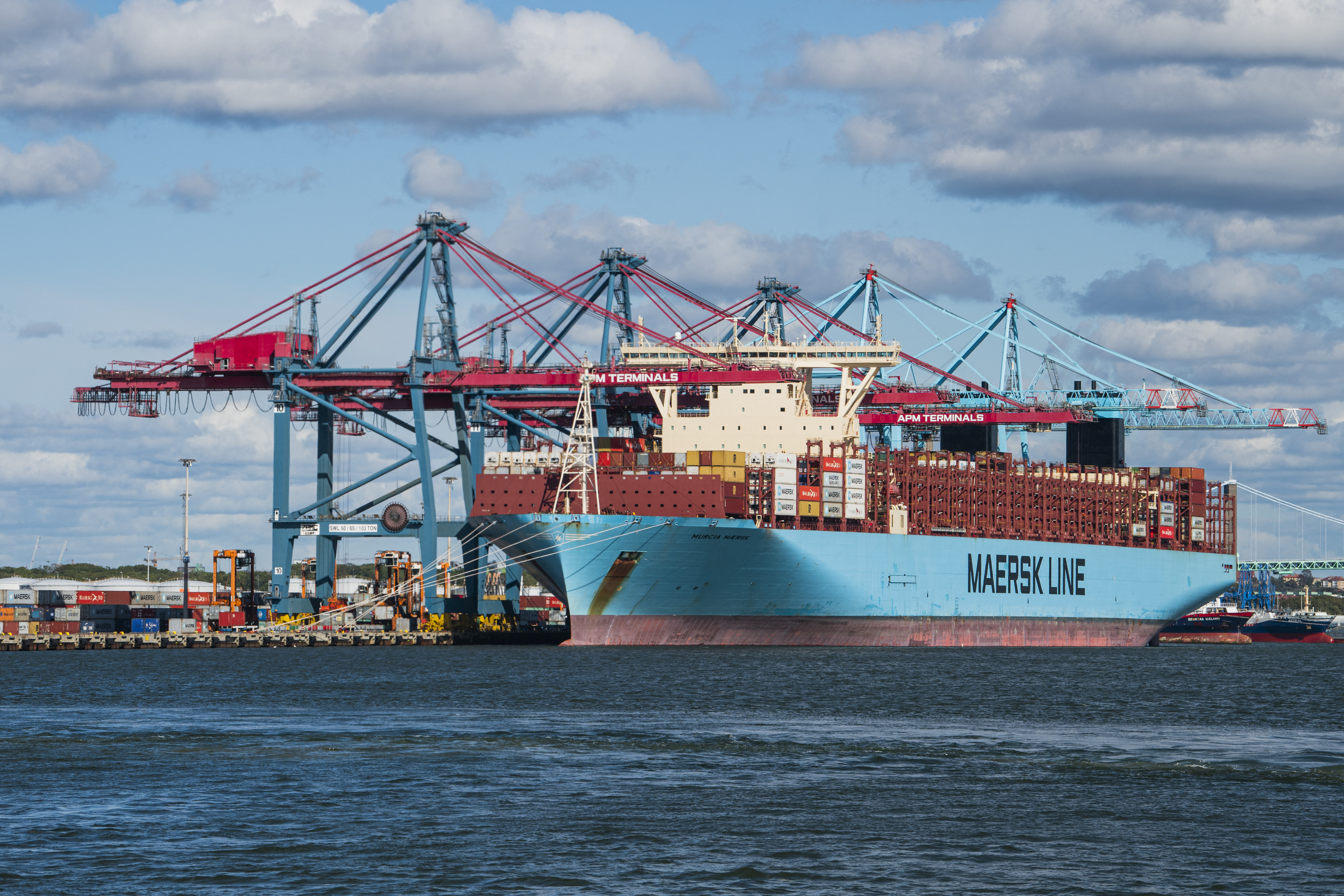
Image : A Maersk container ship (Jonathan Nackstrand/AFP)
News (14)
Western shipowners and shipping experts react cautiously
Western shipowners are cautious about the latest developments in the Strait of Hormuz, saying they are awaiting details on how and whether the strait will reopen.
From the announcement of the ceasefire agreement (Tuesday evening) until Wednesday's deadline, public reports indicated that, apart from two vessels linked to Iran, no other ships had risked transiting the Strait of Hormuz.
On Wednesday, oil tankers stranded in the Gulf received broadcast warnings from Iranian authorities, stating that they would be targets of military strikes unless prior approval was obtained from Iranian authorities.
Maersk, the world's second-largest shipping company, stated that they were working diligently to clarify the relevant terms.
The company stated, "A ceasefire may create transit opportunities, but it does not fully guarantee the certainty of maritime navigation." It added that it would continue to take a "cautious approach" to cargo transport and would not adjust specific services at this time.
According to data from the French commodities tracking company Kpler, approximately 187 oil tankers carrying 175 million barrels of crude oil and refined products are currently stranded in the Gulf. Whether these cargoes can begin to be transported depends on the development of the situation in the Strait.
Industry insiders estimate that 300 to 400 vessels are waiting to leave the Gulf and are preparing to depart once it is safe to pass.
Several traders said they still believe the situation in the coming days will likely remain similar to the past two weeks, with only a small number of Iranian-approved vessels able to pass through certain routes.
Martin Kelly, consulting director at EOS Risk, a maritime information group, told the Financial Times that it is "absolutely impossible" to clear all the ships waiting to depart within two weeks.
He said that due to the "quite time-consuming" customs clearance process, only about 10 to 15 ships might be able to pass through the strait each day, compared to 135 ships per day before the war.
News (15)
U.S. Defense Secretary: Iran is "obsessed" with attacking US aircraft carriers, but it's all in vain
Reporter : Xia Yu / Editor: Ren Zijun / https://www.epochtimes.com/b5/26/4/8/n14737324.htm / Image : On 3 March 2026, an F/A-18E Super Hornet from the USS Abraham Lincoln (CVN 72) of the 151st Strike Fighter Squadron (VFA-151) landed on the aircraft carrier during Operation Epic Fury. (US Navy)
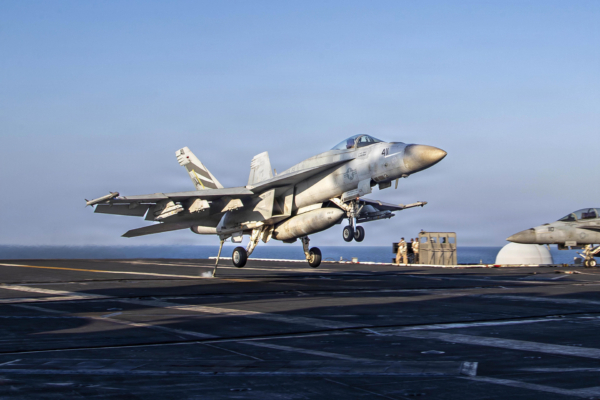
On Wednesday (8 April 2026), U.S. War Secretary Hegseth revealed at a Pentagon press conference that during Operation Epic Fury, the Iranian military was "obsessed" with attacking U.S. aircraft carriers, but "never approached" them.
The U.S. military operation against Iran has lasted for five weeks. On Tuesday evening, US President Trump announced a two-week ceasefire between the US and Iran to begin negotiations.
Hegseth said at a press conference on Wednesday that Iran pleaded for a ceasefire, and that Operation Epic Fury had destroyed Iran's military capabilities. He also stated that the Pentagon "has now completed its part of the mission."
He further detailed some aspects of the war, including the fact that U.S. aircraft carriers were targeted by Iran, but the attack failed.
"Iran launched hundreds of missiles and one-way attack drones at our aircraft carriers. They were obsessed with it, but ultimately couldn't get even a mile away," Hegseth told reporters at the Pentagon.
"Every single missile was easily shot down miles from the USS Abraham Lincoln. They were simply wasting their time," he added.
Since the U.S. and Israel launched Operation Epic Fury against Iran on 28 February, the USS Abraham Lincoln Carrier Strike Group, as a core force of the US military, is currently operating in the Arabian Sea.
On 24 March 2026, U.S. President Trump stated that all 101 missiles launched by Iran at the USS Lincoln were shot down at sea. He said, "They fired 100 missiles at our USS Abraham Lincoln, one of the largest ships in the world. Of the 101 missiles fired, every single one was shot down at sea."
This giant ship can serve as a mobile airfield, supporting up to 90 fixed-wing aircraft and helicopters. Its primary air unit is Carrier Air Wing Nine, which includes an EA-18G Growler electronic warfare squadron.
The Lincoln's defense system combines advanced radar, high-speed interceptor missiles, and highly effective electronic warfare capabilities, forming a core foundation for the U.S. Navy's deterrent power in regional conflicts. Against "missile sea" tactics, the Lincoln can maintain high-precision detection and automated interception, demonstrating the extremely high survivability of carrier strike groups in modern warfare.
News (16)
Trump: Countries providing weapons to Iran will face 50% tariffs
Reporter : Xia Yu / Editor : Li Tianqi / https://www.epochtimes.com/b5/26/4/8/n14737207.htm
On Wednesday (8 April 2026), as the United States and Iran reached a two-week ceasefire agreement, U.S. President Trump announced that any country providing weapons to Iran will face a 50% tariffs.
Early Wednesday morning, Trump posted on Truth Social, "Any country that supplies military weapons to Iran will have all its goods sold to the United States subject to an immediate 50% tariff, effective immediately. No exceptions or exemptions!"
According to data from the Stockholm International Peace Research Institute, Russia is Iran's main arms supplier.
A report submitted to Congress last November by the U.S.-China Economic and Security Review Commission indicated that while publicly available reports have not shown direct assistance from China in developing Iran's nuclear weapons program over the past few decades, it has consistently sold missile components to Iran and helped Iran circumvent sanctions on dual-use items.
Recent data from shipping company MarineTraffic also shows that two more ships linked to the Islamic Republic of Iran Shipping Lines (IRISL) left Chinese ports days after the U.S.-Israel attacks on Iran. It is speculated that China may have been supplying rocket fuel precursors to Iran through these ships.
In recent years, Sino-Iranian cooperation has shifted towards the sale of dual-use technologies and the transfer of defense-related technologies, including technologies related to missile and drone development. Chinese-made components, such as sensors, voltage converters, and semiconductors, have been found in Iranian drones, including those used by Iranian proxies in the region.
Days before the U.S.-Israel airstrikes against Iran in February, anonymous sources reported that China was directly selling weapons to Iran, including offensive drones and a near-finalized deal for anti-ship cruise missiles.
Existing U.S. sanctions already impose severe penalties on countries that supply weapons to Iran. Whether President Trump's statement signifies additional punitive measures, or whether sanctions will be lifted as part of a potential peace agreement with Iran during a ceasefire, remains unclear.
News (17)
U.S. Military: Ready to resume operations against Iran
Editor : Lu Yongxin / Source : News Live Production Team / https://www.ntdtv.com/gb/2026/04/09/a104084586.html / Image : On 8 April 2026, Chairman of the Joint Chiefs of Staff Dan Caine held a Pentagon press conference regarding the potential war with Iran. (Andrew Harnik/Getty Images)
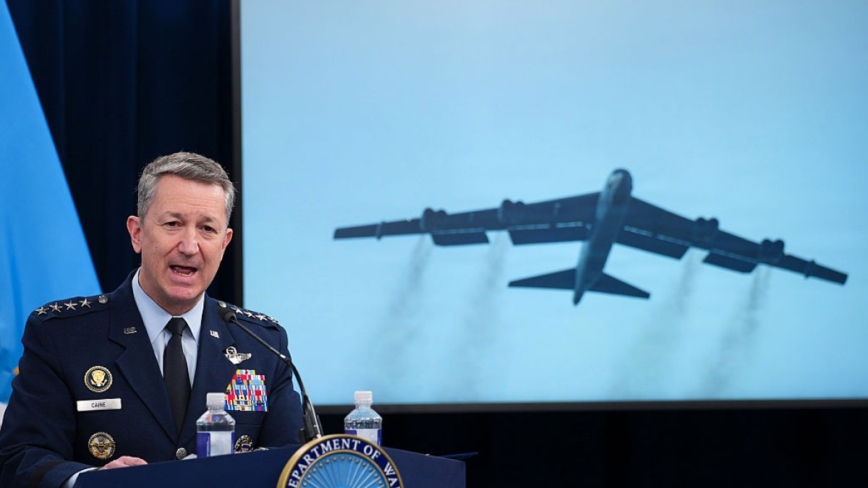
However, even if a ceasefire is reached, the U.S. has stated that it will respond swiftly should the situation change.
Chairman of the Joint Chiefs of Staff Dan Caine stated on the 8th that the U.S. military is ready to resume military operations against Iran should it refuse to reach a final agreement.
Reuters, citing White House sources, reported that Trump plans to send Vice President Vance to Pakistan to continue pushing for peace talks with Iran and demanding that Tehran immediately open the Strait of Hormuz. Simultaneously, the U.S. is also considering negotiating with Israel to include the situation in Lebanon within the ceasefire framework.

Image : On 8 April 2026, rescue workers searched for trapped residents in a residential building on Mazra Boulevard in Beirut, Lebanon, after an Israeli attack. (Daniel Carde/Getty Images)
At a Pentagon press conference, Kane emphasized that the United States hopes Iran will choose "permanent peace." However, he also made it clear that the current ceasefire is only temporary, and that once ordered, the US coalition forces will quickly resume operations with the same speed and precision as in the past 38 days.
On the other hand, despite the ceasefire agreement, the situation in the Middle East has not truly de-escalated.
Iran is accused of continuing attacks, targeting even Saudi Arabia's only current oil export route. Saudi Arabia confirmed that it intercepted nine drones in the past few hours; Kuwait also stated that multiple facilities within its territory were attacked by Iranian drones.
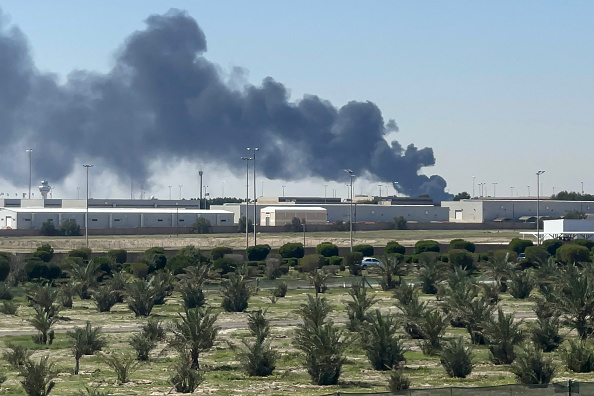
Image : On 1 April 2026, smoke rose from an area near Kuwait International Airport after an alleged drone attack. (Illustrative image) (AFP via Getty Images) / Kuwait OUT / KUWAIT OUT
News (18)
Did a secret note work? How did Iran's Supreme Leader communicate with Trump?
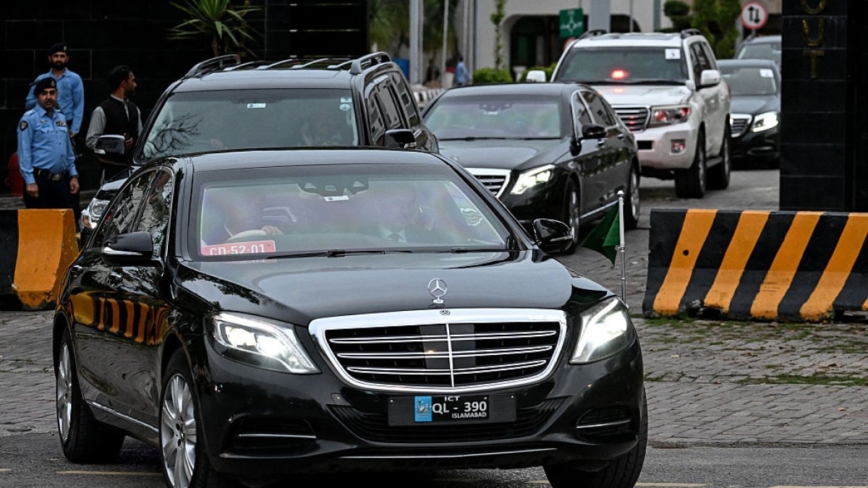
Editor : Lu Yongxin / Source : News Focus Production Team / https://www.ntdtv.com/gb/2026/04/09/a104084579.html / Image : On 29 March 2026, the foreign ministers of Pakistan, Saudi Arabia, Egypt, and Turkiye held talks to discuss the Middle East war. The image also shows Saudi Arabian Foreign Minister Faisal bin Farhan's convoy leaving the Pakistani Foreign Ministry building in Islamabad. (Aamir Qureshi / AFP via Getty Images)
Earlier this week, while U.S. President Trump publicly threatened a full-scale attack on Iran, behind-the-scenes negotiations were actually accelerating.
U.S. media Axios, citing multiple regional sources, revealed that the U.S. and Iran, at the last moment on the verge of full-scale conflict, temporarily put on the brakes through a series of high-risk diplomatic maneuvers.
The report indicates that on the morning of 6 April 2026, while Trump attended the White House Easter event, U.S. Middle East envoy Witkov was engaged in intensive calls with various parties, directly criticizing Iran's "10-point counter-proposal" as a "disaster," thus plunging negotiations into a full day of emergency revisions.
Pakistan mediated between the two sides, assisting the U.S. in communicating with Iranian Foreign Minister Araghchi, while Egypt and Turkey also attempted to bridge their differences.
By evening, a two-week ceasefire plan approved by the US gradually took shape, with the key decision-making power resting in the hands of Mojtaba Khamenei, a figure at the heart of Iranian power.

Image : On 8 April 2026, Pakistani Prime Minister Sheikh Baz Sharif stated that, under his government's mediation, the U.S., Iran, and their allies had agreed to a ceasefire in "all areas," including Lebanon, to end weeks of fighting. The image shows a vendor displaying a morning newspaper at a roadside stall in Islamabad. (Aamir Qureshi / AFP via Getty Images)
Sources revealed that he was involved in the decision-making process throughout, but due to the extremely high security risks, communication was even conducted via passing notes. The outside world described allowing negotiations to proceed as a key breakthrough.
Meanwhile, Iranian Foreign Minister Araqchi played a central role in handling the negotiations and persuading the Revolutionary Guard to accept the agreement; the CCP advised Iran to find a way out.
Although negotiations had progressed by the morning of the 7th, Trump issued a strong warning, saying "Tonight could see the destruction of an entire civilization," which initially led to the misinterpretation that the negotiations had broken down. However, informed sources indicated that the negotiations had never actually stopped.
U.S. Vice President Vance, who was in Hungary at the time, maintained contact with Pakistan by phone; Israeli Prime Minister Netanyahu communicated frequently with Trump throughout the day, but also gradually became worried about losing control of the situation.
By noon on the 7th Eastern Time, the parties were close to reaching a "two-week ceasefire." Pakistani Prime Minister Shebaz Sharif subsequently announced the terms on the X platform and called on both sides to accept them.
Trump then received pressure from hawkish allies and advisors urging him to reject it. However, even some of his closest confidants could not control his final decision, and at one point believed he would veto the agreement.
Ultimately, after speaking with Netanyahu and obtaining commitments from Israel, Trump spoke with Pakistani military leader Munir and approved the ceasefire.
The U.S. military received orders to cease operations within 15 minutes. Iran also stated its commitment to the agreement and reopened the Strait of Hormuz.
This crisis, which had teetered on the brink of full-blown conflict, was brought to a halt at the last minute by diplomatic intervention.
News (19)
Global deception? Research uncovers the truth behind the Strait of Hormuz closure
Reporter : Liu Jiajia / https://www.ntdtv.com/gb/2026/04/06/a104083856.html
A new investigation has overturned public perception: the Strait of Hormuz is not actually completely blocked. The research shows that a large number of oil tankers are "sailing stealthily" by actively turning off their transponders or falsifying GPS data, creating an electronic fog and misleading market judgment. Analysis indicates that the Iranian Revolutionary Guard Corps is using this tactic to create tension, drive up oil prices, and collect passage fees for profit. Following the report's release, international oil prices have clearly fallen.
According to the latest investigation by the independent U.S. investment research firm "Citrini Research," the Strait of Hormuz is not completely blocked as rumoured.
Analysts from the firm personally went to the coast of Oman to observe and found that a large number of oil tankers were still transporting crude oil.
The report points out that approximately 50% of tanker traffic "disappeared" from publicly tracked systems because these vessels deliberately turned off their transponders, forged GPS records, stole the identities of decommissioned ships, or used low-power transmission modes. These operations created an "electronic fog," misleading the market into believing the Strait was completely blocked, thus triggering market panic and causing oil prices to surge.
Analysts also observed that tanker passage is actually controlled by the Iranian Revolutionary Guard. Ships willing to pay tolls and accept escorts can pass smoothly; those refusing to pay may be intercepted or attacked.
The report emphasizes that this "selective blockade" allows Iran to create market tension and maintain a scarcity premium while simultaneously profiting from tolls.
Following the report's release, Brent crude oil prices fell from around $115 to around $108.
The report also specifically mentions that since the outbreak of the war, over $3 billion worth of crude oil has flowed through the Strait to China, some of which were paid to Iran in RMB, potentially indirectly supporting its military operations.
News (20)
Major leak of Chinese National Defense documents: Hackers sell missile design blueprints
Reporter : Li Siqi / Editor : Li Lin / https://www.epochtimes.com/b5/26/4/8/n14737379.htm / Image : Hacker illustration. (Anna Varavva/Epoch Times)

It is believed that hackers stole more than 10PB (approximately 10.7 billion terabytes) of data from the Chinese Communist Party's "National Supercomputing Center" (NSCC) research facilities, involving aerospace, military, bioinformatics, nuclear fusion simulation, etc., and are demanding hundreds of thousands of US dollars for sale, requiring payment in Monero (XMR, a cryptocurrency). This incident is said to be the largest known leak of classified information in China.
An account named "FlamingChina" posted information on an anonymous Telegram channel on February 6th, claiming to have hacked China's NSCC. Samples show the stolen information involves: the Chinese state-owned military-industrial complex Aviation Industry Corporation of China (AVIC); Commercial Aircraft Corporation of China (COMAC, the core company building China's independent civil aviation industry); the National University of Defense Technology (NUDT), affiliated with the Chinese military; Northwestern Polytechnical University (NWPU, a key university with a defense background directly under the Ministry of Industry and Information Technology); and Huazhong University of Science and Technology (HUST, a top comprehensive university with strengths in medicine, computer science, and artificial intelligence).
"FlamingChina" is offering the complete list for sale, with the highest bidder receiving all the data. The post included an XMR address, email address, and sample link.
The Chinese companies and universities mentioned by "FlamingChina" are all core institutions in China's aerospace and defense technology fields.
The leaked information circulating online includes content related to aircraft, submarines, hypersonic vehicles, and missile design blueprints.
Currently, nine supercomputing centers are known to exist in China, including Guangzhou, Shenzhen, and Chengdu. It is alleged that the leak originated from the NSCC in Tianjin. Online comments have stated, "The reason for the hack is rather basic." The NSCC in Tianjin, established in 2009, is China's earliest supercomputing center.
The low-level defenses of Chinese supercomputing centers: Cybersecurity experts stated that the hackers seem to have easily infiltrated the NSCC's supercomputer and continuously stole large amounts of data for months without being detected.
The commentary suggests that because the nodes were all Windows-based, or because remote code execution (RCE) was found—meaning an attacker could directly execute code from a remote location on your computer or server—this is almost a top-level vulnerability. Successful RCE essentially grants control of the host machine. Leaks could also be caused by human error. For example, many supercomputing nodes are configured with Messaging Interfaces (MPI). If usernames and passwords are shared between supercomputing nodes, a breach in one node can lead to breaches in all others.
The commentary stated that downloading such a large amount of data, "assuming it's mixed in with normal data transmission, using 5% bandwidth, would take approximately 56 days." Based on the screenshots, the latest file timestamp is 3 December 2025, and it was listed for sale online on 6 February 2026, a gap of "approximately two months," which is "more than enough."
The commentary also stated, "The intrusion detection system didn't detect anything (abnormalities), and the failure of the system's traffic monitoring was to be expected." It concluded with, "What a shoddy operation."
The Chinese supercomputing center may indeed have been hacked.
CNN's report on the incident stated that cybersecurity experts who reviewed the materials said the hacker group is currently offering previews of some of the materials for thousands of dollars. The sample materials appear to include Chinese documents marked "confidential," as well as technical files, animated simulations, and renderings of defense equipment, including bombs and missiles.
"This is exactly what I expected to see in a supercomputing center," said Dakota Cary, a consultant at the cybersecurity firm SentinelOne specializing in China research, after reviewing the documents.
"Supercomputing centers are typically used for large-scale computing tasks. The sample range released by the seller actually reflects the breadth of the center's customer base," he added. He also pointed out that most customers have no reason to maintain their own independent supercomputing infrastructure.
The documents circulating online include a "Technical Summary Report of the Contract for the Research Project on Target Damage Calculation Models and Tools," dated December 2025. The research unit is listed as the "National Supercomputing Center in Tianjin," and the page states "Made by the Academy of Military Sciences, Institute of Defense Engineering." The content covers specialized damage calculations such as multi-deck explosion simulations of ships, land-based mobile vehicle models, and finite element meshes for concrete bunkers.
"To my knowledge, there have been some data breaches within the Chinese cyber ecosystem, and these data were quickly bought up," Kari told CNN. "I believe many governments around the world are interested in some of the NSCC's data, but some of them may already have it."
Cybersecurity researcher and NetAskari blogger Marc Hofer pointed out that the sheer size of this data makes it extremely attractive to intelligence agencies of hostile countries, "and perhaps only these agencies have the capability to process such a large amount of data and extract useful intelligence from it."
The CCP is currently boasting about competing with the United States to become a world leader in technological innovation and artificial intelligence. However, if this data breach is true, it indicates that the CCP may have deeper systemic vulnerabilities in its technological infrastructure.
This is not the first time that classified information from CCP institutions has been stolen by hackers. In 2021, a massive database, allegedly containing the personal information of up to 1 billion Chinese citizens, was publicly available unsecured for over a year until 2022 when a hacker forum user attempted to sell the data, bringing the incident to widespread attention.
News (16)
U.S. Military robots deployed for mine clearance in the Strait of Hormuz
Editor : Lu Yongxin / Publisher : News Live Production Team / Image : On 26 October 2021, during a joint maritime exercise between the US and Bahraini navies' Fifth Fleet Command and the Bahraini Navy, a Portable Tactical Autonomous System (MANTAS) T-12 unmanned surface vessel (USV) (front) sailed alongside the Royal Bahraini Navy's "RBNF Abdulrahman Al Fadhel" in the Gulf. (Mazen MahdiAFP via Getty Images)
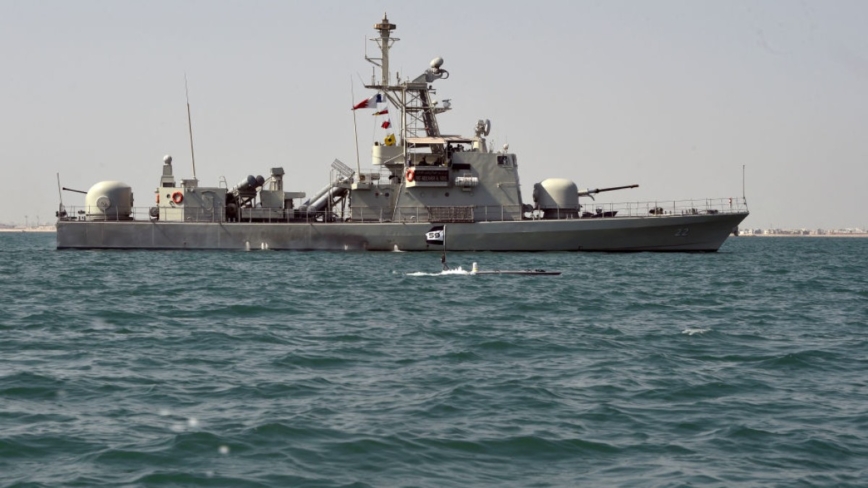
The United States is conducting mine clearance operations in the Strait of Hormuz.
The Wall Street Journal recently reported that the US military is using various unmanned vehicles and underwater robots to quickly clear mines that may be lurking on the seabed of this important waterway.
The report indicates that the US military deployed unmanned maritime systems. Among them, the General Dynamics Unmanned Surface Vessel (UDV), which began operation in 2023 by RTX, can tow a new floating sonar system called AQS-20 to scan the seabed, searching an area of approximately 100 feet (about 30 m wide) at a time.
In addition, battery-powered underwater drones produced by General Dynamics, including the MK18 Mod 2 "Kingfish" and "Knifefish", can also be deployed directly from small boats and search for mines along pre-set paths.
Military analysts stated that because parts of the Strait of Hormuz are relatively narrow, the U.S. military can complete initial searches in a shorter time. Once a target is locked, a second batch of underwater robots can be deployed to clear the mines using explosives or remote detonation.
Former U.S. Navy Vice Admiral Kevin Donegan, and former commander of the U.S. Fifth Fleet in the Gulf region, stated that using unmanned underwater vehicles, the survey of a small waterway can be completed in a few days, instead of taking weeks. He said that once a waterway is cleared, ships can resume passage, and then the navigation area can be gradually expanded.


No comments:
Post a Comment