Direct translations
Opposing Xi’s Re-election! University affiliated with the CCP’s United Front Work Department speaks out, calling for a nationwide resurgence of the “White Paper Movement”
Editor: Fang Xun / Source: The Epoch Times / https://www.aboluowang.com/2026/1115/2457876.html / Image : Following the CCP’s Fifth Plenary Session, reports have emerged online of university students calling for a new "White Paper Movement" to protest the absence of term limits for the President of the PRC. (Provided by the interviewee / Compiled by the reporter)

Following the Fifth Plenary Session of the 20th Central Committee of the Chinese Communist Party (CCP), reports have circulated online suggesting that students at Huaqiao University in mainland China are calling on university students nationwide to revive the "White Paper Movement"—a campaign to oppose the removal of term limits for the President of the PRC, advocate for democracy, and resist autocracy. An informed source has confirmed this to a reporter, though further verification of the details is still required.
University Students’ demands circulate online; Source: They call for a revival of the "White Paper Movement"
On 13 November 2026, images began circulating on overseas social media platforms showing students at Huaqiao University—with the university gate in the background—holding up blank sheets of paper (or "white papers") inscribed with messages. These messages call for the restoration of presidential term limits, the upholding of constitutional order, and the mobilization of university students across the country to oppose phenomena such as the cult of personality.
Even at Huaqiao University—an institution directly under the administration of the CCP’s United Front Work Department—students have begun to speak out.
Some have expressed a desire to see presidential term limits reinstated, putting their thoughts down on paper.
It is clear that young people are neither indifferent to politics nor lacking in their own capacity for judgment. They are simply asking: Why shouldn't there be term limits for the President? Why shouldn't there be boundaries on power?
A single sheet of white paper with a few handwritten lines may not be earth-shattering, yet it is enough to make certain people nervous.
While some online have questioned the authenticity of the photographs, Li Shangkai, a pro-democracy activist based in Australia, told a reporter on 14 November 2026 that several Huaqiao University students—taking advantage of the campus being empty during the holidays—held up white papers bearing their demands. They also wore white ribbons on their wrists as a form of silent protest. Li stated that he has been in contact with one of the participating students, identified by the pseudonym "Zhang Jun," and shared chat logs with the reporter as evidence.
Previously, on 26 October 2026—the day the CCP’s Fifth Plenary Session opened—an "open letter" allegedly co-signed by students from various Chinese universities circulated online overseas, demanding the abolition of the system that allows for indefinite presidential terms.
The open letter cites the oath taken by Sun Yat-sen upon assuming the office of Provisional President in 1912—in which he spoke of his eventual departure from the post—to emphasize the ideal that "the world belongs to the public" (*tianxia wei gong*). The letter lists 14 "participating universities," including Peking University, Renmin University of China, Tongji University, Xi'an Jiaotong University, Xiamen University and Nankai University, with a note stating that "more institutions are joining." However, no individual signatures or evidence of formal endorsement by these institutions were provided.
At the time, the reporter verified that the website where the post appeared, "Siyuan Lake BBS," was hosted on a server located in Seoul, South Korea via Tencent Cloud. The details surrounding the incident have yet to be independently verified.
Li Shangkai stated that Zhang Jun—a contact of his—mentioned seeing a joint appeal on the forum, originally initiated by students at Peking University. The appeal sparked discussions at Huaqiao University, drawing the attention of government-affiliated personnel who arrived on campus to monitor the students' activities—a development that has placed significant pressure on the student body. The students feel that they should not be subjected to such treatment by the government.
"By responding to this initiative from Peking University, we hope to reignite the 'White Paper Movement' and encourage university students across the country to stand up together—to write our demands on blank sheets of paper, tie white cloths around our arms, and take photos," Zhang Jun said during their conversation.
Huaqiao University, which has campuses in Quanzhou and Xiamen, Fujian Province, operates under the jurisdiction of the United Front Work Department of the CPC Central Committee. While the university has historically recruited ethnic Chinese students from Taiwan, Hong Kong, Macau and Southeast Asia, the vast majority of its student body consists of students from mainland China.
November 12 marks the 160th anniversary of the birth of Sun Yat-sen—an occasion for which the Chinese Communist Party has previously held high-profile commemorative events.
Li Shangkai noted that Zhang Jun expressed a firm resolve to participate in the movement. "We hope that on the anniversary of Sun Yat-sen’s birth, the Chinese people will awaken to the fact that we want democracy, not an authoritarian government. We hope our voices will be heard by the outside world, and we hope that university students nationwide will find the courage to stand up, articulate their demands, and tie on white cloths—all for the sake of a better China."
The details regarding students at Huaqiao University holding up blank sheets of paper to voice their demands remain subject to further verification.
Overseas Pro-Democracy Activist: Supporting the awakening of democratic consciousness among university students
Jie Lijian, a pro-democracy activist living in exile in the United States, told a reporter: "Huaqiao University is an institution heavily focused on ideological indoctrination—a school under the direct jurisdiction of the Chinese Communist Party’s (CCP) United Front Work Department. For students within such an educational system to choose to speak out and take a stand—whether by holding up signs or drafting a manifesto—involves significant risk. They are well aware of the potential consequences of their actions, yet they choose to proceed regardless."
"Why did they choose to take action on the anniversary of Sun Yat-sen’s birth? It is because they hope that the 'Three Principles of the People' will continue to spread in China, and that the dictatorial specter of communism will be overthrown sooner rather than later."
"Many young people in mainland China today are experiencing a powerful awakening. A growing number are 'scaling the Great Firewall' [bypassing internet censorship]. Since the pandemic, some universities have begun arbitrarily searching students' mobile phones—a move driven by the fear that students might access information from beyond the firewall and learn the truth about the various crimes committed by the CCP. This clearly demonstrates just how terrified the Communist Party is of young people and students waking up!" he said.
Residents in Guangxi resist with machetes; CCP officials compromise and sign a written guarantee
Editor: Fang Xun / Source: New Tang Dynasty Television (NTDTV) / https://www.aboluowang.com/2026/1117/2458640.html / Image : In November 2026, villagers in Baise City, Guangxi, used knives to resist a forced land seizure, surrounding representatives of the real estate developer. Local officials were ultimately compelled to sign a joint agreement with the developer, guaranteeing a halt to construction. (Video screenshot)
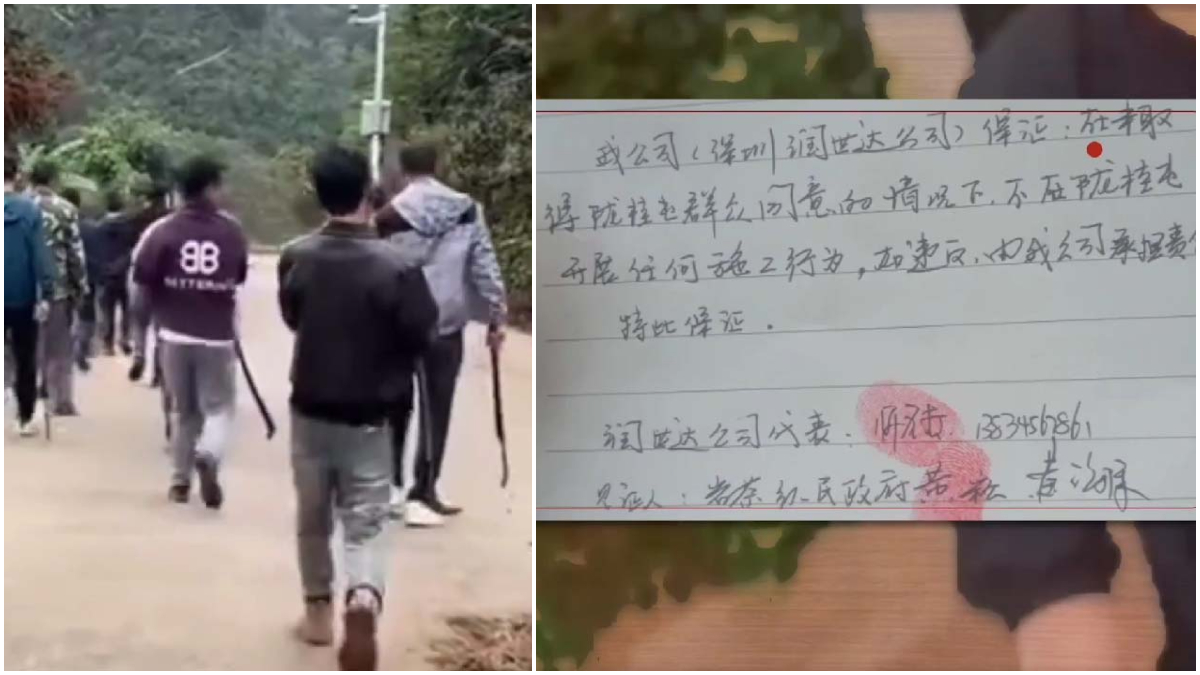
Chinese authorities frequently engage in the forced seizure of villagers' land for commercial purposes, but they recently encountered a setback in Baise, Guangxi. Local villagers, armed with knives, surrounded a construction site, ultimately forcing the developers to sign a written pledge to halt construction—a document that was also signed and endorsed by government officials.
"Yesterday" (昨天), a social media outlet that tracks mass incidents in mainland China, released several videos revealing that the local government and developers in Longgui Tun, Zhe'ai Village, Yancha Township—located in the Longlin Various Ethnicities Autonomous County, Baise City, Guangxi—had forcibly seized villagers' land to install wind turbines. On November 7, a group of villagers arrived at the site armed with machetes to block the construction, nearly triggering a violent, bloody confrontation.
In the end, the developers were only able to leave after signing a public pledge. The document commits the developers to refrain from any further construction activity without the villagers' consent, stipulating that they would bear the consequences should they fail to comply.
"Villagers in Guangxi use knives to stop forced land seizure; developers secure their release by signing a pledge (November 7, 2026)." On November 7, in Longgui Tun, Zhe'ai Village, Yancha Township, Longlin Various Ethnicities Autonomous County, Baise City, Guangxi, local authorities and developers forcibly occupied villagers' land to install wind turbines. Upon learning of this, villagers arrived at the site armed with knives to halt the work, narrowly avoiding a clash. Ultimately, the developers signed a public pledge—promising not to proceed with any construction without the villagers' consent—which allowed them to leave the scene.
— Yesterday (@YesterdayBigcat) November 11, 2026
The videos show several villagers, carrying knives, heading toward the construction site and surrounding an excavator. In subsequent footage, a representative for the developers is seen trapped inside a pavilion, with three uniformed local police officers standing behind him. Such projects, which involve forced land seizures, are typically introduced and approved by local governments; consequently, officials almost invariably side with the developers. Inside a pavilion, villagers angrily confronted a developer’s representative: "Is this your own private land, that you can just dig wherever you please? Do you think it’s that simple?" "Are you implying that you’re so powerful you can dig wherever you want—is that what you mean?"
According to the villagers, they demanded that the representative sign a written guarantee to halt construction; however, the representative evaded the request, claiming he had "no authority to sign such a guarantee on behalf of the company."
Subsequent footage shows the representative apparently unable to leave, prompting local officials to intervene. Ultimately, the representative signed the guarantee and pressed his red-inked thumbprint onto the document. A government official and the local police station chief were also compelled to sign as "witnesses" and guarantors—with the government official even adding his own thumbprint.
Netizens commented extensively, with remarks such as: "When the people no longer fear death, what use is there in threatening them with it?" "Only the brave can defend their own rights." "Those folks from Guangxi are truly fierce—no wonder this is the region that gave rise to the Taiping Army." "If there’s ever another 'Northern Expedition,' we’ll have to rely on the Guangxi faction again." Some netizens quipped, "How come the 'black-skins' (a derogatory term for CCP police) are so useless? Why did they cave in to the locals? Why didn't they just arrest all the protesters?" Others replied: "Are you suggesting that we people from Guangxi only know how to use our machetes to chop sugarcane?" "The 'black-skins' in Guangxi are actually quite well-behaved—looks like they’ve learned their lesson the hard way." "Are you kidding? The police might have some sway in the North or the West, but in places like the East China Plain, Guangxi, or Yunnan—where the local spirit is fierce—if things get out of hand, the central inspection team would take over the local administration the very next day. They might even have to mobilize the military region to come out and 'train' (i.e., suppress the resisting populace)."
Other netizens questioned whether the CCP authorities would actually honour their promises: "In the eyes of the Party-state, a written guarantee is worthless—just another 'historical document' that can be discarded whenever they feel like breaking their word." But a netizen from Guangxi retorted: "How many lives do they think they have? If you push us people from Guangxi too far, we’ll truly risk our lives to fight back!"
Wang Duran, a commentator for *Aboluowang* (Aboluowang.com), remarked: Wind power projects are "cash cows" for local governments, serving both as political achievements and sources of revenue. Since the government controls everything—from project approval and land requisition to the deployment of police—villagers typically have no recourse or place to seek justice. The fact that officials and the local police chief personally pressed their fingerprints onto a document shows that the "stability maintenance" apparatus fears nothing more than an entire village standing united, with the people having nothing left to lose. However, the CCP has a long history of "settling scores later" (retaliating after the dust has settled); the future safety of the villagers who led this resistance will be the real test.
Wang Duran stated bluntly: When a written guarantee can only be secured through the threat of machetes, the rule of law is effectively dead. Next time, it might not just be a single excavator being surrounded.


No comments:
Post a Comment