Direct translations
Ominous sign! COVID-19 resurges in China; Swarms of crows fill the sky in Hebei
Reporter : Luo Tingting / Editor: Wen Hui / https://www.ntdtv.com/gb/2026/10/13/a104141453.html / Image : On 12 October 2026, a massive gathering of crows appeared in Pingquan City, Chengde, Hebei Province, circling overhead in a dense, eerie black mass. (Composite of video screenshots)
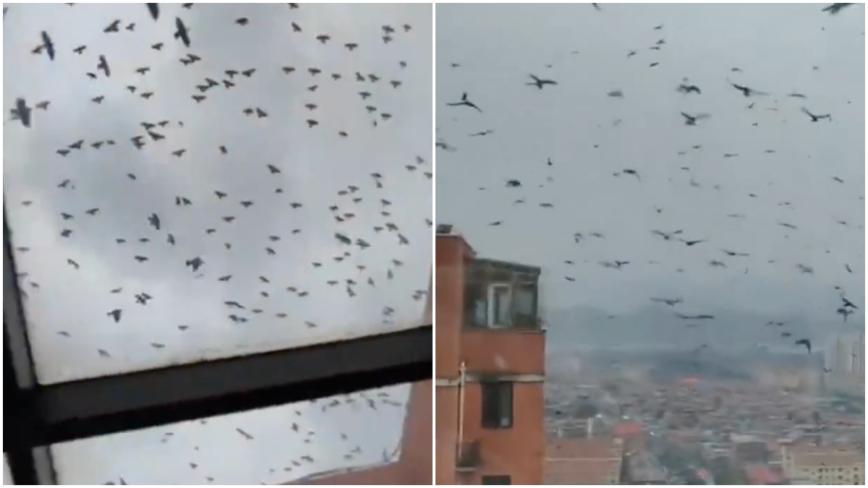
On 12 October 2026, a massive gathering of crows appeared in Pingquan City, Chengde, Hebei Province, circling and flying in the sky—a dense, eerie black mass. Chinese virologists have revealed that a large number of patients in the north have died suddenly after contracting the virus, and the number of severe cases in Hebei continues to rise.
A netizen posted a video filmed at Pingquan Square in Pingquan City showing the sky filled with circling crows; the flock was dense, creating a shocking scene as they swirled overhead in a black mass.
"It’s been going on for three minutes now. Wow, could there be ten thousand of them? There are so many—so many—and over there, too," the man filming said. The footage shows large numbers of crows circling in the distance as well; the entire sky is darkened by the birds, creating a somewhat eerie atmosphere.
COVID-19 resurges in China; on 12 October, swarms of crows filled the sky in Pingquan City, Hebei—a dense, eerie sight! https://t.co/tbtYvrT4MV
— ying tang (@yingtan04410735) October 13, 2026
In traditional Chinese culture, crows are considered symbols of bad luck, and their appearance in large numbers is often viewed as an ominous sign. Previously, during the major COVID-19 outbreak, videos circulated online showing dense flocks of crows circling over various locations—including Jingzhou, Hubei, and Harbin—sparking public alarm. A netizen commented on a video post: "In Jingzhou, Hubei, crows are stirring. As scavengers with an exceptionally keen sense of smell, they can detect the faint odour of decomposing bodies from great distances and flock to the source. Patients in critical condition emit a putrid stench—imperceptible to humans—before they pass away; the crows arrive, drawn by the scent, even before the person has died."
In Jingzhou, Hubei, crows are stirring. As scavengers with an exceptionally keen sense of smell, they can detect the faint odor of decomposing bodies from great distances and flock to the source. Patients in critical condition emit a putrid stench—imperceptible to humans—before they pass away; the crows arrive, drawn by the scent, even before the person has died. 😳 https://t.co/2YxyiDGFst
— 交织声 (@genderandlabor) January 28, 2020
Chinese Virologist : Surge in sudden deaths among infected patients
A massive gathering of crows in Pingquan, Hebei, has once again raised public alarm. According to official CCP reports, the COVID-19 epidemic has entered another peak period this autumn and winter.
In mid-September, a team from the Changping Laboratory, led by Peking University scholar Cao Yunlong, released a research report indicating that the COVID-19 variant PJ.2.1 exhibits significantly higher binding affinity to the ACE2 receptor compared to other strains circulating during the same period, such as NB.1.8.1, XFG, and BA.3.2.2.
A Chinese virologist, Mr. Wang (pseudonym), told an NTD reporter that the PJ.2.1 variant is the most transmissible to date: "It has already caused a large number of severe cases in the north, with the number of severe cases rising sharply."
Mr. Wang revealed that wastewater monitoring data from various locations across China shows that PJ.2.1 peaked in mid-August and has remained at high levels since—particularly in the north, where medical resources are concentrated on "sentinel hospitals" designated for key monitoring and prevention. Internal laboratory data indicates a surge in sudden deaths among infected patients. "Cases in Hebei and Shanxi have been steadily rising; a large number of severe cases are emerging at the Affiliated Hospital of Hebei University—including patients transferred there—making it a crucial sentinel site. Jilin and Liaoning also have such sentinel sites," Mr. Wang said. "Once infected, it triggers other new ailments. Currently, cardiac arrest ranks highest, alongside various types of infarctions—including cerebral issues and vascular problems—which are surging exponentially."
He further revealed that the research report on the PJ.2.1 variant caused sleepless nights for virologists and physicians alike; yet, the CCP authorities have consistently concealed the epidemic, official media outlets have been silenced, and those who attempted to release information faced suppression and censorship.
In July 2026, the Chinese Center for Disease Control and Prevention (China CDC) announced that the number of newly confirmed COVID-19 cases nationwide had reached 522,000—a 5.6-fold surge compared to June.
A staff member from the Hebei Provincial Health Commission disclosed to New Tang Dynasty (NTD) Television that the figure of 522,000 represents only those who sought medical treatment at hospitals; the actual number of infections is far higher, as people generally only go to the hospital when their bodies can no longer withstand the illness.
He stated that COVID-19 cases are currently skyrocketing, leading to a shortage of hospital beds and a high death toll; in many places, there are queues for cremation, yet officials forbid the release of this information.
The owner of a funeral service company in Dalian revealed that while the company previously handled seven or eight bodies a day, they have recently handled as many as 30 in a single day.
Sudden collapses seen again in China; Sudden deaths among young and middle-aged without warning on the rise
Reporters : Xiong Bin and Peng Xinyu / https://www.ntdtv.com/gb/2026/10/09/a104140482.html
During China’s "October 1st" Golden Week holiday, the epidemic spread rapidly, and incidents of tourists suddenly collapsing were observed at tourist attractions across the country. Funeral industry workers have revealed a recent increase in sudden, symptom-free deaths among people born in the 1980s and 1990s. Virologists have also warned that the risk of a fatal outcome rises with the number of infections, advising people to avoid overexertion and excessive exercise.
Videos circulating online show tourists suddenly collapsing at various scenic spots during the holiday. Mr. Wang, a resident of Hebei, recounted that the tour guide for his group urged everyone to rest frequently as soon as they boarded the bus, noting that cases of sudden collapse and death were becoming increasingly common.
Mr. Wang (Hebei resident): "At many scenic spots during the holiday, young people would often just suddenly collapse while walking. After contracting the virus, many people’s physical health deteriorated; even touring the sights could exceed their physical limits. The tour guide told us that if we felt tired, we should rest immediately and strictly avoid excessive exercise."
Ms. Mu, a funeral industry worker in Liaoning, stated that the majority of the deceased she has served recently were in their thirties or forties—individuals who appeared healthy but died suddenly without warning.
Ms. Mu (Liaoning funeral industry worker): "Recently—from the second half of last year through this year—there has been a surge in sudden deaths among young people born in the 80s and 90s; they are gone in an instant. We recently handled the case of a 38-year-old man who suffered a fatal heart attack with absolutely no prior symptoms; his family was inconsolable with grief at the funeral home."
Mr. Zhang, a Chinese virologist, revealed that research reports indicate an increasing number of people in China have been infected with COVID-19 three or more times this year—an estimated figure approaching half the population. The data shows that the risk of a fatal outcome increases with the frequency of infection, with cardiac and cardiovascular/cerebrovascular complications topping the list of causes. Exertion and physical exercise are high-risk factors that must be avoided.
Mr. Zhang, a Chinese virologist, stated: "COVID-19 sees annual peaks and has triggered complex, novel disease issues affecting various organs; however, the extent of the harm it causes is currently a forbidden topic. Data from the front lines shows that over 80% of young and middle-aged people are asymptomatic—for instance, a person might already be in advanced-stage heart failure yet show no symptoms."
Mr. Zhang also revealed that the data gathered from field research was shocking, yet authorities forbade its publication.
The research indicates that the physical damage sustained by severe cases is irreversible, and survival rates are low. The study further predicts that between 2026 and 2027, many people will quietly pass away; due to repeated infections, their T-cells (immune cells) will reach a critical point of exhaustion, resulting in a loss of immunity where even minor illnesses could easily prove fatal.
Mr. Zhang noted: "The findings show a higher death toll in rural areas compared to urban centers. Once a case becomes severe, recovery is difficult, and the survival rate within three months is very low; patients essentially pass away quietly, and their deaths are not attributed to COVID-19."
Details of Russian plague case unclear; Hong Kong and Chinese Provinces step up monitoring
Reporters : Lin Jiawei and Huang Yukai / Special Correspondent : Gu Xiaohua / https://www.ntdtv.com/gb/2026/10/13/a104141635.html
A young plague researcher in Russia recently passed away from an undetermined cause. Although Russian authorities claim there are no signs of an outbreak spreading, over a hundred people have been quarantined, triggering high alert in Europe and the United States. Hong Kong and parts of China have initiated border and flight monitoring, while some Chinese nationals in Russia have begun panic-buying face masks.
In Siberia, Russia, a female researcher died of severe pneumonia, leading to the quarantine of hundreds of people. Because she worked at a plague research facility prior to her death, speculation has arisen regarding whether the fatality was linked to a potential plague leak.
In response, warnings have been issued across multiple Chinese provinces and Hong Kong. The city of Manzhouli in Inner Mongolia highlights the ongoing risk of importing cases of pneumonia of unknown origin. Meanwhile, disease control authorities in Hunan and Guangdong have released information on plague prevention and public awareness. In Hong Kong, the Centre for Health Protection announced on 12 October 2026 that it would step up health monitoring for passengers on relevant flights from Russia—including temperature checks and requirements to declare travel history—and refer individuals with pneumonia symptoms to hospitals for examination. Given the Chinese Communist Party's history of concealing disease outbreaks, these measures have drawn significant attention.
The incident has also sparked a rush to buy face masks among Chinese nationals in Russia. Within China, some residents have begun stockpiling food and supplies.
Yang Ming, a man from Harbin, Heilongjiang, said: "I asked a friend who used to work in Irkutsk. Locals say it can be contained—or that it *has* been contained—but no one knows the actual situation. Whatever news or information pops up online... let me tell you, the medicines in the pharmacies sell out within a day or less."
Dr. Adalja, a U.S. public health expert, noted that while modern plague is easily treatable, the crucial step now is to clarify exactly which pathogen caused the researcher's death. He also expressed concern over whether Russia has revived the secret biological weapons program of the former Soviet Union.
Western nations and the World Health Organization have also called on Russia to provide comprehensive information to clarify the cause of death and to continue assessing potential public health risks.


No comments:
Post a Comment