Tuesday, October 1, 2024

This list of officials is getting longer and longer, and Xi has lost all his authority

Report by : Du Zheng / Editor : Zhongkang / Source: Shangbao / https://www.aboluowang.com/2024/1001/2109849.html
More and more CCP officials love to read banned books, and this trend has been discovered in the official bulletins frequently released.

Throughout history, there have been countless banned books, and the reasons for banning them seem to be only two: politics and sex. However, under the CCP, which is dominated by politics, the books on the list of banned books by the party and the state seem to be mainly political and religious books.

The ancients said, "Read banned books behind closed doors on snowy nights." Banned books are best read on snowy nights because there are very few visitors on snowy nights, which is not only relatively safe, but also ensures the continuity of reading.

A friend who just came out of China told me that CCP officials now also love to read banned books late at night. Most of them have not been discovered for a long time, and occasionally they will share them with others, but once there is mutual infighting in the officialdom, it may become a serious crime. "Political disloyalty is the first problem, and corruption is something that everyone has, but it is not the main one."

The list of officials who read banned books is getting longer and longer

In the past two years, the storm of investigating the purchase and reading of "books and periodicals with serious political problems and audio-visual products" by senior officials within the CCP has intensified.

It was observed that at the end of Xi Jinping's first term, when Wang Qishan was in charge of the Central Commission for Discipline Inspection, he began to propose that anti-corruption is political supervision. After Xi Jinping was re-elected after the constitutional amendment in 2018 and Zhao Leji took charge of the Central Commission for Discipline Inspection, the authorities carried out political inspections, and official reports on officials who were dismissed for privately bringing "reactionary books and periodicals" into the country, and privately storing and reading "foreign books and periodicals with serious political problems" and other similar terms began to appear. By the 20th National Congress in 2022, when Xi Jinping was re-elected for the third time and Xi's confidant Li Xi took charge of the Central Commission for Discipline Inspection, related reports "exploded".

The latest example was on 23 September 2024, when the Gansu Provincial Commission for Discipline Inspection and Supervision of the Communist Party of China reported that a case had been filed for investigation against Wang Huanxiang, the former counselor of the Gansu Provincial Government, saying that Wang Huanxiang was "actually a greedy and corrupt person" and that Wang Huanxiang "privately brought banned books into the country and read them for a long time."

The author can find that there are nearly 30 officials who have been accused of bringing banned books into the country, reading or disseminating them in recent years. Here are only a few of the higher-ranking ones:

Wang Xiaoguang, former vice governor of Guizhou Province; Lin Gang, former vice mayor of Guiyang City, Guizhou Province; Zhang Zulin, former vice governor of Yunnan Province; Liu Liange, former party secretary and chairman of Bank of China; Zhou Qingyu, former party committee member and vice president of China Development Bank; Zhu Congjiu, former vice governor of Zhejiang Province; Zhang Guilin, former director of Beijing State-owned Assets Supervision and Administration Commission; Xu Shiping, former president and editor-in-chief of Haidongfang.com; ...

There used to be privileges to read banned books within the system

For decades after the founding of the Communist Party of China, senior officials have always had the privilege of obtaining more information. The Propaganda Department of the Communist Party of China published "gray books" in the early days and set up a special office for the compilation of foreign political and academic books. For example, the works of Bernstein, Kautsky, Trotsky and others who were considered "reactionary" were still available to some people under strict control.

The top leaders of the Communist Party of China even have the privilege of watching banned films. In the 1980s, there were always movie watching activities during vacations in Beidaihe. Taiwan's Central News Agency once reported that some films that are not suitable for public screening or have not passed the review will also be arranged to be included in the Beidaihe viewing list. This includes the 2012 French erotic film "Dans la maison" which cannot be released in mainland China.

Of course, banned films are another topic. Here we are mainly talking about political banned books.

According to the rules of the CCP, current case handlers still have to read the contents of these banned books. Therefore, the authorities require such people to be extremely politically loyal. In fact, the main thing is to be loyal to the party leader.

What are the current political banned books of the CCP?

Regarding what are "foreign books and publications with serious political problems", the official media once explained that they involve "discrediting the image of the party and the country, or slandering and defaming the leaders of the party and the country, or distorting the party history and military history".

Specifically, the so-called banned books in the CCP's view refer to those involving the June 4th Incident and the Hong Kong Incident, including the suppression of various groups, as well as exposing the private lives of CCP senior officials and the overseas assets of CCP officials, as well as insider books and publications on the power struggles within the CCP senior officials.

Hong Kong used to be a "paradise of banned Chinese books", and upstairs bookstores in downtown areas were once places where books could be freely purchased. In the old Hong Kong airport bookstore, the "best seller" shelves were filled with banned Chinese books, which became souvenirs that many mainland tourists must buy before leaving Hong Kong.

However, after the implementation of the Hong Kong version of the National Security Law in 2020, Hong Kong's freedom of the press and freedom of publication were unprecedentedly suppressed by the government and self-censorship, and officially entered the dark age. Printers, publishers, and distributors are silent about politically sensitive books. The trend of mainlanders buying banned books when traveling to Hong Kong has dissipated.

The free Chinese publishing world has now only moved to Taiwan. But in fact, the CCP has never been able to completely block the underground channels into mainland China, especially for privileged officials.

Details of reading banned books in the CCP officialdom

Officials secretly reading political banned books was more popular more than 20 years ago, just when the banned book market in Hong Kong was booming. In the late 1990s, the author was a young cadre in a county government. At that time, a middle-level leading cadre "Brother Chen" and I trusted each other. He was a witness of the June 4th Incident. He was known as a reformist official in the local area and had room for promotion, but he was also a corrupt official. There were some unfavorable news about him in the local area, but his brother was in the province, so no one could touch him.

"Brother Chen" often cursed the Communist Party in private, such as those rigid ideological policies, and had to deal with them when the documents were issued. Later, I left the system and kept in touch with him. He dared to read the banned books I brought back from Hong Kong, including the history of the "Cultural Revolution" and the truth of the June 4th Massacre. He also collected a copy of "Nine Commentaries on the Communist Party".

Although many people read banned books 20 years ago, the official said publicly that officials knew it tacitly. It was only in the Xi era that such "problems" were publicly reported, which also shows that the authorities believed that "the problem was serious."

Zhang Guilin, the former director of the Beijing State-owned Assets Supervision and Administration Commission, who was dismissed from public office in June 2023, was reported for a crime of "privately possessing and reading books and periodicals with serious political problems", and it ranked first among all the problems.

An insider revealed that what caused Zhang Guilin's trouble this time were the books published in Hong Kong by Bao Tong's son Bao Pu, and the New Era Weekly was also seized. It is said that there were people in Beijing who specialized in underground books at that time, which were shipped in from Hong Kong and unpacked.

A cultural friend who had just come out of China once revealed to the author that among the officials he knew, there were those who read banned books, but they were most afraid that their colleagues would know.

The trend of informing is prevalent within the CCP. This trend is not new. Before and after the founding of the CCP, there was constant mutual reporting in internal struggles. The peak was during the Cultural Revolution, when fathers and sons, and husbands and wives could report each other. The anti-corruption campaign in the Xi era, especially after the so-called "political physical examination", has made the environment faced by officials more complicated. In order to get promoted, officials can do everything they can to pull others down, which makes secretly reading banned books a very dangerous thing.

However, people want to know the truth in order to avoid risks. This ultimate safety is more important, so many people have taken the risk of secretly bringing banned books into the country from overseas in recent years, and there are so many officials who have been found out, which is evident.

Reading banned books and "making irresponsible comments on the central government" both worry the Zhongnanhai

The high-ranking officials who are listed for reading banned books are often also charged with "making irresponsible comments on the central government", which also frequently occurs.

Zhang Junlai, former party secretary and chairman of the Changsha Industrial Investment Group in Hunan Province, was directly charged with the primary crime of bringing books and periodicals that slandered and defamed the leaders of the Communist Party of China into the country without permission.

Former Zhejiang Vice Governor Zhu Congjiu and former Bank of China President Liu Liange and other high-ranking officials read banned books involving so-called "serious political issues", and the primary one must also be "vilifying the image of the party and the country, or slandering and defaming the leaders of the party and the country", etc., mainly targeting Xi himself.

Recently, all the senior officials of the Institute of Economics of the Chinese Academy of Social Sciences were replaced, and the reason was said to be implicated by the deputy director Zhu Hengpeng's "making irresponsible comments on the central government". The Wall Street Journal revealed that Zhu Hengpeng had been detained and removed from his post for criticizing Xi Jinping's management of the domestic economy in a private WeChat chat group. Zhu Hengpeng's remarks included comments on the weakness of the Chinese economy and implicit criticisms of Xi Jinping's "personal life and death".

We do not know whether Zhu Hengpeng has read the banned books about Xi, but people with clear minds will probably accept reading such banned books and accessing real overseas information by climbing over the firewall.

If political banned books are subdivided, there are two categories: anti-communist and anti-Xi. If they involve other leaders, they can also be classified as anti-communist, but those involving Xi Jinping may be more valued by the authorities.

Multiple sources said that criticizing Xi is more likely to anger the authorities than opposing the CCP. Perhaps because the CCP has been infamous for a hundred years and is approaching its end, Xi Jinping wants to protect the party and control the entire party. He is more afraid that if he can't even protect himself, the CCP will be gone.

A mainland media friend who is familiar with the CCP official circle revealed that local officials, including ordinary civil servants, are still "lying flat" regardless of the central government's repeated orders. They still like to go to dinner parties most on a daily basis, but they are more careful and afraid of being recorded when they talk. At various dinner parties, whenever people talk about ridiculous or irritating people or things, or even express dissatisfaction with their superiors, they will vent their anger on Xi, just using some of Xi's code names, and then causing laughter.

During the three-year epidemic, Xi Jinping's dynamic zero-clearing policy destroyed the little popularity he had accumulated in the past few years by fighting corruption and catching corrupt officials, but people are increasingly finding that this selective anti-corruption is just to protect his power. In recent years, the economy has been bad, and there is resentment in society. The CCP relies on high pressure to maintain stability and strong blockades, but the paper can't cover the fire after all.

After Xi Jinping came to power at the end of 2012, he immediately created a crime of "making irresponsible remarks about the central government" in the officialdom, which seemed to be well prepared. Perhaps he expected that one day "making irresponsible remarks about the central government" would become a trend and spread from the officialdom to society, which means that he would lose all his authority. The disappearance of the authority of the CCP leader is actually accompanied by the end of the CCP's luck.

From the recent waves of social backlash against the CCP's policies, including the online certificate system, housing pensions, and delayed retirement, it can be seen that no matter what the CCP does or says now, it will not be truly believed. People are temporarily helpless and lying down, but the buried time bombs can be detonated at any time by emergencies!

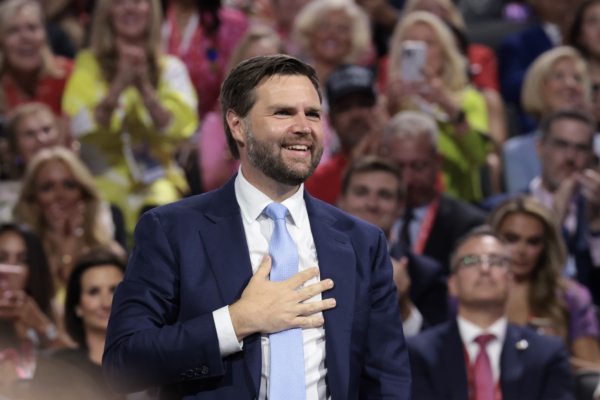


What Vance had to say about the economy, war, China and more

Research, editing : Gan Yung Chyan, KUCINTA SETIA / Reporter : Cheng Wen  / Editor : Ren Zijun / https://www.epochtimes.com/b5/24/9/30/n14341538.htm / Image : On 15 July 2024, Trump announced that his vice presidential partner would be 39-year-old Ohio U.S. Senator J.D. Vance. (Win McNamee/Getty Images)

萬斯就經濟、戰爭、中國等議題說過什麼話

The vice presidential candidates of both parties in the United States have held the only vice presidential debate in the 2024 election cycle on 1 October 2024. The Republican candidate J.D. Vance has made his first official appearance in front of national voters. This article takes a look at what comments Vance has made in the past period on issues such as the U.S. economy, overseas wars, military strength, tariffs, fentanyl, China, Taiwan, big technology companies, and artificial intelligence (AI). From them a glimpse into the style and stance Vance might have taken on in the debate.

Since in mid-July this year, former U.S. President Trump announced Vance—a new U.S. senator born in the 1980s who only turned 40 in August—as his vice presidential running mate. Vance's autobiographical memoir "Hillbilly Elegy" published in 2017 began to go viral in China. A report in Bloomberg said: "Vance's nomination resonates with many Chinese, because the country has about 300 million 'hillbillies'. ... President Xi Jinping's emphasis on high-end manufacturing is leaving them behind."

The rapid rise of American "hillbilly" Vance shows a typical "American dream", which is likely to help Trump win the attention and support of many young American voters. Trump's choice of Vance also seems to have the effect of "killing multiple birds with one stone."

To some extent, if elected, Vance will be an important spokesperson and executor of Trump’s policies and programs during his second presidential term, and even the successor to Trump’s policies in the future post-Trump era. 

Vance, who holds a doctorate in law from Yale University, explained matters more clearly and clearly. Let's take a look at what Vance said on some of Trump's key issues.

A strong economy equals strength
Vance believes that a country's strong economy is equivalent to its strong power. He hopes that the United States will become "strong" economically, militarily and culturally.

How to make the United States "strong" again? Vance believed this required re-industrialization within the United States.

On 19 May 2024, Vance said on CBS’s “Face the Nation”:

"Look, the reason Europe is weak is because they have 'deindustrialised'. Why have they deindustrialised? Because they are pursuing a green energy agenda under the Biden administration - which will certainly empower China and Russia.

Vance said that "reindustrialization" will bring much-needed innovation to the United States, saying:

“One of the things I hope we do is to broaden our horizons and think not just about innovation in software, but also innovation in transportation and logistics, innovation in energy — everything.”

“We have this idea that we can separate the making of things from the design of things. … But if you want to build a high-tech, high-dynamic growth economy, you have to have some local manufacturing and some self-reliance. "


Military strength is the result of industrial strength
Vance believed that the U.S. civilian sector industrial base was indispensable to the production of war materials during World War II, suggesting that the strength of a country's military power was the result of the strength of its industrial power.

He said in a June 19 op-ed in The New York Times:

"The most important lesson of World War II is that...military power is downstream of industrial power. At present, we are still the world's military superpower, mainly because of our industrial power in the 1980s and 1990s. But China is now A country that is industrially stronger than us means that in 20 years they will have a stronger military."

Use tariffs to help bring manufacturing back to the United States
Vance supports Trump's broad tariff policy, which he believes will help bring manufacturing back to the United States in the long run. When CBS host Margaret Brennan pointed out on "Face the Nation" on May 19 that tariffs are by definition inflationary, Vance responded:

"I don't necessarily believe the premise of that statement. If you impose tariffs, which is what it is, you're saying we're going to punish you for using slave labor in China and importing these things into the United States. Over time, that punishment It will help insource industry, which is not only in the interest of national security, but will also lower prices for Americans in the long run.”

Vance said he does not like that "China has stolen a lot of American jobs."

Industrial subsidies should be given to American workers, not to China
In September 2023, Vance introduced the "Drive America Act" in the Senate, which would replace electric vehicle subsidies with fuel vehicle subsidies. He said:

"If we subsidize anything, it should be for Ohio workers, not for 'green energy daydreams' outsourcing jobs to China."

Vance also supports the Biden administration's push for the CHIPS and Science Act, which received bipartisan approval from Congress in August 2022 and is worth $280 billion to promote domestic semiconductor research and manufacturing in the United States. , and the reshoring of key industries. Both parties agree that this is a national security imperative for the United States. Vance praised the bill saying:

"This is great legislation and the policy we need to break our dependence on China."

Also scrutinize U.S. investments in China
In addition to scrutinizing Chinese investments in the United States, Vance also seeks to scrutinize U.S. investments in China. In an interview with the American Conservative website on March 15, 2023, when discussing foreign policy, Vance talked about the harm of Sino-US joint ventures to US sovereignty:

"(Sino-US) joint ventures usually take the form of American Company China controls it. We should basically try to prevent such arrangements altogether.”

“[U.S. business executives might say] ‘If the cost of opening these markets to our commerce is a little bit of theft along the way, then that makes economic sense.’ For the United States as a sovereign nation, that simply doesn’t make sense. It just doesn’t make sense.”

Stop fentanyl, don’t be afraid of a trade war with China
On "Face the Nation," Vance was asked by Margaret Brennan how he would "exercise appropriate influence on Chinese and Mexican drug cartels" to prevent them from exporting fentanyl to the United States. Si replied:

"Well, I think you go to Beijing and you talk to Xi Jinping and you say to him, 'Your whole economy is going to collapse unless you can get into the U.S. market. You need to take this fentanyl issue seriously, or we're going to "You impose harsh tariffs and financial penalties because you don't obey our laws and help us stop the flow of this deadly poison."

Brennan asked Vance again: "Aren't you worried about the impact on the U.S. economy?"

Vance replied:

"I think we have a strong economy, we have the best workers in the world. If we need to fight a trade war with China, we will fight it, and we will win."

The fentanyl crisis is a personal issue for Vance, who told The American Conservative:

"China manufactures fentanyl and ships it into our country, where it will destroy American communities, jobs and families."

The primary concern is to prevent China from invading Taiwan
The issue that Vance is most concerned about and worried about—more important than any economic goals, global warming, or the Iranian nuclear issue—is the emergency in the Taiwan Strait, because it will directly affect the national security and economic security of the United States. On April 27, 2023, Vance said in a speech at the Heritage Foundation:

"What we need to prevent most - more than anything - is a Chinese invasion of Taiwan. That would be catastrophic for us as a country. It would destroy our entire economy, the computer chips in them - many of which are in Taiwan Made...this will plunge our country into a Great Depression.”

We hope to end the Russia-Ukraine war immediately. The United States needs sufficient strength to confront the CCP
In a New York Times op-ed, Vance said he wanted to end the Russia-Ukraine war immediately, "freeze the territorial line closer to where it is now" and provide "some long-term U.S. security assistance." This is not done because Vance hates Ukraine or likes Russia, but because he is a realist who believes:

"China poses the greatest threat to the United States." "Today, the degree of 'deindustrialization' in the United States is too severe to support a strong military to simultaneously confront Russia and deter China."

He said at the Heritage Foundation:

"Now, you know (President) Joe Biden is not going to send weapons to Taiwan - the weapons that we promised the Taiwanese - because we are sending those weapons to Ukraine or elsewhere. Does that make sense?"

“It is difficult for many of us to accept that the ‘Arsenal of Democracy’ in World War II (referring to the United States) now makes only one-twentieth of the artillery shells made by Russia. But this is reality. "

In a New York Times column, Vance said:

"These weapons (referring to the "Patriot missile system") are not only needed by Ukraine. If China sets its sights on Taiwan, the Patriot missile system is critical to Taiwan's defense. In fact, the United States has pledged to provide Taiwan with nearly $900 million worth of of Patriot missiles, but delivery of these weapons and other vital resources has been severely delayed, in part due to shortages caused by the war in Ukraine."

On 28 April 2024, Vance said in an interview with Fox News:

"The United States is stretched thin. We don't have the industrial capacity to support a war in Ukraine, a war in Israel, and possibly another war in East Asia if China invades Taiwan, so the United States has to pick and choose. ..."

"You have to ask yourself, will China be more dissuaded because we are beating our chests and acting tough in Europe? Or will it be more dissuaded because we have the necessary weapons to stop them from invading Taiwan?"

“My argument is that China is focused on real strength. They’re not focused on how tough people are saying on TV or how strong our purported resolve is. They’re focused on how strong we actually are — for Strong enough to fight back against China, we have to focus on that now, we are stretched thin.”

On 17 March 2023, after Xi Jinping and Russian President Vladimir Putin had just signed a declaration that China-Russia relations had entered a "new era," Vance expressed his opinion on the X (formerly Twitter) platform:

"I've heard many people say that the goal of our Ukraine policy is to show China that we are 'tough' and will not be easily pushed around. The Chinese obviously don't care about this."

These remarks indicate that Vance hopes to reduce military assistance to Ukraine to increase the United States' deterrent and deterrent capabilities against the Chinese Communist Party in a possible conflict across the Taiwan Strait. If the Russia-Ukraine war continues, it will be difficult for the United States to completely shift its military focus to Asia.

For die-hard realists like Vance, the West's "determination" or "solidarity" with Ukraine does not have much practical significance in deterring China from invading Taiwan unless there are enough "missile systems, artillery systems and bullets." as a back-up. Therefore, Vance believes that the United States and its allies are not ready to prepare or fight against the CCP.

Will the United States send troops to help defend Taiwan?
If China really invades Taiwan with force, will Vance hope that the United States will send troops to help defend Taiwan?

Vance never explicitly confirmed what practical actions the Trump administration would take in response. President Biden has made it clear at least four times that the United States will send troops to protect Taiwan, but he has also caused controversy for being too straightforward.

In a New York Times op-ed, Vance responded diplomatically: "The honest answer is, we'll figure out what we're going to do if they attack."

Last year, Vance said in an interview with the American Conservative website:

"Look, we may eventually be forced into a war with China. But if we do, God forbid, we need to be more economically self-sufficient."

At the Republican National Convention (RNC) on July 17 this year, Vance said in his speech accepting the nomination for vice president:

"We will send our children to war only if we must. But as President Trump has shown in taking down ISIS and more, when we punch, we punch hard. Attack."

Support open source AI and break up Google
Mainstream media has struggled to understand Vance’s policies on artificial intelligence (AI) and Big Tech.

On the one hand, Vance hopes for "looseer regulation"; on the other hand, he "openly supports open source AI." At a Senate hearing on 11 July 2024, four days before Trump announced Vance as his vice presidential candidate, Vance raised a question:

"A lot of times, it's CEOs — especially CEOs of big tech companies that I think already have a strong position in AI — who will come and talk about the dire security dangers of this new technology and how Congress needs to act as quickly as possible. Act and regulate. I can't help but worry that if we do something under the duress of these incumbents (the dominant corporations), it will benefit these incumbents and not the American consumer."

Vance believes that the regulations promoted by big technology companies with AI advantages will actually only consolidate their own existing advantages and be detrimental to competition.

At the same time, Vance "called for Google to be broken up" and "urged more investment in American (tech) companies to help them compete with China."

Ishiba Shigeru as Japanese PM; Is the clarion call for the CCP to invade Taiwan sounded?

 Direct translation / Host : Tang Hao, Crossroads of the World / Image : Web Screenshot / https://www.epochtimes.com/b5/24/10/1/n14342112.htm


October 1st marks the 75th anniversary of the founding of the Communist Party of China, and is also the first day that Japan’s new Prime Minister Shigeru Ishiba took office. However, Ishiba’s stance on the CCP has been relatively mild in the past. He twice said that the CCP poses “zero threat” to Japan, which triggered concerns from the outside world: Will Shigeru Ishiba change Japan's cross-strait policy after taking office? Coincidentally, after Shigeru Ishiba was elected, the CCP launched public opinion wars, legal wars and missile threats against Taiwan. Does the CCP really think that Japan’s change of prime minister is a good time for them to invade Taiwan? Will Shigeru Ishiba turn pro-CCP? If something happens to Taiwan, will Ishiba Shigeru's cabinet abandon Taiwan?

1 Japan’s new Prime Minister Shigeru Ishiba took office on 1 October 2024. Will the balance of relations between the United States, China, Japan and Taiwan tilt towards the CCP? In the past two days, the leader of the Communist Party of China and the Minister of Foreign Affairs suddenly claimed in a high-profile manner that "no one can stop" the reunification of Taiwan. Is the CCP really preparing to accelerate its invasion of Taiwan in 2025? Today, we are going to talk to you about this topic.

As Ishiba Shigeru takes over Japanese Prime Minister, is the clarion call for the CCP to invade Taiwan sounded?

On 27 September 2024, Shigeru Ishiba was officially elected as the new president of the Liberal Democratic Party of Japan, which is equivalent to ascending to the throne of Japan's prime minister. Although Shigeru Ishiba was Japan's Defense Minister, he once said in 2000 and 2014 that the CCP poses "zero threat" to Japan.

In addition, his most respected political mentor is former Japanese Prime Minister Kakuei Tanaka. Tanaka is a very famous pro-communist figure, so the outside world is also very worried about whether Japan's diplomatic line will change from the current "pro-communist" after Shigeru Ishiba becomes prime minister. "Beauty in the distance", gradually turning to "beautiful in the distance" or "beautiful in the distance"? Especially when something happens to Taiwan, will Japan still step in to provide support?

The day after Shigeru Ishiba was elected, Chinese Communist Party Foreign Minister Wang Yi unilaterally claimed at the United Nations General Assembly that United Nations Resolution 2758, the Cairo Declaration, and the Potsdam Declaration had clearly returned Taiwan and Penghu, which were stolen by Japan, to the People's Republic of China. Simply put, Taiwan It is the territory of China.

Did you see that? The Chinese Communist Party has introduced their "three-piece package to unify Taiwan" again, which is the United Nations Resolution 2758, the Cairo Declaration, and the Potsdam Declaration. What's in this three-piece set? What are the absurdities and fallacies in the CCP’s reference to this three-piece package? We have already analyzed it in the past, so we won’t repeat it here. You can look for past programs to watch.

However, Taiwan's Ministry of Foreign Affairs issued a stern response the next day. They said that only the government elected by the Taiwanese people can represent Taiwan, and asked the CCP to stop misleading the international public. They criticized the CCP's move to use this three-piece package to create legal grounds for future military invasion of Taiwan. Base.

Some people may think that Taiwan's Ministry of Foreign Affairs seems to be making a fuss out of a molehill? In fact, no. On the same day, the Chinese Communist Party’s Rocket Force and Army conducted missile shooting drills in Inner Mongolia, Gansu, Qinghai, Xinjiang and other places, and the Taiwan military also monitored them. The next day, September 30, Xi Jinping declared at a reception marking the 75th anniversary of the founding of the Communist Party of China that "Taiwan is China's sacred territory" and that "no one can stop" the complete reunification of the motherland.

Well, after reading the series of news, we can’t help but ask: Why did the CCP deliberately choose the time when the United Nations General Assembly and Shigeru Ishiba was elected as the new prime minister to openly use legal warfare, public opinion warfare and missiles to intimidate Taiwan? Is the CCP really eager to take advantage of the "2025 window" brought about by the US election to seize Taiwan, as we said last time? Or do they really think that Shigeru Ishiba will support CCP China and leave the United States and let the CCP get whatever it wants?

Shigeru Ishiba’s foreign policy views

So what is Ishiba’s attitude towards the United States, the Chinese Communist Party, and Taiwan? Let’s see what he said. Recently, Shigeru Ishiba shared his foreign policy views with the American think tank Hades Institute. There are several main points:

1. Establishing an “Asian Version of NATO”

First, Shigeru Ishiba advocates the establishment of an "Asian version of NATO". He said, "Today's Ukraine is tomorrow's Asia." It just changed from Russia's invasion of Ukraine to the CCP's invasion of Taiwan. However, Asia currently lacks a collective defense organization like NATO. Once a war breaks out in Asia, countries will not have the responsibility to defend each other. Therefore, he believes that establishing an Asian version of NATO with Western allies is the most important means to deter the CCP.

2. The Asian version of NATO will deploy nuclear weapons

Second, the Asian version of NATO will deploy nuclear weapons. Ishiba believes that Russia and North Korea have established a military alliance, and nuclear weapons technology may be being transferred to North Korea. If the Chinese Communist Party’s nuclear weapons also join, the United States’ current Asia-Pacific deterrence strategy will be limited, so nuclear weapons must be deployed to counter it.

3. In the Japan-U.S. security alliance, Japan will become an “equal partner”

Third, the security alliance between Japan and the United States must become "equal partners." Shigeru Ishiba said that the current Japan-US security treaty obliges the United States to protect Japan and Japan is obliged to provide bases to the United States. However, he hopes that Japan can cooperate with the United States on a reciprocal basis as a normal country and also allow the Japanese Self-Defense Forces to station in Guam.

Well, judging from Shigeru Ishiba's arguments, we can probably find a few things: First, he, like Abe and Fumio Kishida, is a leader who wants to lead Japan out of the pacifist constitution and towards a normalized country. He also further hopes that Japan can cooperate with the United States with an equal international status, rather than "singing beautiful songs and following Japan" and being a follower. Whether the United States can agree to this is one thing, but it at least reflects that as the new prime minister, he does need to talk about some more structured and ambitious ideals.

Secondly, he is very clear that the biggest threat to Japan and all of Asia is the Chinese Communist Party, along with Russia and North Korea. Therefore, he called for the establishment of an "Asian version of NATO" to gather the power of various medium-sized countries in Asia to deter the joint threat of China and Russia, the two military powers. Especially in the past month or so, the Chinese Communist Party and Russian military aircraft have successively broken into Japanese airspace, posing an immediate threat to Japan; and Chinese Communist ships have also continued to enter the waters of the Diaoyu Islands. Therefore, Ishiba Shigeru’s major threat to national sovereignty is the Chinese Communist Party.

Also, Shigeru Ishiba knew the importance and danger of Taiwan, but he did not want to close the possibility of dialogue with the CCP. Therefore, he did not explicitly say whether he would support Taiwan or whether he would help defend Taiwan. However, he called for the formation of an Asian version of NATO to deter the CCP from invading Taiwan.

However, it is very difficult to establish an Asian version of NATO, and when he visited Taiwan in August this year, he was very cautious in his remarks about Taiwan. When he was asked by the media, if a war broke out across the Taiwan Strait, would Japan help defend Taiwan? His answer turned out to be "It's not convenient to answer here." Ishiba was also criticized for being "afraid of offending the CCP" and "sending a wrong signal to the CCP's crimes against Taiwan."

Well, after reading this, we can find that Shigeru Ishiba is a politician with "Japanese core values". This is beyond reproach. As for whether he will help defend Taiwan? Will it turn pro-communist? Let me make a conclusion first: to defend Japan, we must first defend Taiwan. Ishiba can only actively or passively support Taiwan, or even help defend Taiwan. Why?

Five major factors: To defend Japan, we must first defend Taiwan
We have just mentioned that if you want to defend Japan, you must first defend Taiwan. There are several important internal and external factors that will make Ishiba Shigeru continue to be "pro-American and friendly to Taiwan" and will make it difficult for him to switch to "pro-China and separation from the United States". on the road to:

Reason 1: If Taiwan falls, Japan will become a hostage or puppet

The first reason is that if something happens to Taiwan, something will happen to Japan. Once Taiwan falls, Japan will become a hostage or puppet of the CCP. As we all know, Japan relies on imports for a large amount of oil and raw materials, and these goods must be transported through the Taiwan Strait. If the CCP controls Taiwan, it will definitely turn the Taiwan Strait into an inland sea and use its navy to block the right of passage in the Taiwan Strait and surrounding waters. This threatens Japan to cooperate with the CCP.

At that time, Japan will be in a dilemma of running out of food, oil, and goods, and will have to become a hostage of the CCP.

Reason 2: If Taiwan is lost, Okinawa will be lost

Second, if Taiwan is lost, Okinawa will be lost. As we all know, the CCP has been wooing Okinawa for many years. It not only sends a large number of tourists to Okinawa to fight for the economy, but also welcomes the governor of Okinawa to visit China in a high-profile manner. Chinese netizens also clamored that "Ryukyu should be independent." Furthermore, last year, Xi Jinping deliberately talked about the historical relationship between China and Ryukyu in a high-profile manner, saying that Ryukyu used to be a vassal state of China. These measures are actually the CCP's deliberate incitement to "Okinawa independence." Why?

On the one hand, the CCP wants to use "Okinawa independence" to hold Japan back, so that Japan does not dare to support Taiwan too much against the CCP; on the other hand, the CCP is preparing to incite Ryukyu independence after seizing Taiwan, and even join the CCP's protective circle so that the CCP can completely control the Miyako Strait from the Pacific to Northeast Asia, monopolize control of Northeast Asia, and allow the CCP to develop from a land power to a sea power.

Reason 3: The U.S.-Japan alliance remains unchanged and the U.S. resistance to communism remains unchanged

Third, the U.S.-Japan alliance will not change, the U.S.’s confrontation with the CCP will not change, and Japan cannot change either. Japan's armed forces are not enough to fight against the three rogue countries of China, Russia and North Korea, so it must need the security umbrella of the United States. However, no matter whether Harris is elected or Trump is elected next, the general direction of the United States in confronting the CCP politically, economically, and militarily will not change. Therefore, Japan must also actively or passively "pro-US and far away".

Of course, facing a "negotiable" leader like Shigeru Ishiba, the CCP is likely to use the rhetoric of "you want strategic independence" to coax Japan not to follow the United States. Last year, Xi Jinping used this trick to convince French President Macron to be fooled. Later, Macron was surrounded and suppressed by European countries, saying that he was "isolating himself" and "weakening Europe." I believe Ishiba will also remember this lesson.

Reason 4: Japanese public opinion is highly anti-communist and the Prime Minister cannot disobey them

The fourth reason is that Japanese public opinion is highly anti-communist and the prime minister cannot disobey the people. According to a poll conducted by the "Yomiuri Shimbun" this year, as many as 92% of Japanese people believe that the CCP is a security threat to Japan, an increase of 6% from a year ago; in addition, the rate of Japanese people having a bad impression of China has also exceeded 92%. Therefore, even the Prime Minister of Japan cannot insist on going against the will of public opinion, otherwise he will suffer a counterattack from public opinion within the party and at home.

Reason 5: China’s economic decline leads to counter-espionage and xenophobia, Japanese companies are at high risk

The last reason is that China's economy is in decline and it is engaged in counter-espionage and xenophobia. Japanese companies are not only unprofitable, but also extremely risky.

As you all know, although the CCP has launched a series of rescue measures in the past two days to stimulate the economy, and the Shanghai stock market has also risen for several days, these are actually the CCP's "National Day fireworks", dazzling and short-lived, expensive and fragile, and no one Optimistic about the prospects of China's economy. For example, China's latest September PMI, the official number has been falsified, and it only dares to give 49.8, which reflects that China's manufacturing industry has shrunk for five consecutive months.

Why is the manufacturing industry shrinking? Because consumer demand is sluggish and no one dares to invest, China is now entering a vicious cycle of deflation, and deflation is one of the most difficult problems in economics to solve. Therefore, even if Shigeru Ishiba wants to develop the economy and be on good terms with the CCP, entering China now will not only trap him, but may also cause more unnecessary harm to Japanese companies and people.

Well, we can find that there are too many internal and external factors that will force Ishiba's cabinet to be "pro-American and friendly to Taiyuan and China." Although Ishiba may have some dialogue or contact with the CCP, Sino-Japanese relations will not improve much because the CCP will continue to be the biggest threat to Asia-Pacific countries.

StayGate Exclusive Airport Pictures : Ulanhot Airport and Genghis Khan Airlines

  Photo copyright by : Gan Yung Chyan, KUCINTA SETIA