Direct Translation
Significant change! Beijing's policy focus has shifted
—A major shift in Beijing's focus! Scholars from the CCP Party School reveal the secrets
Reporter : Wang Duruo / Editor: Fang Xun / https://www.aboluowang.com/2026/0716/2408662.html / Image : China began implementing the "Law on Promoting National Unity and Progress" on 1 July 2026. Scholars from the Central Party School stated that this move signifies a shift in Beijing's policy focus from handling specific ethnic affairs to ethnic assimilation. (AFP document photo)
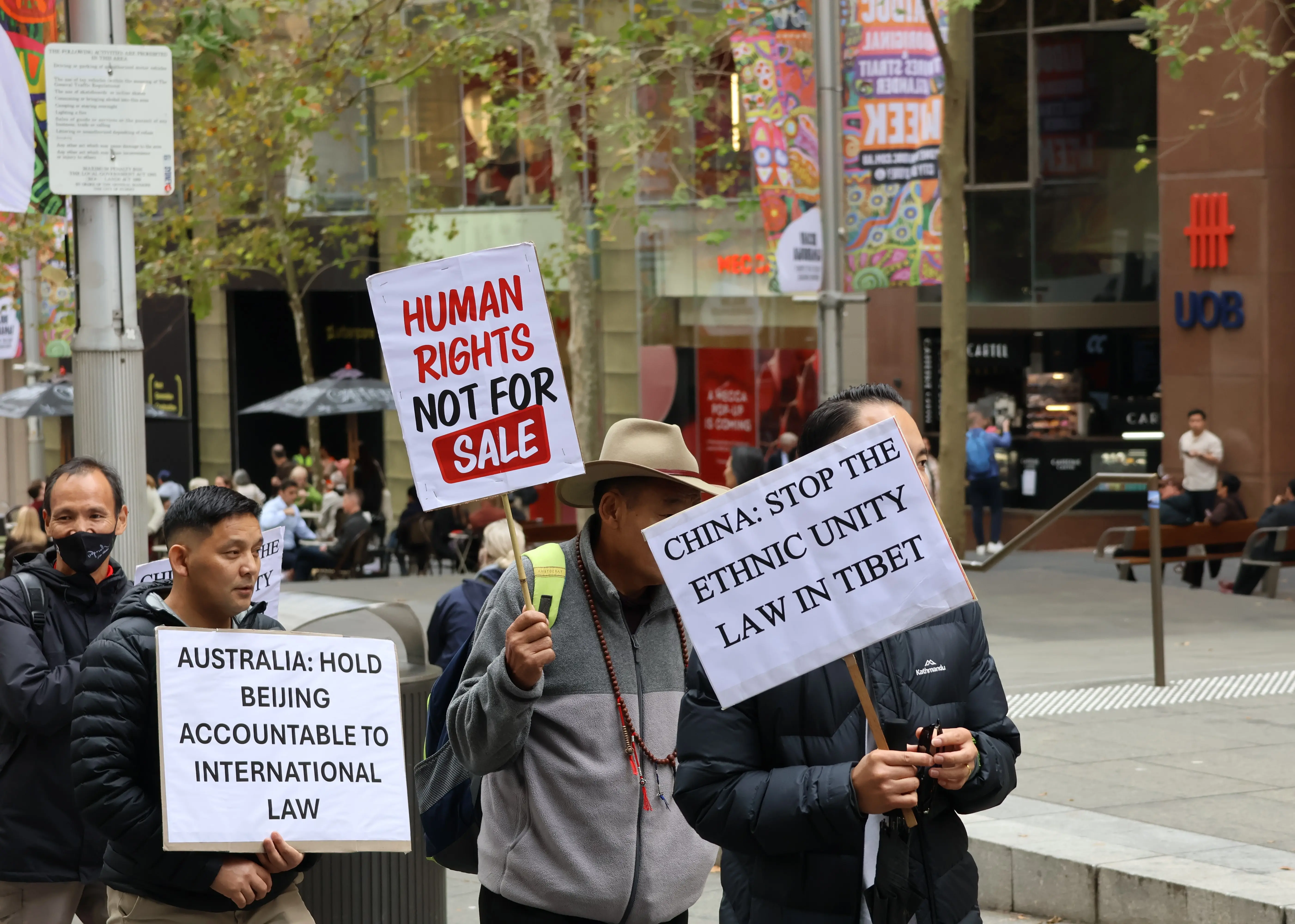
The CCP officially implemented the "Law on Promoting National Unity and Progress" on 1 July 2026.
According to a report by the Hong Kong-based South China Morning Post on 12 July 2026, scholars from the Central Party School of the CCP stated that this marks a major shift in Beijing's ethnic policy. The focus of governance has shifted from handling specific ethnic affairs to overall governance centered on building a "community of shared Chinese nation," which is seen by the outside world as an important signal for further promoting ethnic assimilation. This law establishes a new framework for ethnic governance. Its purpose is not only to counter the influence of Western ideology but also to provide the CCP with a legal basis for the assimilation of ethnic minorities through legislation.
An article by Chen Shanshan, a scholar from the Central Party School of the CCP (National Academy of Governance), published in the Beijing Daily on 6 July 2026, points out that the implementation of the "Law on Promoting National Unity and Progress" means that the focus of ethnic work has shifted from "transactional governance" to "holistic governance." Chen Shanshan explained that in the past, the focus was mainly on specific ethnic affairs and relations, but now the emphasis is on building a "community of shared Chinese nation," strengthening national identity, cultural identity, and shared values.
Xi Jinping has repeatedly called for "forging a strong sense of community of the Chinese nation" in ethnic minority areas. The new law also incorporates ethnic affairs into the "overall national security concept," strengthens patriotic education, and stipulates the accountability of individuals and organizations that undermine national unity and split the country, even extending to overseas personnel and organizations. Simultaneously, the law requires the promotion of the national common language and script, and those who obstruct its promotion will be held legally accountable.
In recent years, Inner Mongolia has promoted the change of core school curricula from Mongolian to Chinese and strengthened the regulation of Mongolian cultural and artistic activities. Policies concerning ethnic minorities in Tibet and Xinjiang have also continued to attract international attention. Western countries have long accused the CCP of implementing cultural genocide, forced assimilation, forced intermarriage, and arbitrary detention, which Beijing has consistently denied.
In April of this year, the European Parliament passed a resolution condemning the "Law on the Promotion of National Unity and Progress" for further exacerbating the institutional suppression and assimilation of minority identities.
In response, Wang Duren, chief commentator for Apollo News, analyzed that what Xi Jinping is promoting is superficially "Chinese nationalization," but at its core, it is actually "CCP-ization." Taiwanese commentator Yang Chang-chen once summarized this policy as "Han chauvinism and Chinese nationalism," but Wang Du-ran believes that what Xi Jinping truly wants to establish is not a traditional nation-state, but a party-state community where the CCP defines identity, interprets history, controls belief, and monopolizes political loyalty.
She points out that this is entirely consistent with the logic of Xi Jinping's recent promotion of "Sinicization of religion." The so-called "Sinicization," on the surface emphasizing integration into Chinese culture, actually requires religion to first and foremost submit to the leadership of the CCP, the socialist system, and official political goals. Religious scriptures, religious leaders, and religious sites must all be subject to the supervision of the Party organization.
Wang Du-ran states that the *Law on Promoting National Unity and Progress* also adopts this model. Although the law requires all ethnic groups to integrate into the "Chinese nation community," the right to define "Chinese nation" is entirely in the hands of the CCP. How history is interpreted, how language is used, and how culture is passed down are all uniformly shaped by the party-state apparatus. Therefore, this project is not only about assimilation of ethnic minorities, but also a project of transforming party-state identity. The ultimate goal is not simply "Chinese nationalization," but rather to make all ethnic groups, religions, and social groups submit to the leadership and ideology of the CCP, achieving "CCP-ization of the entire population."


No comments:
Post a Comment