Direct translation
Nikkei: Japan does not recognize Taiwan as Chinese territory; if a joint communiqué on reunification by force were to be signed, the premise would collapse
Editor : Shi Fang / Source : Newtalk / https://www.aboluowang.com/2025/1125/2310581.html / Image : For the past 50 years, successive Japanese prime ministers have adopted an ambiguous stance on the "One China" principle, never acknowledging Taiwan as Chinese territory. Sanae Takaichi is no exception. (Image: Taken from Sanae Takaichi's X)

China recently reacted strongly to Japanese Prime Minister Sanae Takaichi's response to a question about the potential triggering of collective self-defense adjustments in the event of a "Taiwan crisis." The Chinese Communist Embassy in Japan criticized Takaichi on social media on the 10th, stating that she "seriously violated the 'One China' principle." In response, the Nikkei Shimbun pointed out today (25 November 2025) that Japan and China have differing interpretations of "One China." Japan does not recognize Taiwan as Chinese territory, and "if China were to militarily invade Taiwan, the premise of the Japan-China Joint Communiqué would collapse."
The report points out that China claims Japan recognizes the "One China" principle based on the 1972 Japan-China Joint Communiqué; however, this document deliberately leaves some ambiguities rather than explicitly stating "recognition."
Article 2 of the Japan-China Joint Communiqué states that Japan "recognizes" "the People's Republic of China as the sole legal government of China." Article 3 outlines the relationship between China and Taiwan. China declared that "Taiwan is an inseparable part of the territory of the People's Republic of China." Japan stated that it would "fully understand and respect" this position. Subsequently, Japan continued, stating that "we will firmly uphold our position in accordance with Article 8 of the Potsdam Declaration."
What exactly did Japan promise in Article 3? Testimony from diplomats involved in the negotiations with China at the time is recorded in Shoichi Kuriyama's (then head of the Treaty Division of the Ministry of Foreign Affairs, later Vice Minister of Foreign Affairs) 2010 book, *Diplomatic Testimony: The Return of Okinawa, the Normalization of Japan-China Relations, and the Japan-US "Secret Agreement"* (Iwanami Shoten). He wrote that the initial draft submitted by the Japanese government to the Chinese side only contained the phrase "fully understand and respect." Unlike "recognition," "understanding" and "respect" are considered meaningless terms in the diplomatic context.
Kuriyama proposed the wording of Article 8 of the Potsdam Declaration, allowing Japan to adopt a vague position, neither recognizing Taiwan as Chinese territory nor denying its existence. While "understanding and respecting" China's "One China" principle, Japan has maintained relations with Taiwan for over 50 years.
When Japan negotiated the establishment of diplomatic relations with China, the Japanese government's position could be summarized as follows: it would not oppose China's future reunification with Taiwan, but only if the issue was resolved peacefully. Some within the Japanese government also believed that "if China were to militarily invade Taiwan, the premise of the Japan-China Joint Communiqué would collapse."
The report points out that recently, statements made by China, including those from the Chinese Embassy in Japan, regarding the "One China" issue, have claimed that Japan recognizes this principle in the Japan-China Joint Communiqué. This reveals China's attempt to disseminate its interpretation of "One China" internationally and gain an informational advantage over Japan.
However, Japan did not directly acknowledge "One China" during the negotiations for the Japan-China Joint Communiqué, but rather adopted an ambiguous stance, believing that the Taiwan issue would ultimately be resolved peacefully. To some extent, successive Japanese prime ministers have inherited this spirit, avoiding concrete assumptions about a potential "Taiwan crisis."
Insider information: A single sentence from Takaichi intimidated Xi Jinping for five days! The prelude to the Taiwan Strait conflict has begun
Reporter : Wang Duruo / Editor : Zhongkang / https://www.aboluowang.com/2025/1124/2310220.html
Yuan Hongbing, a Chinese legal scholar in exile in Australia, revealed inside information to "Vision Times": Sanae Takaichi's declaration, "If Taiwan is in trouble, Japan is in trouble," triggered a national will that sent the CCP machinery reeling, leaving it in a zombie-like silence for five days! A conscientious person within the system revealed that only after dictator Xi Jinping gave the order did the Ministry of Foreign Affairs, the CCP's military, and its propaganda apparatus revive like demons, unleashing a barrage of attacks—slashing throats, secretly taking thuggish photos, cursing and hurling insults—revealing the despicable and sinister nature of Xi, the leader of a mafia-like organization!
This round of diplomatic and propaganda warfare is the prelude to the CCP's cross-strait offensive! It directly forces Sanae Kao to apologize and resign, strategically destroying Japan's fighting spirit: conquering Japan so it dares not retaliate if it invades Taiwan; making an example of Japan to undermine the resolve of the US, UK, Australia, and Europe to intervene. The CCP's sinister intentions: to unite with Trump, the high-profile purchase of US soybeans on the 18th was a test of bribery—Yuan Hongbing believes this is a potential act of contempt and insult from Xi Jinping towards Trump!
Yuan Hongbing's "The New Order After WWII": Japan Abandons Militarism, Elevates its Democratic System, and Reaches the Pinnacle of Civilization! The CCP, however, imprisons China and Japan in historical hatred, glorifying its rhetoric as a means to maintain international order—utterly absurd! The post-WWII order was originally a clash between evil socialist autocracy and free democracy, but it has drastically changed: the communist bloodline has spread throughout East Asia, and China has become a Marxist-Leninist colony. The CCP, the most brutal traitorous group, has sold its soul, destroyed China's spiritual homeland, its cultural homeland! All Chinese people are cultural slaves and political slaves; after the collapse of the Soviet Union and Eastern Europe, the CCP has become a global communist Bastille, and Xi Jinping's totalitarian expansion has become the source of 21st-century war and an enemy of humanity!
In contrast, Japan: after 80 years of reflecting on its crimes of aggression, it has transformed into a free and democratic nation, with its constitutional spirit above all else; its contributions to science, education, economy, and culture are irreplaceable. The Takaichi's statement reveals the life-and-death bond between free Taiwan and Japan! The CCP, along with the Russian-Korean axis, has imprisoned the Chinese people in the ruins of WWII for life, using hatred to dominate current relations.
Yuan Hongbing pointed out that the only way out for the Chinese people is to resist and destroy the CCP's tyranny, comforting the nearly 100 million wronged souls; to reclaim freedom and human rights, making China like Japan and Taiwan, a land of popular sovereignty and a sacred land of freedom!
The CCP is at its wits' end; Wang Yi lashes out. Scholars: The CCP is the one with the aggressive nature
News Focus Production Team / Editor: Liu Mingxiang / https://www.ntdtv.com/gb/2025/11/24/a104041146.html / Image : Faced with Japanese Prime Minister Sanae Takaichi's hardline stance, the CCP is furious and has resorted to various threats and intimidation. The photo shows Japanese Prime Minister Sanae Takaichi (center) answering questions at a meeting of the House of Councillors Budget Committee in Tokyo's National Assembly on 12 November 2025. (Kazuhiro NogiAFP via Getty Images)
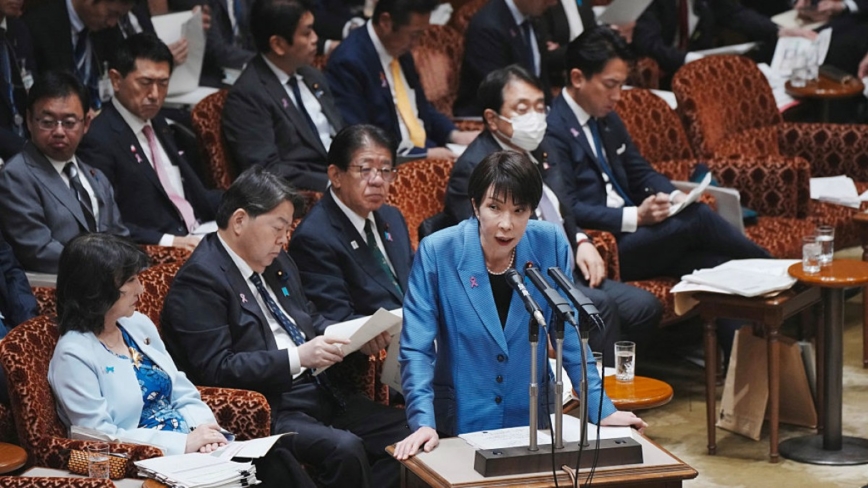
Sino-Japanese relations remain tense. Faced with Japanese Prime Minister Sanae Takaichi's hardline stance, the CCP is furious and has resorted to various threats and intimidation, but the Takaichi cabinet's approval rating has actually risen.
During his visit to three Central Asian countries from 19 to 22 November 2025, Chinese Communist Foreign Minister Wang Yi claimed that Sanae Takaichi "crossed a red line that should not be touched," and that the CCP "has the right to re-account for Japan's historical crimes."
On 21 November, the Chinese Communist Consulate in Japan cited the "enemy state clause" in the 1945 UN Charter, arguing that it could take military action against Japan without UN permission.
Previously (7 November 2025), Sanae Takaichi, during questioning in the Diet, stated that if China were to attack Taiwan, located only about 100 km from Japan, it could be considered a "threat to Japan's survival," allowing Japan to deploy its Self-Defense Forces for defense.
Japan has repeatedly emphasized that "the enhancement of its defense capabilities is for national security, not a revival of militarism."
Feng Chongyi, an associate professor at the University of Technology Sydney, told The Epoch Times that Japan has been known for its peace since the post-war period, while China, on the other hand, has been aggressive and uses hatred to divert attention from domestic contradictions accumulated under its totalitarian rule.
Feng Chongyi stated that history has been completely reversed; Japan is on the defensive, while China is aggressive and poses a significant threat to the surrounding region.
In an interview with The Epoch Times, Canadian writer and veteran commentator Sheng Xue stated, "The CCP's so-called revival of militarism is merely a political propaganda tool." To incite hatred towards Japan among the Chinese people, they have consistently cultivated a so-called "Japan threat theory." However, a consensus is gradually forming within Japan regarding the CCP: the CCP's threat must be resisted.
Feng Chongyi pointed out that the original "enemy state clause" corresponded to the Republic of China. At that time, the CCP had not yet established its regime; the main body of the Chinese government was the Republic of China.
Sheng Xue stated that the CCP is waging a propaganda war. Its very mention of the "enemy state clause" exposes its predicament, because conventional threats are no longer effective, and it is isolated and helpless in the international community. Therefore, it foolishly resorts to digging up old World War II archives.
Meanwhile, according to the latest polls, the Sanae Takaichi Cabinet's approval rating is as high as 72%.
Immediately after speaking with Xi Jinping, Trump called Sanae Takaichi to confirm close US-Japan cooperation
Reporter : Li Jianwei / Editor : Zhongkang / Source : Newtalk / https://www.aboluowang.com/2025/1125/2310727.html

Image : Japanese Prime Minister Sanae Takaichi held her first telephone conversation with US President Donald Trump on the 25th since taking office, exchanging views on US-China relations and regional security. This conversation, occurring amidst diplomatic tensions between Japan and China stemming from Takaichi's remarks regarding Taiwan, has garnered significant attention. (Photo: IC Photo)
Following the recent phone call between the leaders of the U.S. and China regarding the situation in Taiwan, high-level interactions between the two countries have quickly resumed. Japanese Prime Minister Sanae Takaichi held her first telephone conversation with U.S. President Donald Trump today (the 25th) since taking office, exchanging views on U.S.-China relations and regional security. This conversation, occurring amidst diplomatic tensions between Japan and China stemming from Takaichi's remarks regarding Taiwan, has garnered significant attention.
According to reports from Reuters and Japanese media, Takaichi told the media after the call that it was initiated by Trump's side. During the call, Trump briefed her on the latest developments in U.S.-China relations, including his conversation with Chinese President Xi Jinping the previous evening. Takaichi emphasized that the two sides "reaffirmed the close cooperative relationship between Japan and the United States" during the call.
According to a report by Japan's Fuji News Network (FNN), Sanae Takaichi, in an interview at the Prime Minister's Official Residence this morning, explained that her call with Trump today was "an earlier phone conversation held at President Trump's request," and noted that the content broadly covered strengthening the Japan-US alliance and the situation and challenges facing the Indo-Pacific region.
Recently, Sanae Takaichi stated in the Diet that "if China takes military action against Taiwan, Japan will not rule out a military response," a statement that triggered a strong backlash from Beijing, which subsequently exerted pressure through measures such as restricting its citizens' travel to Japan and limiting imports of Japanese seafood, causing a rapid cooling of Sino-Japanese relations.
According to Xinhua News Agency, Xi Jinping, in his call with Trump on Monday (24 November 2025), elaborated on China's position, emphasizing that "Taiwan's return to China" is an important component of China's vision of the international order, and did not rule out the use of force. Trump was described by the Chinese side as "understanding the importance of the Taiwan issue to China."
However, the US's public statement released after the meeting made no mention of Taiwan, drawing significant attention from Japan. South Korean media pointed out that the differences in key messages between the US and China regarding Taiwan have made Japan even more concerned about Washington's true attitude at this sensitive time.
Trump later posted on the Truth Social platform, praising progress between the US and China on trade issues and revealing a possible visit to China next April, but again made no mention of Taiwan.
Japanese Chief Cabinet Secretary Minoru Kihara stated that the stability of US-China relations is crucial to the international community, but he declined to comment on Xi Jinping's remarks to Trump regarding Taiwan.
A powerful push! Xi can't stop Sanae Takashi's "Advance"
Editor : Fang Xun / Source: World Journal / https://www.aboluowang.com/2025/1126/2311042.html / Image : Japanese Prime Minister Sanae Takaichi attended the G20 Leaders' Summit in South Africa on 22 November 2025. (Reuters)

Japanese Prime Minister Sanae Takaichi stated, "If something happens to Taiwan, something happens to Japan," implying that war in Taiwan would constitute a crisis for Japan's survival and suggesting Japanese intervention. This statement crossed Beijing's red line, prompting Chinese retaliation. China suspended imports of Japanese seafood, halted negotiations on beef imports, issued travel and study warnings, and advised hundreds of thousands of its citizens against traveling to Japan. Subsequently, China conducted naval exercises in the Yellow Sea.
Several days later, Beijing remained firm. China's UN representative, Fu Cong, declared that if Japan dared to militarily intervene in the Taiwan Strait situation, China would invoke the so-called "old enemy state clause" in the UN Charter, granting it the right to take military action against Japan and other defeated nations of World War II. The intimidation continued to escalate.
This time, China strictly controlled its countermeasures, limiting them to official and state media actions to avoid a repeat of the anti-Japanese demonstrations that erupted in Chinese cities in 2012 following the Diaoyu Islands incident. That previous demonstration escalated into vandalism of Japanese cars and shops across the country, with people using U-locks to smash Japanese cars owned by their fellow citizens. The current situation in China is like a powder keg; mass demonstrations could easily turn into anti-CCP protests, a spark that could ignite a prairie fire. Beijing, hesitant to act rashly, is trying to control the anti-Japanese sentiment. While the number of Chinese tourists visiting Japan has decreased, many still act as they please.
Many online commentators say that the CCP's three magic weapons of rule are: promoting hatred of Japanese aggression and American hegemony, using force to unify Taiwan, and suppressing capitalists. These three cards are used interchangeably and have proven consistently effective. From Japan's discharge of nuclear wastewater in 2023, to retaliating against Lai Ching-te's remarks and conducting military exercises around Taiwan, to promoting the idea that the military unification of Taiwan is the great rejuvenation of the Chinese nation, and to incite hatred of the US, all these tactics can be used to quickly shift the focus when the CCP faces difficulties and public discontent rises. The U.S.-China trade war and Beijing's actions against Taiwan have been repeatedly manipulated in this way, becoming a panacea for the CCP regime.
However, the consequences of playing these cards are that they scare away Taiwanese, Japanese, and Hong Kong businesses, and American and foreign businesses are also withdrawing, exacerbating the current large-scale factory closures and withdrawals by foreign investors. Severe unemployment is leading to a recession across all industries, and many people are returning to their hometowns seeking refuge. Now, the CCP has introduced a "crackdown on malicious returns to the countryside," fearing that unrest in rural areas will affect stability, and that the policy's backlash will harm its own economy and the livelihoods of its people.
While Beijing is boycotting Japan, it cannot ignore Japan's monopoly on the supply of photoresist and precision machine tools to China. Rumors suggest that China's photoresist inventory is only enough for seven weeks, and all 1,200 photoresist machines in China producing chips larger than 7 nanometers will be grounded without photoresist. Japan is already wary of China's 2012 rare earth embargo. If Sino-Japanese relations continue to deteriorate, it's difficult to say who is holding whom hostage and who is more afraid of boycotts.
The Economist magazine believes that since Xi Jinping came to power, he has continuously consolidated his leadership through nationalism, and now Beijing and Tokyo are like locked in a "game of chicken." Both Xi Jinping and Sanae Takaichi are proponents of nationalism and hawkish leaders. It's unexpected that the clashes between the Chinese and Japanese governments would occur so quickly, with these two nationalists leading the charge in their conflict.
Chinese Consul General in Osaka, Xue Jian, made a "decapitation" remark on social media, causing an international uproar. Subsequently, Masaaki Kanai, Director-General of the Asian and Oceanian Affairs Bureau of the Japanese Ministry of Foreign Affairs, went to Beijing for consultations. Liu Jinsong, Director-General of the Asian Affairs Department of the Ministry of Foreign Affairs in Beijing, displayed an arrogant and condescending attitude, insulting the Japanese representatives and clearly belittling Japan for "domestic consumption." However, Takaichi's statement garnered 48.8% support among Japanese citizens, while only 44.2% opposed it, and she has shown no intention of retracting her remarks.
Beijing claims it will go to war with Japan if necessary, ignoring the U.S.-Japan security treaty and the fact that Japan has over a hundred U.S. military bases of varying sizes. Does Beijing intend to wage war against the U.S.-Japan coalition simultaneously? Japan is aggressively developing its military, already possessing two quasi-aircraft carriers capable of carrying F-35B fighter jets. With U.S. support, Japan is gradually regaining its status as a military power in Asia and a "normal country," a situation that China will find difficult to prevent. This propaganda war between China and Japan should be brought to an end; otherwise, it will be detrimental to China's image as a peaceful major power, and the consequences could even lead to a lose-lose situation for both countries.
After finishing her conversation with Trump, Sanae Takaichi talks about Taiwan again, and she's even more audacious now!
—Sanae Takaichi: Statements regarding a potential crisis in Taiwan are entirely consistent with the Japanese government's unified stance
Reporter : Hong Shengfei / Editor : Zhongkang / Source : Newtalk / https://www.aboluowang.com/2025/1126/2311304.html / Image : Sanae Takaichi holds a discussion with the leaders of various Japanese political parties. (Photo: Image courtesy of Munehito Kamiya, leader of a participating political party)

Prime Minister Sanae Takaichi stated today (26 November 2025) during a discussion with the leaders of various political parties that her mention of "Taiwan in trouble" during her response to questions in the Diet Budget Committee was solely for the purpose of ensuring the smooth running of the meeting, and that her explanation was entirely consistent with the unified view of the Japanese government, "without addition or subtraction."
Fuji News Network (FNN) reported earlier that Constitutional Democratic Party President Yoshihiko Noda again questioned Prime Minister Takaichi at today's meeting of party leaders regarding whether "Taiwan in trouble" constitutes a threat to Japan's survival.
In response, Sanae Takaichi stated, "Regarding the assessment of whether a situation constitutes a threat to Japan's survival, and what constitutes a threat to Japan's survival, the government will make a comprehensive judgment based on all information and the specific circumstances of the event. I have stated this repeatedly in my previous answers." She emphasized, "The unified view of the Japanese government is exactly as I stated in my previous answers, without additions or omissions."
Yoshihiko Noda dismissed the strong backlash from China regarding Takaichi's response in the Budget Committee. Takaichi pointed out, "The questioner limited the question to an emergency situation of 'Taiwan in distress' and mentioned the blockade of sea lanes," explaining, "I also don't want to mention any specific details, but because this is the Budget Committee, simply repeating the government's previous answers could lead to the meeting being interrupted."
When Takaichi said that "the Budget Committee might be interrupted," opposition lawmakers present murmured their doubts.
Noda also inquired whether Prime Minister Takaichi's response would lead to a deterioration in Japan-China relations. In response, Takaichi stated, "At the summit, we reaffirmed our commitment to building a mutually beneficial and win-win relationship based on shared strategic interests, and to establishing a stable and constructive relationship. We also confirmed that any concerns or issues arising between the two sides will be resolved through communication between leaders."


No comments:
Post a Comment