Direct translations
Before China's new entry and exit regulations took effect, those who were already stranded
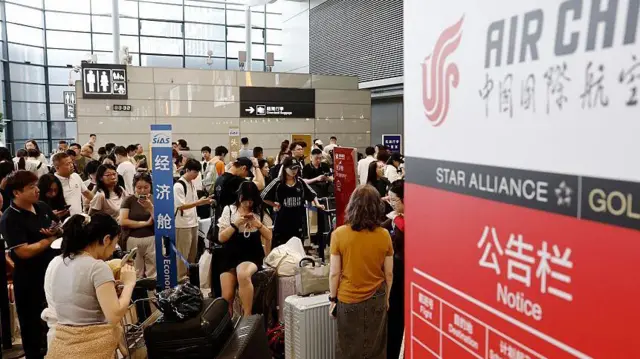
Editor: Zhongkang / Source: BBC / https://www.aboluowang.com/2026/0820/2423277.html / Image : On 9 August 2026, passengers waited to collect their checked baggage at Terminal 2 of Shanghai Hongqiao International Airport.
Li Ming (pseudonym), from Hunan, has been struggling for two months to protect his rights regarding leaving the country.
Li Ming is 25 years old. In June, while traveling in Malaysia, he received a call from the local police station. Li Ming claims they demanded he return to China within three days, or they would label him a "fraudster" and cancel his household registration. To prove his innocence, Li Ming quickly booked a flight back to China.
However, he did not expect that this time he would be unable to leave again—without prior notice, Li Ming was listed as a "high-risk fraudster" by the immigration authorities. "I can't leave the country, not even to Hong Kong or Macau."
He began seeking redress, visiting the police station every few days, calling the mayor's hotline, and spending 6,000 yuan on a lawyer, but has yet to receive a resolution.
At the end of July this year, China announced new entry and exit regulations to be implemented from 15 September 2026, including empowering border control personnel to "dissuade" citizens from leaving the country, causing considerable public concern about restrictions on freedom of travel. In reality, even before the new regulations were introduced, many people, from civil servants and state-owned enterprise employees to ordinary citizens, were already unable to leave the country due to passport confiscation and being blacklisted.
Wu Lei (real name Li Jinxing), a Chinese human rights lawyer currently residing in Japan, was previously restricted from leaving the country for six years by the Chinese authorities on charges of "endangering national security." He told BBC Chinese that he was not surprised by the new regulations, but rather did not understand why the public was "making a fuss"—"Hasn't China always done this?"
Listed as a "fraud suspect" after traveling in Southeast Asia
This was Li Ming's first trip abroad.
In August 2025, Li Ming used money he had saved in China to travel to Southeast Asia. He said he did not set a return date, intending only to "spend all the money and then go back home." He departed from Guangzhou, first going to Malaysia, then Indonesia and Cambodia. During these nearly ten months, he traveled while also working to earn money, working as a hotel security guard and in a logistics centre.
Li Ming said he was surprised when he received a call from the police station in June, wondering, "How did they know where I was?"
Faced with the request to return, he did not immediately agree, but first sent his family to the police station to inquire. According to Li Ming, his family said the police were forceful and said they would "persuade everyone overseas to come back." Li Ming did not understand why, but he said the police had promised on the phone that if he returned, he could leave the country again in two days.
However, the day after returning to China, seven or eight police officers came to Li Ming's door. The police kept taking pictures of him and questioned him about his travel itinerary in detail. Li Ming felt like a "prisoner."
One of the officers told Li Ming, "Now that you're back, you shouldn't go out again." Li Ming was taken aback and asked why. The officer replied, "China is good; it's not safe for you to go abroad."
Li Ming did not think much of it and went to the immigration department to apply for a Hong Kong and Macau travel permit, only to be told by staff that he was listed in the system as a "high-risk person suspected of telecom fraud" and could not leave the country. “I am very sad and distressed… I was put in this situation without my knowledge.”
BBC Chinese could not independently verify this statement. However, according to publicly available information, Chinese citizens currently cannot check their border control status themselves—unless officially notified in writing or verbally, citizens generally only learn of their travel restrictions when applying for documents or attempting to leave the country.
Li Ming's experience is not an isolated case.
Starting this year, numerous posts on social media have indicated that after returning from trips to Southeast Asia, individuals received calls from the police requiring them to register and were placed on a “list of suspected fraudsters.” BBC Chinese's review of publicly available information revealed that since at least 2021, some individuals have been restricted from leaving the country due to being listed on high-risk lists for telecom fraud.
Some netizens believe that border controls are related to “sensitive places of residence.” The Chinese Communist Party has been cracking down on fraud in recent years, and has previously publicly released lists of key areas for combating telecom fraud, specifically naming provinces such as Fujian, Guangxi, Hainan and Henan.
Li Ming knew his registered residence in Hunan Province was on the "list," but "there are many people from Hunan who are legitimately doing business there (in Southeast Asia)." What conflicted him was that "I even provided a certificate of no criminal record."
In Li Ming's view, the authorities could not differentiate between groups; "it's a blanket approach, labeling everyone as a fraudster."
The Chinese Communist Party (CCP) has not published the criteria for including those suspected of fraud on the list. However, those listed must "prove their innocence" by submitting proof of employment, salary slips, and other documents to the Public Security Bureau for verification before they can be removed from the list.
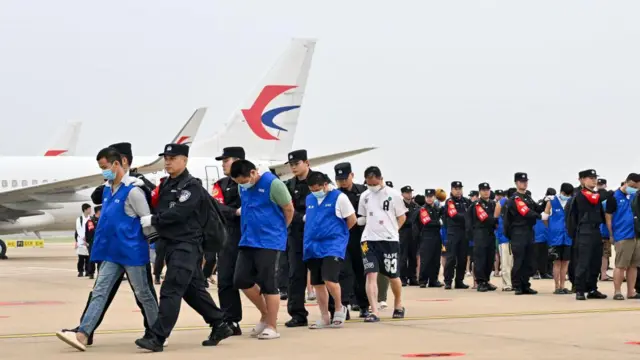
Image : On 13 April 2024, Chinese suspects involved in gambling and fraud arrived at Wuhan Tianhe International Airport in Hubei Province under police escort.
In recent years, China has vigorously cracked down on telecom fraud, extraditing fraud suspects from Cambodia back to China.
"No way to protect my rights"
The potential reasons for being subject to border controls are not only regional factors.
Pipi, 26, gave an interview to Hong Kong media during the anti-extradition bill movement. After returning to China, Pipi claimed he was questioned by the State Security Police (China's national security police). “The village committee calls me every now and then to ask what I’m doing.”
After China resumed international travel in January 2023, he tried to apply for a passport, but the relevant department has refused to process his application.
Currently, China’s Exit and Entry Administration Law lists six situations in which citizens are prohibited from leaving the country: those holding invalid documents, defendants in criminal cases, those involved in unresolved civil cases and whose courts have decided against leaving, those deported from other countries and restricted from leaving, those endangering national security, and other situations where leaving the country is prohibited by laws and administrative regulations.
For the past three years, Pipi has been shuttling between the local police station and the immigration department, seeking only a reason for the passport application being refused. He said that a local immigration officer explicitly told him, “It’s because of the Hong Kong issue.” However, the officer only gave verbal instructions and never provided any written documentation.
“If he gave me official documents, I could apply for administrative review. (But) he just said one thing: you can’t go.” Pipi is helpless: “I talk to him about the law, but he doesn’t talk to me about the law.”
Li Ming also stated that the departments he has been dealing with have never provided any written proof. “In China, there is no way to seek redress by restricting exit from the country,” Chinese human rights lawyer Wu Lei stated unequivocally.
According to China’s Administrative Licensing Law, when an administrative agency decides not to grant an administrative license, it should provide a written explanation of the reasons—but it is widely believed that this is not strictly enforced in practice.
Wu Lei has been subject to border control in China since 2013 without ever receiving written notification from the authorities. He describes this as a “blind spot” in China’s judicial system—“There is no one responsible; it’s like there’s an invisible hand controlling you.”
In Wu Lei’s view, border control has become a tool for public security organs to control citizens. “Attending church, reading groups, issuing statements—even just petitioning can lead to charges.”
The Chinese Ministry of Foreign Affairs and the Entry-Exit Administration did not respond to BBC Chinese’s inquiries.
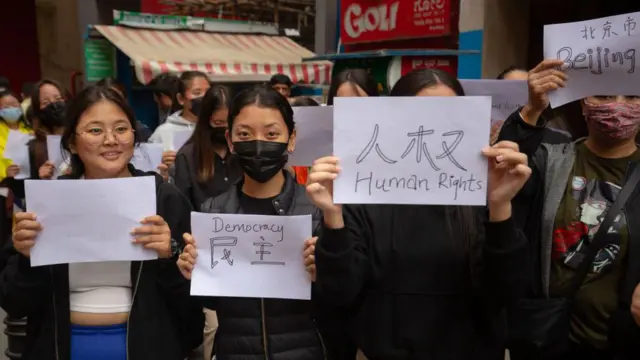
Image : Professor Tom Kellogg, Executive Director of the Center for Asian Law at Georgetown University, described the new regulations as another “tool to control what Chinese citizens do and say overseas.”
Professor Tom Kellogg, executive director of the Center for Asian Law at Georgetown University, told BBC Chinese that China has used exit bans for various purposes over the years.
“In some cases, to ensure that individuals cannot criticize the Chinese government overseas or be punished for their human rights activities, the Ministry of State Security will directly refuse to issue passports,” Kellogg said. On the other hand, state security personnel will also demand that human rights activists and lawyers promise not to criticize the Chinese government as a condition for issuing passports.
Wu Lei “made a deal” with the Chinese authorities in 2019. “They told me I couldn’t oppose Xi Jinping or his constitutional amendment for re-election, and then I said okay, you have to let me go abroad.” BBC Chinese could not independently verify his statement. He subsequently moved to Japan in 2022.
It is worth noting that the upcoming new regulations explicitly state for the first time that “Chinese citizens who engage in illegal or criminal activities abroad, endangering national security and interests” may be prohibited from leaving the country for up to three years after returning.
According to Kroger, "This is another tool designed to control what Chinese citizens 'do and say' overseas." In the future, anyone criticizing the government overseas will be subject to a legally binding ban from leaving the country, and the ban will likely last "far longer than the initial timeframe."
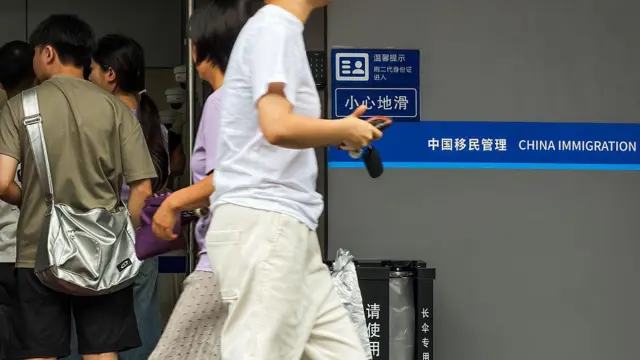
Image : In late July of this year, China announced new entry and exit regulations to be implemented from 15 September 2026, including empowering border control personnel to "dissuade" citizens, sparking public panic about restrictions on freedom of travel.
Starting with civil servants, and now tightening restrictions on state-owned enterprise employees' travel abroad
Besides border controls and passport refusal, travel restrictions have long been a part of the "routine management" of specific groups.
Civil servants were among the first groups to be included in this management, and the restrictions have been gradually tightening.
In 2014, the Organization Department of the CPC Central Committee further required strengthened management of leading cadres' overseas travel, including centralized custody of passports by personnel departments. The official explanation at the time was that "the phenomenon of individual leading cadres fleeing abroad has occurred from time to time, causing a negative impact on the Party and the country."
By 2015, the Beijing News reported that the policy of surrendering passports had been tightened to include only section-level civil servants.
A retired grassroots civil servant in Anhui told BBC Chinese that, according to his recollection, his workplace required passports to be surrendered around 2018. To travel abroad, one had to submit an application form explaining the reason, but approval was not always granted—he observed that trips to visit relatives were more likely to be approved, but simple tourism trips were often rejected.
This civil servant will retire in 2025, and his passport will still be kept by his former workplace. In his view, the passport surrender policy has some rationale, "mainly to prevent corrupt officials from escaping or transferring assets, and for higher-ranking officials, it may be to prevent the leakage of state secrets."
However, last year, The New York Times reported that in some areas, in addition to civil servants, even some public school teachers, bank and state-owned enterprise employees were required to surrender their passports.
Xiao Wang, 32, works at a state-owned financial institution in Beijing. He confirmed to BBC Chinese that his institution had long had a clear rule requiring passports to be surrendered, and that travel abroad required applications and approvals from multiple levels of leadership.
Xiao Wang also said that his supervisor had verbally reminded him that "sensitive countries like Japan are definitely off-limits," while other countries were generally unrestricted. However, Xiao Wang noted that due to the limited five days of annual leave and peer pressure from intense work competition, only a minority of his colleagues travel abroad; "If you go, you'll stand out."
He felt that current entry and exit restrictions in China are not uniformly defined; "it seems to depend on different jobs and different leadership styles."
Xiao Wang explained that his civil servant friends, including those working in museums, find it "very difficult to travel abroad," and even applying for a passport is met with accusations of "not being able to apply directly due to their profession." Among his friends working in banks, some have no restrictions on traveling abroad, while others have applied but are not allowed to leave.
Xiao Wang lamented, "It feels like experiencing both extremes."
Regarding the new regulations, he expressed his biggest concern about a "one-size-fits-all" approach. "Many domestic regulations tend to be layered and tightened at each level. If the higher-ups are strict, the lower levels, to avoid problems, will simply lock things off."
"The world is so big, I still want to have the opportunity to see it," Xiao Wang said. "If it becomes a complete ban on leaving the country, that would be quite troublesome."
With less than a month until the new entry and exit regulations take effect, public anxiety about the restriction of personal freedom is already evident.
"It reminds me of that painful era."
With less than a month until the new entry and exit regulations take effect, public anxiety about the restriction of personal freedom is already evident.
In March of this year, 19-year-old Bei Bei (pseudonym) transited through Shandong to attend a concert in South Korea. Since the beginning of the year, she has seen numerous news reports online about people being stopped by police at airports and forced to call their parents. That was her first time traveling abroad alone. On the same day she departed, she saw a news report about a girl from Qingdao being stopped at the border.
Beibei recalled being so nervous during border control that she was "sweating profusely and felt nauseous." Although the border officers only looked at a copy of her visa and asked a few questions before letting her through, Beibei said she still feels lingering fear.
She told BBC Chinese that she did not understand why border control had become so strict—yet in the comments sections of related news articles, people generally supported the authorities' proactive interception.
On Xiaohongshu (a Chinese social media platform), many netizens left the comment "For your own good" under posts about the "new entry and exit regulations"—a phrase originally used to describe Chinese parents' superficial care but actual interference and control over their children, now used to mock the various restrictions imposed on the people by the Chinese Communist Party.
"We were just going to a concert. I think adults have the ability to judge right and wrong and aren't so easily fooled," Beibei said.
Kroger pointed out that China's imposition of travel restrictions on an increasing number of groups is deeply worrying and reflects the increasingly strong ideological control in Xi Jinping's era.
He mentioned that during the Mao Zedong era, China was largely isolated from the Western world. It was not until the reform and opening-up period that traveling abroad for tourism, study, or family visits became part of daily life for Chinese people. However, the current restrictions on leaving the country "remind one of that painful era."
After the new regulations were announced, the National Immigration Administration of China published an expert interpretation article.
Guo Yongliang, Vice Dean of the School of International Security at the Chinese People's Police University, stated that the new regulations implement "Xi Jinping's thought on the rule of law and the overall national security concept," granting government departments "the power and responsibility to proactively identify risks" and "enhancing the overall ability to prevent and control overseas security risks."
On 17 August 2026, Li Ming stated that after submitting materials and following up multiple times, the police station finally indicated that, after verification, he had been removed from the blacklist. However, Li Ming said that perhaps because of his frequent complaints, he is still unable to leave the country freely.
Pipi expressed despair. He dared not petition like Li Ming, fearing that escalating the situation would only bring worse consequences. "If I did that, I would go (to jail)."
Besides constantly speaking out on social media, he said he did not know what else he could do. "I'm just an ordinary person, right? I'm a young man, I haven't done anything wrong..." "I don't know if I'll ever get out of here."
He flew first before he dared to speak! He spoke out for the first time en route to Los Angeles!
—Former Anta CEO Xu Yang responds to his resignation for the first time while en route to Los Angeles
Editor : Fang Xun / Source: The Epoch Times / https://www.aboluowang.com/2026/0820/2423127.html

Image : Former Anta CEO speaks out for the first time on plane! With the CCP tightening travel restrictions, industry leaders are only speaking out after flying away
On Tuesday (18 August 2026), Xu Yang, former CEO of the Chinese sportswear brand Anta, responded to his resignation for the first time on his WeChat Moments, stating that he had decided to relocate to the United States due to family members studying abroad. His Moments post was geotagged as Hong Kong International Airport, and the accompanying image showed that the plane had taken off about an hour ago and was en route to Los Angeles.
Xu Yang wrote on his Moments: "I didn't arrange any farewells because of the guilt of betraying trust and the weakness of not wanting to show it to others. I hope everyone is doing well!" Xu Yang resigned as CEO of Anta on 15 July 2026, citing "family reasons," and was temporarily replaced by Anta co-CEO Lai Shixian.
His departure comes at a time when the CCP is tightening travel restrictions, and has once again sparked discussion on Chinese social media. Some netizens commented that under the CCP's new travel regulations, everyone is anxious, and now even industry leaders only dare to respond while on a plane. Some netizens expressed confusion as to why wealthy Chinese families immigrate to the United States, yet CCP propaganda portrays the US negatively.
In late July, the State Council of China announced new border control regulations. These regulations, effective September 15, include stricter checks on travelers and provide new grounds for restricting Chinese citizens' exit from the country; in some cases, the exit restrictions can last up to three years. Chinese citizens have already faced stricter scrutiny when leaving the country in recent years, with some civil servants even required to surrender their passports for safekeeping by their work units. Following the announcement of the new regulations, numerous discussions emerged on Chinese social media, with some netizens openly questioning whether they would still be able to travel freely abroad after the regulations take effect.
Gao Shuchao, a law professor at Singapore Management University who studies Chinese trade policy, urged those currently in China to leave while they still can.
Li Shaomin, a professor at Old Dominion University in Virginia, pointed out that the CCP's control over exiting the country not only affects ordinary citizens but also imposes stricter constraints on those within the CCP system. He wrote that during the Mao era, only those most trusted by the organization had the opportunity to travel abroad; now, the situation seems to be reversed, with those considered "one of their own" and members of the power structure being the most strictly controlled when it comes to traveling abroad. "The closer someone is to you, the less likely they are to travel freely," Li Shaomin wrote. "They not only distrust the people, but they also distrust their own cadres and those they promoted." He added that the CCP regime seems to be increasingly insecure.
Aboluowang commentator Wang Duran pointed out: "The most intriguing aspect of Xu Yang's WeChat Moments post isn't what he said, but rather his choice to post it an hour after takeoff—this timing itself is a carefully calculated self-preservation strategy. He only dared to speak the truth after confirming he had flown out of the CCP's control. This is no longer just the personal choice of a few corporate executives, but a survival strategy of 'fly first, speak later' collectively practiced by the entire Chinese elite class."
She further pointed out: "Professor Li Shaomin's paradox is extremely accurate—if a regime guards against even its own hand-picked and most trusted officials, preventing them from leaving the country at will, it shows that it knows better than anyone that its internal morale is already low and fraught with crisis. When a power system treats even its own 'insiders' as potential defectors, the regime's sense of security has collapsed to a pathological degree."
Wang Duran commented: "When a regime begins to fear more those it has promoted than its enemies, it means it no longer knows who is truly on its side."


No comments:
Post a Comment