Direct translation
Breaking! Trump announces full-scale war against Iran, warning extended to third-party countries
—Breaking News! Trump announces full-scale Economic War against Iran
Editor: Fang Xun / Source: FX168 Finance / https://www.aboluowang.com/2026/0820/2423195.html
U.S. President Donald Trump announced a more aggressive round of economic pressure on Iran on Wednesday (19 August 2026), warning that any country or entity continuing to provide financial, trade, or transportation support to Iran would face severe economic consequences. This escalation of rhetoric compared to statements in recent weeks has made the oil market one of the most directly exposed assets to this new round of geopolitical risks.
In a post on Truth Social, Trump stated that Iran has had multiple opportunities to reach an agreement but has failed to seize them, therefore the U.S. will launch what he described as "the toughest economic action ever taken against a country."
He also reiterated that the U.S. will not allow Iran to acquire nuclear weapons.
Trump extends warning to third-party countries and entities
The core of this statement is not just targeting Iran itself, but extending pressure directly to all third parties that might provide economic support to Iran.
Trump stated that any country that allows its financial institutions, businesses, airports, or government entities to provide a "lifeline" to Iran in any form will face severe economic consequences.
He specifically demanded an immediate halt to various channels, including oil smuggling, currency swap lines, cash transfers, currency exchange institutions, ship registration, and shell companies.
This means that the potential focus of US law enforcement may expand further from direct sanctions against Iranian entities to intermediary institutions that help Iran maintain oil exports, fund settlements, and cross-border trade.
Trump also called on US allies to join this action to isolate Iran, describing the operation as an "economic D-Day."
The crude oil market becomes the most directly risky asset
The impact of Trump's latest statement on the crude oil market is particularly noteworthy.
The current situation in the Middle East is already highly tense, and shipping in the Strait of Hormuz and the trajectory of the U.S.-Iran conflict continue to influence oil prices. If the U.S. further imposes sanctions on third-party institutions that help Iran transport crude oil, complete settlements, or maintain exports, then even if the official traffic volume in the Strait of Hormuz remains unchanged, the actual supply of Iranian crude oil that can enter the international market may further decrease.
It is especially noteworthy that if the new restrictions ultimately cover intermediary institutions in China, Russia, or Gulf states that help process Iranian crude oil transactions, market concerns about "effective supply tightening" could significantly intensify. This also means that the risks to oil prices no longer solely stem from a Straits blockade or military conflict, but are further compounded by the risks of secondary sanctions and financial blockades.
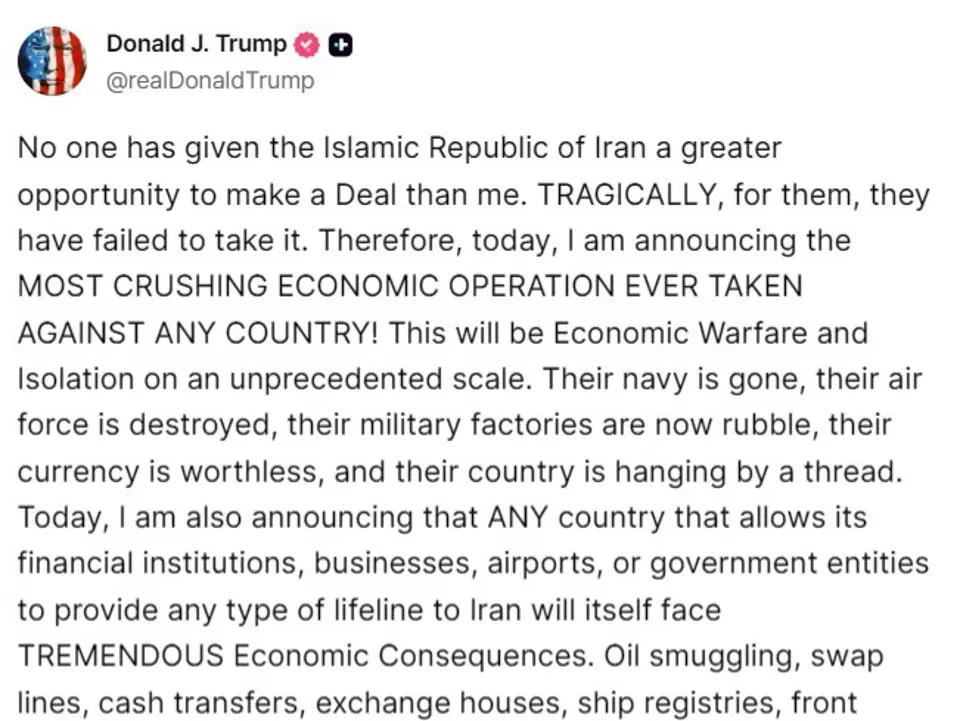
Image source: Truth Social
Oil smuggling and "shadow networks" face increased pressure
Trump's explicit inclusion of oil smuggling, ship registration, and shell companies as channels requiring immediate cessation has brought greater market attention to Iran's long-standing informal trade networks used to maintain crude oil exports.
Under formal sanctions, Iranian oil exports often rely on complex intermediaries, ship ownership arrangements, third-party registration, and unconventional settlement methods.
If the US further expands its enforcement scope to these intermediary networks in the future, even if Iranian crude oil can be loaded onto ships, it may face higher transportation, insurance, settlement, and final delivery costs.
At the same time, banks, currency exchange institutions, shipping companies, and registered entities involved in related transactions will also face higher risks of secondary sanctions.
Image : AP/Dazhi Image
Geopolitical risk premium may rise further
Trump's speech may also push up broader geopolitical risk premiums.
Crude oil prices have recently been affected by shipping uncertainties in the Strait of Hormuz and the US-Iran conflict for several consecutive trading days. If Washington further expands its pressure from the military and shipping sectors to global financial and trade networks, the market may need to reassess how much crude oil exports Iran can sustain.
Furthermore, stronger economic pressure increases the likelihood of Tehran taking retaliatory rhetoric or action.
Therefore, in the coming trading days, the market needs to pay attention not only to whether the US announces a specific sanctions list, but also to observe whether Iran responds through the Strait of Hormuz, oil tanker transport, or other regional actions.
Trump claims Iran's military and economic capabilities have been severely damaged
In his statement, Trump also gave a strong description of Iran's current military and economic situation.
He stated that the Iranian navy has disappeared, the air force has been destroyed, military factories have been razed to the ground, and the currency has lost its value, describing the country as being in a very vulnerable state.
These statements constitute the political background for Trump's further strengthening of economic pressure.
Judging from his remarks, Washington's current strategy is advancing simultaneously from multiple directions: military pressure, maritime blockade, and financial sanctions, with the goal of further weakening Iran's ability to sustain war and foreign operations.
The next key factor for oil prices will be the "implementation strength"
For the market, Trump's statement itself has already increased the risk premium, but the key to the subsequent reaction of oil prices will still be how the measures are specifically implemented.
If the U.S. only strengthens existing sanctions, the market impact may be more reflected in the risk premium at the sentiment level; however, if Washington begins large-scale sanctions against third-party institutions involved in Iranian oil transportation, financial settlement, and ship registration, then Iran's actual exports may be more significantly affected.
Therefore, investors will focus on whether the U.S. announces new sanctions against banks, shipping companies, currency exchange institutions, and third-country entities, and whether these measures will truly affect Iranian oil entering the international market.
Against the backdrop of the still unstable situation in the Strait of Hormuz, Trump's expansion of the sanctions threat to third-party countries and institutions means that Middle Eastern energy risks are extending from simple military conflict to the financial and trade systems. For the oil market, this may become one of the most important new variables in the next stage.




No comments:
Post a Comment