Direct translation
Trump just dropped a bombshell: Iran has replaced its top generals with six new ones
Reporter : Wang Duruo / Editor : Zhongkang / https://www.aboluowang.com/2026/0811/2419613.html
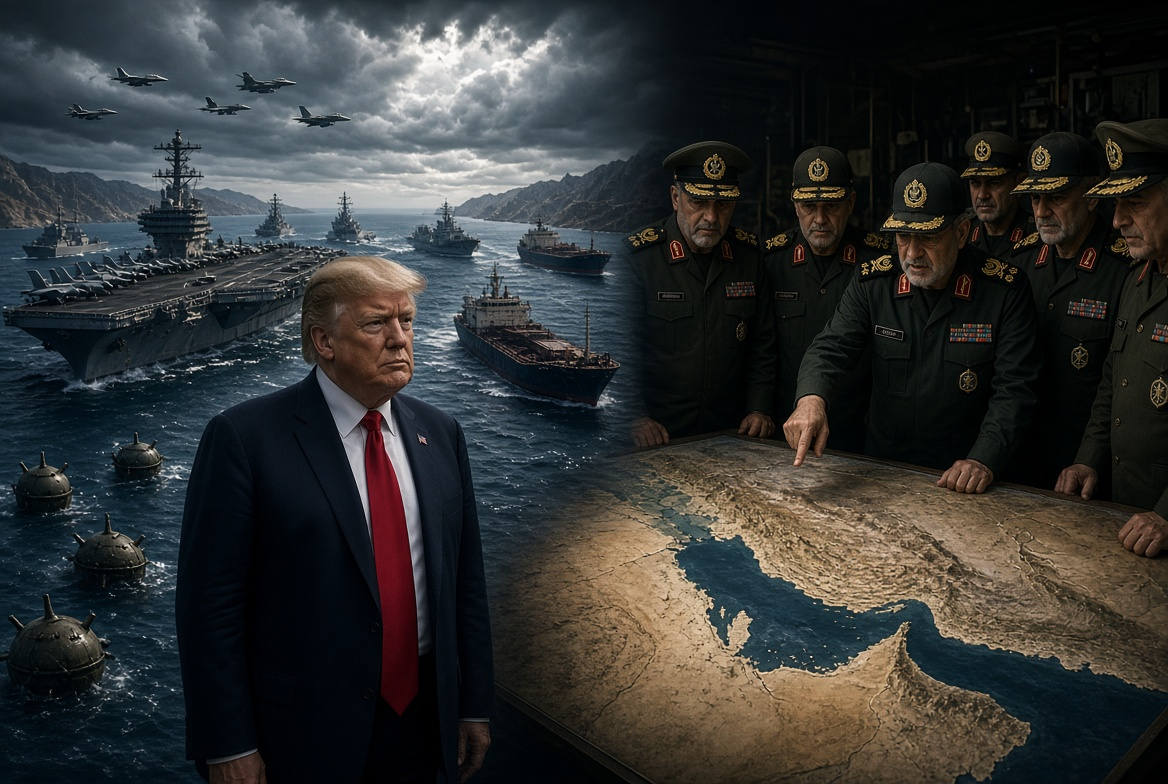
On 10 August 2026, Trump suddenly released a bombshell announcement: the U.S. military had cleared mines from the Strait of Hormuz, and the U.S. Navy now has "100% control" of this most important global energy route. He stated at the White House that the U.S. Navy had completed a comprehensive mine-clearing operation along the entire strait, and that "the only force currently controlling the Strait of Hormuz is the U.S. Navy." While Iran occasionally lays mines, the U.S. military can quickly detect and clear them. Trump even described this blockade as an "ironclad wall."
Trump's signal was clear: The strait is no longer under Iranian control, but under American control. More importantly, he directly addressed the Iranian economy, claiming that Iran is nearing "bankruptcy," unable to even pay its soldiers' salaries, and with inflation reaching 300%. This statement was not solely Trump's opinion—U.S. Treasury Secretary Bessant has repeatedly stated publicly that sanctions and blockades have left more than 50% of Iran's military without pay, police officers not reporting for duty, and inflation potentially exceeding 200%. In early August, he further mentioned food inflation reaching 150% to 180%, describing Iran as being "strangled." The two high-ranking U.S. officials echoed each other, conveying the message that Iran is on the verge of collapse, and the U.S. has no need to rush into another war.
On the 6th, Bessant went further, stating that the Strait of Hormuz will never be able to return to its pre-war state. He predicted that this waterway, which carries about one-fifth of the world's maritime oil trade, will become "irrelevant" in the next two years because Iran had tried to use it as a "choke point." Currently, more than 50% to 70% of the energy transported through the strait will be diverted to underground pipelines in the future. The alternatives he mentioned are already underway: the UAE is building a second oil pipeline to the port of Fujairah, Saudi Arabia is considering expanding its pipeline to the Red Sea, and on 17 July 2026, Iraq and Syria signed an agreement with the U.S. to repair and rebuild a pipeline extending from Kirkuk to the Syrian Mediterranean coast with a daily capacity of 700,000 barrels, providing an alternative route around the Strait of Hormuz.
However, Iran does not see it that way. Tehran's demands were equally tough: the U.S. must lift the maritime blockade and sanctions, withdraw its military forces from the region, unfreeze its assets, and pay war reparations; otherwise, the Strait of Hormuz would not truly reopen. This created a bizarre stalemate between the U.S. and Iran—the US claimed control of the Strait and demanded talks; Iran countered by saying it would not reopen the Strait without troop withdrawal and lifting of the blockade. Even more ruthless, after Iran demanded reparations, Trump countered by proposing that Iran compensate the U.S. for casualties caused by past attacks and decades of suppression of protesters—the negotiations had transformed from a "ceasefire negotiation" into a major reckoning of the war's accounts.
Meanwhile, on 10 August 2026, Iran's Supreme Leader Mojtaba signed several appointment orders, formally appointing six people to core senior positions in the General Staff of the Armed Forces, the Revolutionary Guard, and the Basij militia, including Chief of the General Staff Ali Abdullahhi and Revolutionary Guard Commander Ahmed Vahidi (a seasoned hardliner promoted from brigadier general to major general, and former Minister of Defense and Minister of the Interior). These changes occurred after the U.S.-Israeli military strikes resulted in the deaths of several senior commanders. Several of the new commanders had previously been sanctioned by the US and Europe. Observers interpret this as Tehran rebuilding its command structure based on a logic of "protracted confrontation" rather than "end of war." Some official appointment documents even attributed the deaths of former commanders to the "enemy" and demanded that the new leadership prepare for a strong counterattack.
Aboluowang commentator Wang Duran points out: The Mara regime may no longer be calculating economic gains, but rather the political gains of its survival. For a regime that maintains its legitimacy through a hardline anti-U.S. stance, showing weakness may be more dangerous than stubbornness. As the Strait of Hormuz, its only bargaining chip, is being gradually dismantled by its adversary, Iran is betting that it still has time. Trump is not rushing into negotiations; he is betting that time is on his side.


No comments:
Post a Comment